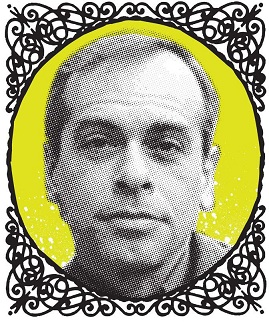
Very sad news. The cultural analyst and theatre scholar Dragan Klaic has passed away at age 61. I knew him as a host with the most. He was also perhaps the most freakishly productive person I ever met. Yet he always had time to answer any silly questions that this Canadian boy had about ‘Europe’. During his memorial at Amsterdam’s Felix Meritis this past Sunday, a video compilation was screened. In one clip, he was particularly hilarious as he mocked populist politicians who imagine a loss of national identity through outside forces. ‘Identity is not something you can lose! It’s not like a wallet or a shoe!’ Below is an interview I did with him a few years back that aspired to capture his bouncy brain in action. It doesn’t do him justice.
The FSTVLisation of everyday life Amsterdam Weekly, 31 May 2007
By Steve Korver, Illustration by Robin van der Kaa
There’s one incontrovertible explanation for the explosion in the number of festivals over recent years: festivals can be fun and people like to have fun.
Amsterdam-based cultural analyst and theatre scholar Dragan Klaic, however, has a deeper view. Among his many activities as a Central European intellectual type — lecturing here, leading discussion groups there — he is chairman of the European Festival Research Project (EFRP), and plans to lead a workgroup at the University of Leiden’s Faculty of Creative and Performing Arts to research what he calls the ‘festivalisation of everyday life’.
The above painting The Baker of Eeklo hangs in the kitchen of Muiderslot castle just outside Amsterdam. It was painted in the second half of the 16th century by two rather obscure artists, Cornelis van Dalem and Jan van Wechelen. The depiction of cabbage-heads can probably only be truly understood by a people who grew up on medieval tales of magic windmills grinding up old people and pumping them out all young and sprightly again. In this particular story, bakers are slicing the heads off clients, adding special flours and oils, and re-baking their faces to specification. Awonder cabbage (a symbol for an empty head) was placed on the neck to keep the body fresh and viable while it waited for its ‘whole new look’. Of course accidents did happen. But these mishaps helped to account for such personality types as the ‘half-baked’, the ‘hothead’, and the plain old freak ‘misfiring’. Looking through the Dutch tabloids of today, it’s clear that these same descriptions can still apply to the more contemporary products of Dr Plastinstein. And coincidentally (or not), most of Hollandwood’s glitterati who take advantage of rejuvenation technologies live within 10 kilometers of this painting. So not only is the story behind this painting alive and well, it has also stayed close to home. And certainly with this mythic background of rejuvenating windmills and ovens, it’s easier to accept the fact that the Dutch exceed even the Americans in their ardor for plastic surgery. Perhaps this shouldn’t be so surprising, given that the Netherlands used to be on the cutting-edge of penis extensions. (Currently this expertise belongs to certain non-metric countries — weenie enhancement being a specialty, one supposes, about which people want to hear about inches, not centimeters. But that’s just a theory.) So what’s my, um, point? Maybe the Middle Ages were not so ‘other’ after all…
There is a new virtual museum dedicated to the Amsterdammer, Dr FrederikRuysch (1638-1731), who is regarded as one of the greatest anatomist and preserver of body-bits of all time. But he was not just content with potting parts in brine and suspending Siamese twin foetuses in solution. Artistic compulsion led him to construct moralistic panoramas of bone and tissue. He started simple: an ornate box of fly eggs labelled as being taken from the backside of ‘a distinguished gentleman who sat too long in the privey’.
Another had a mounted baby’s leg kicking the skull of a prostitute. But these were tame next to his later work which oozed with baroque extravagance: gall- and kidney-stones piled up to suggest landscape, dried arteries and veins weaved into lush shrubs, testicles crafted into pottery, and these whole scenes animated with skeletal foetuses who danced and played violins strung with strings of dried gut.
A visiting Peter the Great (1672-1725), who was passing through to learn shipbuilding and how to build a city on a bog (which would inspire his pet project St Petersburg) became fascinated with this collection of preserved freaks — not surprising for a seven-foot giant of a man. After kissing the forehead of a preserved baby, Peter paid Ruysch f30 000 for the complete collection and brought it all back to St Petersburg with him.
You can still get a flavour of those heady times by visiting the Waag which once served as Death Central as the place where criminals were executed and later dissected in its Theatrum Anatomicum, a spot immortalized by Rembrandt as the setting for his goriest paintings The Anatomy Lesson of Dr. Tulp (the guy who had Ruysch’s job before him). You can also check out the painting The Anatomy Lesson of Dr. Frederick Ruysch by Jan van Neck (pictured) at the Amsterdam Historical Museum. And for another impressive collection of dead bits, be sure to visit the frolicsomely named Museum Vrolik that is located in the Amsterdam’s largest hospital and features a bona fide Cyclops in brine.
Brussels Goes Brel/ The Face of Brelssels/ Oui, I’m Talkin’ to Jou: Brel is Belgian!
The Globe & Mail, 2003
Brussels is out to remind the world that the king of French chanson, Jacques Brel, was in fact as Belgian as fries, waffles, comic books and bilingualism. This chain-smoking icon of heart-on-your-sleeve expressionism died from lung cancer 25 years ago and his hometown is now spending 2003 striving to commemorate him with an intensity that befits a man of such walloping charisma. By organizing hundreds of events such as concerts, cabarets, exhibitions, guided tours, sculpture competitions and outdoor screenings of concert films, it’s as if Brussels wants to overshadow its perceived facelessness brought on by being home to EU bureaucracy with Brel’s horse-toothed and handsome face convincingly twitching between tender romanticism and spitting vitriol within a single wheeze of a melancholic accordion. And indeed, Brel can be seen as worthy poster boy for the dream of what the EU should be. His songs and performances – both singular in their urgent need to shake the world free of hypocrisy – transcended language barriers and made for large rapt audiences whenever he toured across Europe, USA, USSR and the Middle East. As one of the most covered songwriters in history, Brel’s message was also echoed in such diverse English interpreters as David Bowie, Leonard Cohen, Scott Walker, Ray Charles, Frank Sinatra, Petula Clark, Shirley Bassey, Nina Simone and Mark Almond. He also came up with a concept for Belgium that seems equally applicable for across Europe (not to mention, Canada…): “If I were king, I would send all the Flemings to Wallonia and all the Walloons to Flanders for six months like military service. They would live with a family and that would solve all our ethnic and linguistic problems very fast. Because everybody’s tooth aches in the same way, everybody loves their mother, everybody loves or hates spinach. And those are the things that really count”.
But what really counted for Brel was to follow his heart and that meant that he was quick to forsake his family’s suburban Brussels cardboard factory – as well as a wife and two daughters – for the chanson clubs of 1950s Paris. Here he paid his dues with years of heckling from the black turtleneck set who could not quite get their beret clad head around this rather odd and emoting foreign entity. But with the help of the business brain of Jacques Canetti (brother of the Nobel Prize winning writer, Elias) and an immortal song, “Ne me quitte pas”, Brel entered the 1960s as France’s most shining star. With the mastery of his art, he could now nail audiences to their seats with his sweaty and intense sincerity. But just as American journalists were hailing him as the “magnetic hurricane”, his heart told him to quit the “idiotic game” of touring and with typical dramatic flair he emphasized his resolve by coming out during his 1967 farewell concert dressed in pyjamas and slippers. But he did not rest… Perhaps spurred by the feeling of mortality brought on by a cancer diagnosis, he went on to focus his considerable energies on film acting and directing while still finding plenty of time to indulge in his passions for flying, yachting and exotic affairs. This latter obsession subsided when during his last film, L’aventure c’est l’aventure, he fell in love with the young dancer/actress Madly Bamy and together they spent the last four years of his life on Hiva-Oa island, the same Polynesian pearl made famous by Gaugain. Here Brel created a huge fan base among the natives by air taxiing much needed supplies between the islands. He only returned to Europe on occasion: once in 1977 to record his final album – managing to attain new heights with but a single lung – and the last time to die at age 49. His body was later returned to Hiva-Oa and buried a few meters from Gaugain.
Paying worthy tribute to such a dynamic legend – especially one who did not shy away from depicting his countrymen as “Nazis during the wars and Catholics in between” – has proven a challenge. For example, the contrast between an inspired exhibition of comic strip tributes and the decidedly kitsch fireworks program at the Mini-Europe theme park seems to suggest that Belgium remains a divided country. But perhaps a year’s worth of reminders to Brel’s legacy will prove unifying. As his daughter France observed: “While the French relate to my father intellectually… the Belgians feel him. Brel is somebody who ate mussels and fries and drank beer. He belongs to them, he’s one of them.” And visitors to Brussels can perhaps best express their oneness to the idea of both a united Belgium and a united Europe by settling themselves down in one of Brel’s charming old haunts to listen to his worldly tunes and to indulge in some fine mussels, fries and beer…
The man who made ‘pulling a diagonal’ an institution is dead. An obituary.
By Steve Korver, 22-05-2008, Amsterdam Weekly
Grease communion
A visit to the FEBO can put an eerie edge on any late Friday night. Just witness the almost religious quieting of a loud, beer-fuelled crowd as they stand in line, ready to slot some change into a futuristic glowing wall and magically receive the crunchy sacrament of grease: a kroket, bamibal, nasischijf, burger or kaassouffle. As if hooked up to some Pavlovian machine, they first drool, then abandon themselves to the oily lipstick kiss that these fast foods ultimately deliver.
Last week, it was announced that local fast food pioneer Johan de Borst, who gave us all this, died peacefully at age 88. De Borst learned his trade at a bakery on the Ferdinand Bolstraat. As a tribute, he contracted that street name to Maison Febo when, in 1941, at age 21, he opened his own business at Amstelveenseweg 274.
Automation revolution
Besides the usual baked goods, De Borst also sold his own self-made salads and deep-fried snacks. And his kroketten hit like a bomb: old photographs document 100-metre line-ups of people awaiting their fix. That sort of demand would get anyone thinking. And so, in 1960, at his own house around the corner at Karperweg 3, De Borst built a service counter at his living room window and an automatiek in the wall of his sons’ bedroom. A family business was born. In 1990, one of De Borst’s sons took over the business, and today a grandson also sits on the board.
De Borst didn’t invent the automat, or automated food dispenser. It was developed in the US and arrived in the Netherlands in the 1920s, where it was used to circumvent a much-hated shopping-hours law that did not allow personal service after 6pm. But by the 1960s, it had essentially disappeared from the international streetscape—the technology just couldn’t go against the natural laws of coagulation—until FEBO came along with its nifty space-age design and quick rotation of the goods supplied.
Fast fine art
Alec Shuldiner, an American systems analyst who now lives in Amsterdam, wrote his 2001 doctoral dissertation on the history of the automatiek, using FEBO as a case study. He says that the key to FEBO’s success was that they managed to overcome the automatiek’s bad image. ‘They were seen as teenage hangouts that served the worst meats, fried in the oldest of oils,’ says Shuldiner. ‘And what FEBO did was clean up both the image and the food and turn this business model into a fine art. Actually, “fine art” is probably not the best description—but you get the idea.’
And indeed, De Borst had a reputation as an honest perfectionist who was scrupulous about hygiene. While friendly, he was also firm and liked to be addressed with the formal u. To maintain his good name, he always made the kroketten himself. Even in old age he was often on hand in the factory to oversee the production of his snacks before they were delivered—fresh, not frozen—to a total of 58 franchises. In Amsterdam alone, there are 22 FEBOs, scattered all around town like pimples on the face of an adolescent.
Of the 350 million kroketten and 600 million frikadellen that the Dutch eat annually, only one or two per cent are bought at the FEBO. But according to Shuldiner, they are a hugely profitable company. ‘They were in the top ten of restaurant chains of the Netherlands as of early 2000. And just compare their outlet on Leidsestraat to the McDonald’s across the street in terms of space and personnel: sales are comparable, but FEBO’s costs are only a fraction of McDonald’s.’
Moving with the times
While the vast majority of FEBO outlets are franchises, the family has always delivered the products in the name of quality control. The company also tries to stay with the times. Recognising the multicultural reality of Amsterdam, they took the pork out of their bamiballen, to make them Halal, and introduced spicy chicken to appeal to Surinamese customers.
In 2007, they opened a new production centre in Amsterdam Noord; they also tested payment via mobile phone at a computer-chip-enhanced automatiek at their Leidsestraat outlet. Meanwhile, they are busy developing a low calorie ‘vitaaltje’ kroket and plan to open new outlets in popular Dutch tourist destinations such as Spain and Turkey—or at the very least, have a ‘mobile FEBO car’ doing a circuit of the Costas.
A vision spreads
These days, FEBO is more than just a purveyor of food. ‘Een kroket trekken bij de FEBO’ has entered the Dutch universal consciousness. Everyone has a FEBO story. There are endless urban legends—usually involving a student prank. It provides endless fascination for tourists. In fact, one of these tourists, David Leong, was so inspired by the FEBO concept that he opened Bamn Automat in NYC’s East Village last year.
And if FEBO continues to move with the times, perhaps they will build ever larger walls with ever larger slots—and maybe let students rent them. And consider the biofuel possibilities: perhaps one day, the mere wringing out of a FEBO napkin will be enough fuel to get your scooter to the next bar. But all these are still dreams, to be implemented by a fast-food visionary to come.
Volkszanger André Hazes died last week, aged only 53.
By Steve Korver, 29-09-2004, Amsterdam Weekly
When the news came through last week that people’s singer André Hazes had died, it pushed the Shakespearean drama then unfolding around the Hells Angels right off the front pages. Dré is dead.
Every bar in town began playing his songs. Text messaging traffic doubled for the first hours as the news spread, according to KPN. Signings of the condolence register on his website at a rate of more than a dozen a minute. His memorial, this past Monday — his body lying in state at the centre line — packed the ArenA stadium with over 50,000 people as the likes of Blof, René Froger, Guus Meeuwis and Xander de Buisonjé paid tribute. Time stopped the following day at five minutes before noon when he was cremated. Many Amsterdammers opened their windows to let ‘Zij gelooft in mij’ ring out into the street. It was a simultaneous demonstration of sympathy that may have helped to make the single, his signature song, the number one hit he always craved for in his lifetime.
Some outsiders to the Hazes phenomenon might lump him with the sentimental singing superstars of other countries — France’s Johnny Halliday, Canada’s Celine Dion, Germany’s Udo Jurgens, England’s Robbie Williams… But André was different. He was a 130-kilo blob of heart-on-your-sleeveness, a sweaty and unlikely icon who sang straight from the heart while dripping (literally) with the residue of tragedies and marital breakdowns which were first lived, then obsessively covered by the nation’s tabloids, and then written up into song format with the aid of a rhyming dictionary.
Often described as the ‘Netherlands’ only true soul singer’ or ‘a Dutch fado singer’, André considered himself a bluesman like his first hero Muddy Waters. But in fact, he was always more of a levenslied boy. The levenslied is a Jordaan-born genre that mixes sing-a-long drinking melodies with lyrics that glorify poverty, neighbourhood bonds and the simple pleasures of issuing curses, making babies, drinking coffee, and passing comment on passers-by — and which sometimes dwelt suspiciously long on the ‘long stiff tower’ of Westerkerk. Besides a greater degree of honesty than usual in the genre, Hazes’ contribution to the levenslied was to dump the accordion and replace it with guitar, which he liked because of — as he put it — its ‘Kedang!’ sound. He turned the levenslied into levenspop.
When the Gemeentelijke Vervoerbedrijf was asked if they would continue their transport strike on the night of his ArenA memorial concert last Monday, a spokesman answered: ‘Of course we are… André was a man of the people, he’d understand.’
Although his wide vibrato was certainly expressive, Hazes wasn’t a ‘great’ singer. But he was certainly a ‘big’ singer. And you couldn’t help but like a guy who was willing to cry in the name of communication. Like no other, he deserves his stature as a true people’s singer. He also deserves a statue — whether decked out like a Blues Brother or more relaxed in his tracksuit — alongside those of Tante Leni, Johnny Meier and Johnny Jordaan on the Elandsgracht.
His death at the relatively young age of 53 is very sad. Hazes had long been a walking warning against the dangers of caloric excess. He lived his life as he sang his songs: as if each moment would be his last. While that last sentence might sound like a cliché, there are times in life when only a cliché will do. Andre knew this better than most. And bless him for it.