I miss free food. But with the enshittification of the internet, there might be room again for more old-school restaurant reviewers using third-party expense accounts. Chubby fingers crossed!
Back in the day, I made a good part of my living reviewing restaurants. Getting paid to eat is obviously a great job. It was my passion, and I embraced it. I was one smug, well-fed puppy. Until Yelp, TripAdvisor, and their ilk brought in the crowd and ruined it for me. Eventually, I grudgingly admitted the democratic approach made perfect sense. I accepted that the crowd was generally a better reviewer than any individual, especially when that individual (me) was grumpy. But still, I miss it.
Of course, there’s still room for knowledgeable professional reviewers at big-name publications. But I’m not built for hyper competition. And anyway, I was more of a meat-and-potatoes type: guidebooks, travel magazines, newspaper supplements, and soon-to-fail website startups. Sure, I could have tried to become a food influencer – there are some great ones – but the income streams are complicated, and your integrity is always up for grabs. I want it simple: get paid to eat, with the tab picked up by a third party. Good times.
Now, with the enshittification of the internet, both the crowds and the influencers are losing trust. Maybe I can get my old gig back.
The power of positive reviewing
I was never interested in writing bad reviews. My job was usually to select and write about the best restaurants, balancing cuisines, price ranges, and captivating stories (from that steakhouse secretly serving horse to that snackbar selling a Kapsalon Viagra). The goal was to showcase Amsterdam’s culinary scene, which at the time was finally moving away from over-boiled veg and half-assed French – with only the food of Indonesia and Suriname as consistent bright spots.
If a restaurant sucked, you’d simply skip it. Very straightforward. There were exceptions, of course – a non-melted cheese tosti might be forgiven if the place had a mind-melting décor. Then, you could still mention it but with some balanced reporting (“Amazing Art Nouveau wallpaper! But stick to a beverage. For food, grab a broodje pom at the Indo-Suri-Chin snackbar around the corner. Be sure to ask Ricardo for extra sambal.”).
But in general, I just wanted to stay positive. This was important to me (and not only as tribute to my psychotically positive mother). I had previously run aground as a pop culture/cult pop journalist precisely because I had been enthusiastically positive about the wrong things. I originally got into journalism to hype the underhyped – ESG! Ween! Philip K. Dick! But when a London editor discovered I could write scathing, sarcastic reviews (which the British love), I was only ever assigned things they knew I’d hate: U2, Madonna’s children’s book, some second-rate Philip K. Dick wannabee. The work dwindled, and I moved on to other specialties – sex, human rights, or sometimes both.
Restaurant reviewing as lifestyle choice
For as long as it lasted, I took restaurant reviewing very seriously and lived by the quip: “I’m on a seafood diet. If I see food, I eat it.”
After much worshipping from afar, I also had the pleasure of getting acquainted with the legendary Johannes van Dam, Amsterdam’s iconic and iconically bitchy restaurant critic, which felt like a kind of professional blessing (though he had no patience for my happy-shiny positive ways).
While Johannes always had an assistant along when he reviewed a restaurant (a job I would have gotten a tummy tuck for), I preferred the solitude. I rarely shared my expense account, preferring to go out alone whenever possible. There was also the undercover aspect that I enjoyed – hiding my notes in a newspaper, feeling vaguely like a spy, with my own expanding girth as an increasingly effective bulletproof vest.
I did get busted once. The owner asked directly if I was writing a review, and I didn’t lie or deny. At first, I was delighted when the ordered half lobster became a whole one, and many extra glasses of wine materialised. Everything was delicious and had that secret ingredient known as love. But as I got pissed on the wine, I also got pissed off and grumpy: How dare he try to bribe me? I have my objectivity, goddammit! So, I simply left his restaurant out of the guidebook. Ha! Showed him.
Why Richard Branson is my favourite billionaire
It was definitely a case of faking it until I made it. Expense accounts, like my income, were limited. For the high-end market, I had to depend on the advice and stories of monied friends. Then Richard Branson entered my life…
He tried to break into the guidebook market with a Virgin City Guide series covering the world’s major cities. I handled the eating section for Amsterdam, was paid well, and received an unprecedented expense account that covered the dozens of restaurants I wrote about. There was even a week when I had to do two five-course meals a day to meet the deadline. I brought a friend once or twice, but mostly I was greedy – this was my chance to learn about restaurants I could never afford.
The Virgin guidebook, predictably, didn’t survive. Too much overhead went in, through, and out of my digestive system.
But thanks for making me legit, Dick.
Five days, five fondues
It’s not all glamour. There are occupational hazards.
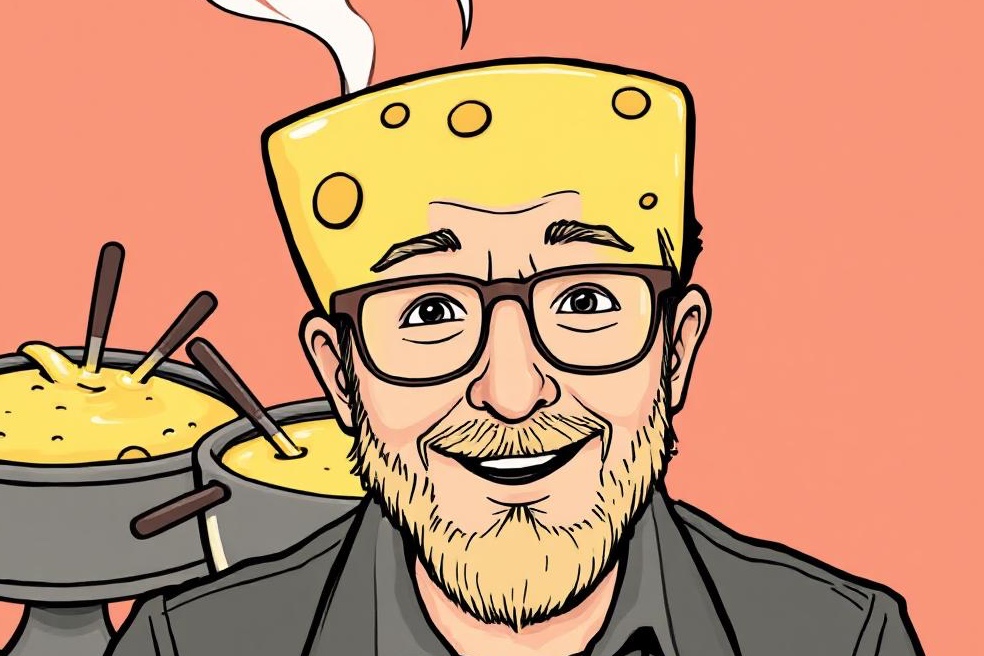
Once, due to a deadline crunch, I had to review five of Amsterdam’s best cheese fondue restaurants in five days. It felt like a dream assignment. At first…
Day one: lovely and down-to-earth, with a recipe that apparently originated with a nuclear physicist. Great selection of salads for balance. (And the restaurant still exists, largely unchanged: Café Bern – check it out.)
Day two: fancy. They even cut the bread into bite-sized pieces for you, and the recommended wine was a nippy little white delight that easily made its own friends.
Day three: still fine, technically. I found myself taking detailed notes about the cheese-to-bread ratio. In retrospect, this obsessiveness should have set off some alarm bells.
Day four: the smell of Gruyère and Emmentaler had begun to follow me home. I began to suspect that my once-discrete double chin was now drooping more downward and in danger of dipping into the bubbling cauldron of napalm-like cheese. I began hearing some ding-dongs.
Day five: my pores were no longer excreting sweat but grease. I was strung out on stringy cheese. I was no longer reviewing fondues – I had become one. Call it method eating. Call me Al Pecorino. Robert de Cheesewheel. They say you are what you eat, but this was next level.
It was a couple of years before I went near a fondue again. But I got over it. I’m a professional that way.
Don’t mention the butter tasting
As reviewing became more crowd-sourced, expense accounts dried up. There was an ethically dubious transition period when the restaurant would pick up your tab. And as a bonus, the visit usually involved a chat with the chef – and we would usually end up gossiping about Johannes van Dam. Apparently, Johannes would still go to butter tastings in his toothless final days. Instead of imagining a man I admired slobbering on butter sticks, I’d wonder how one cleanses one’s palate between butters. By gargling with olive oil?
Of course, these conversations were always wonderful and culinarily educational (for instance, I learned a carbonated mineral water is the standard palate cleanser during butter tastings).
But you could no longer call it independent journalism.
Trust me: don’t believe the democratic hype
Gradually, the crowd took over, and I found it genuinely useful. While driving around Europe on vacation with my family, I could type something along the lines of, “shameless omnivore with fussy kids and a vegan wife” and usually find something that made everyone happy. This was the democratic ideal working as intended.
This means there could be space for a passionate person who knows what they’re talking about, has no affiliate links to disclose, and just wants someone else to foot the bill.
In other words, I’m a simple man with simple needs and talents whose time has hopefully come again. I promise to up my game and not let grumpiness get in the way of an objective view. I’ll also work harder at staying incognito; I won’t even tell my family (otherwise they might force me to bring them along and pick up their tab).
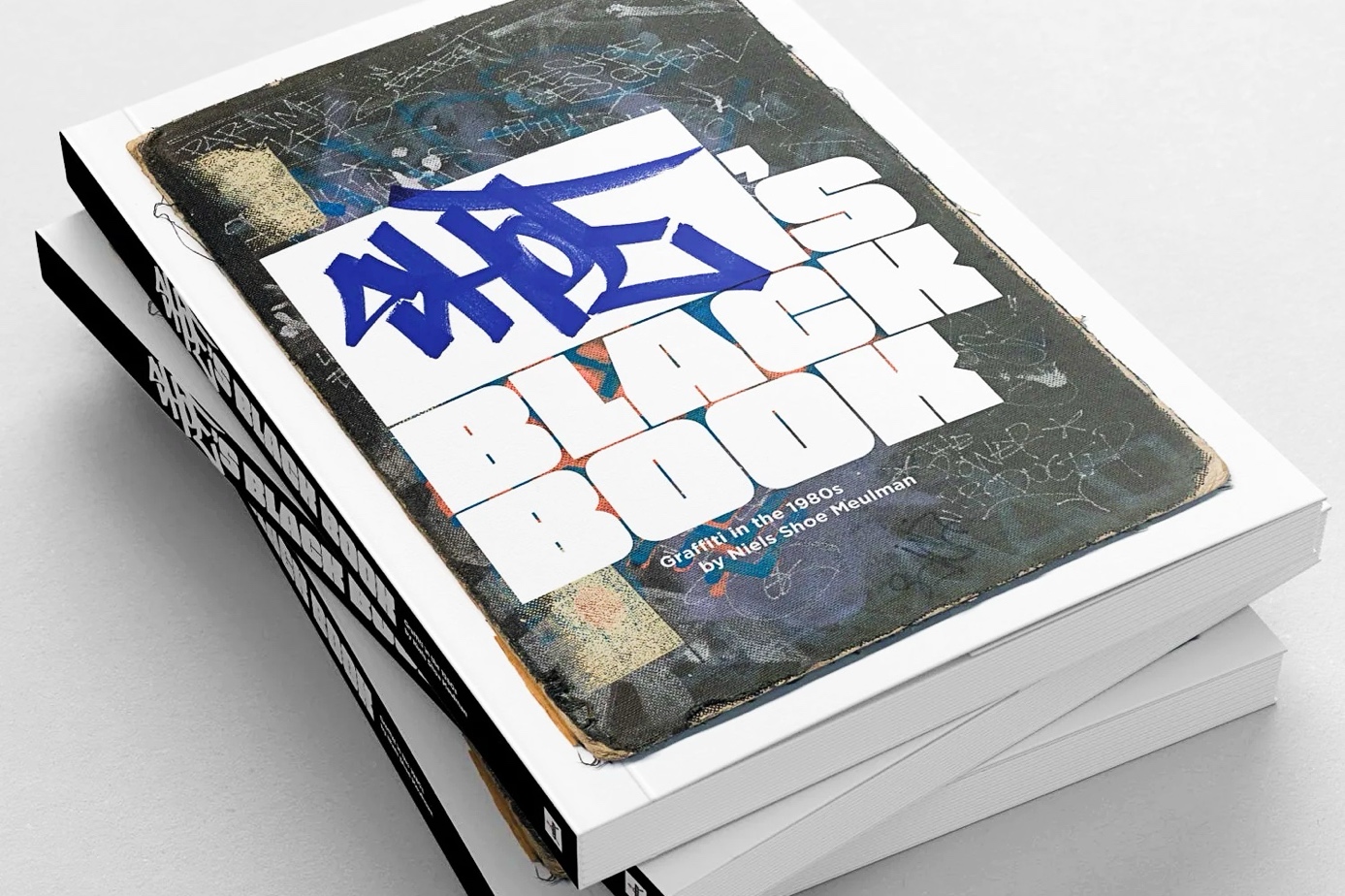
I had the pleasure of editing Shoe’s Black Book − Graffiti in the 1980s by Niels Shoe Meulman. It’s based on his original black sketch book from when he was drawing, learning and vandalising under the tutelage of legends from the original NY graffiti and street art scene like Rammellzee, Dondi White and Keith Haring. The resulting book actually represents a whole new genre: a book-within-a-coffeetable-book-within-an-international-art-heist-flick.
When Amsterdam was shaded
Amsterdam in the mid-1980s wasn’t the museum city postcard it is today. Vacant lots remained vacant. Squatters squatted. Trams hissed like old, asthmatic snakes. Bikes still needed to be pedalled. And the shadows were thick enough to swallow a kid whole.
That’s where a teen writer named Shoe started keeping a small black book. It was nothing fancy, just early tags, legends’ signatures, and the kind of secrets only the graffiti scene cared about – like wtf “window down whole car” means.
Every spread in the new book shows a page from the original black book paired with Shoe’s photos and recollections. It’s half diary, half evidence locker – but with the statute of limitations long past.
The stories are hilarious. For instance, when gothic-futurist-slash-cosmic-rebel RAMM:ΣLL:ZΣΣ – wearing his flamboyant red gown with cape and multiple sunglasses – lured Shoe to do throw-ups on the Stedelijk Museum of Modern Art. Naturally, they were arrested immediately. At the police desk, Ramm kept shouting “Ramm, Ell, Zee!” while cops demanded his passport name. “He never gave it, and they let us go because it was all just too confusing for them.”
And that’s how it was back then. The lines between art, crime and confusion were thin.
Or when Keith Haring, already world-famous and in town for his massive exhibition at the very same Stedelijk in 1986, was casually drawing in Shoe’s teenage bedroom when his mother came home from work. “She was flabbergasted. He gifted my mom one of the Swatch watches he had designed.”
Indeed, Keith knew how to work a room – and win over a confused Dutch mom.
Returning to the scene. The crime scene
But the real mystery began in ’89, when the black book disappeared from Shoe’s mother’s house. Vanished along with all his graffiti gear. No witnesses or clues. Just a broken window. The loss soured him on graffiti somewhat and nudged him towards a successful international art career. So, in a way, the theft – along with Shoe’s own escalating jail time – served as an unconventional guidance counselor.
Years later, the book reappeared, like a cold case that had caught fire. Anonymously. No explanation or apology. Shoe flipped through it. It seemed intact, only slightly vandalized by its captors.
More time passed, and Shoe discovered something chilling: a Keith Haring drawing titled ‘RADIO MAN (FOR SHOE)’ had surfaced at Christie’s auction house and apparently sold to an unknown French collector for 4,000 guilders. The dedication was unmistakable. And then he remembered: this was from his black book. Someone had carefully excised it.
The case remains open. Shoe believes the missing page will eventually emerge from the shadows and be his again. He might be right. After all, art – like a criminal – has a way of returning to the scene.
The book, hand-signed with a Shoe tag, also has a special hardcover edition with additional original art. Both were designed by Ferry van Zijderveld of Undog and published via his Ruyzdael Publishing, with support from the Mondriaan Fund. Check out Ruyzdael’s other graffiti-related books and sign up for the mailing list – Ferry has numerous inspiring publishing plans in the works.
Meanwhile, the book was presented on 7 December 2025 at Amsterdam’s posh and well-lit city archive, Stadsarchief, complete with a city councillor quoting whole verses from KRS-One. Yes, the times have changed…
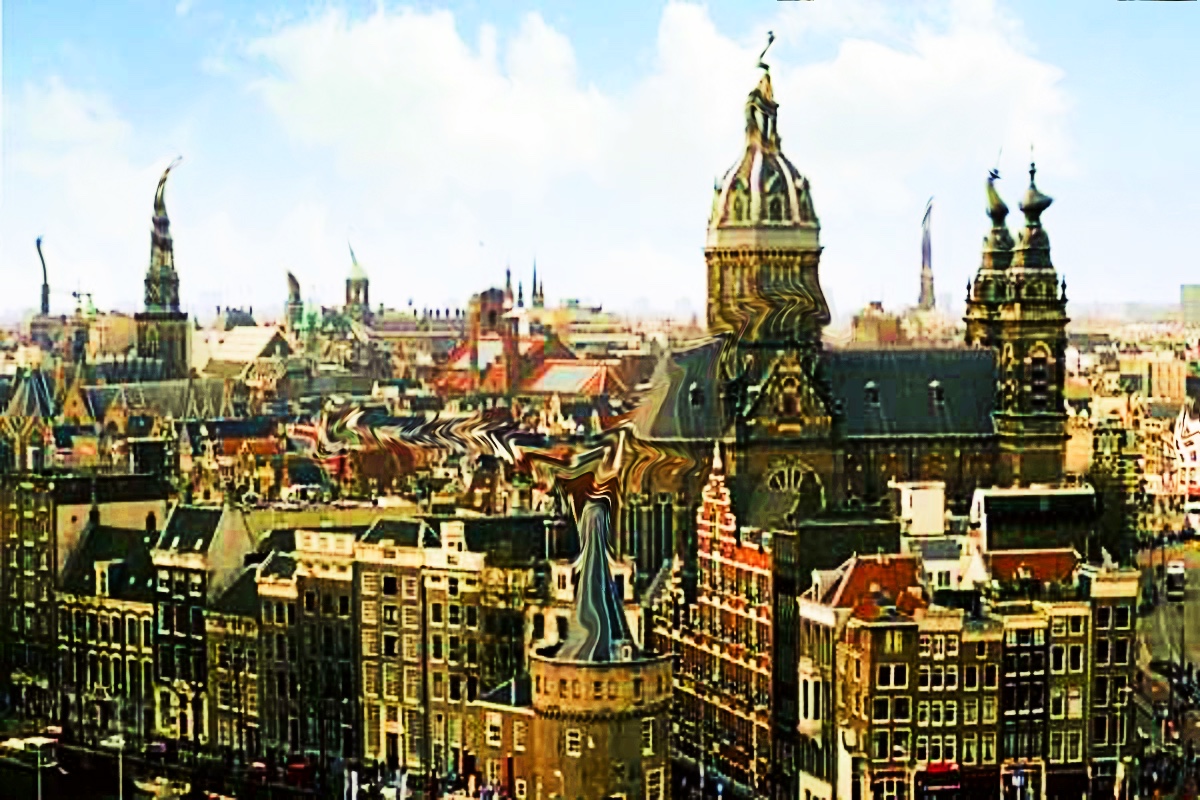
Amsterdam tells great stories through its buildings – often hilarious, dark or both. In the process, it also offers a concise overview of architecture’s history. One brick, two birds! Combine, if you must, with a café crawl.
While it may lack a surplus of tall buildings, Amsterdam – built on conquered mud, as one 19th-century critic put it – offers a 700-year overview of how our living arrangements have evolved. Unlike Rotterdam, it never got clean-slated by bombs. Plus, you don’t need a glossary.
Only four things shaped almost everything here: sloppy soil, beer money, an obsessive business sense, and mistakes.
Like shit, wood floats
Amsterdam first pulled itself out of the unsanitary bog by using light, floaty wood to build homes. As it became a successful trading town thanks to toll exemption and a fat monopoly on Hamburg beer, residents could afford to drive supportive wooden poles into the ground to reach more stable sand, which made brick construction possible – and no more Great Fires.
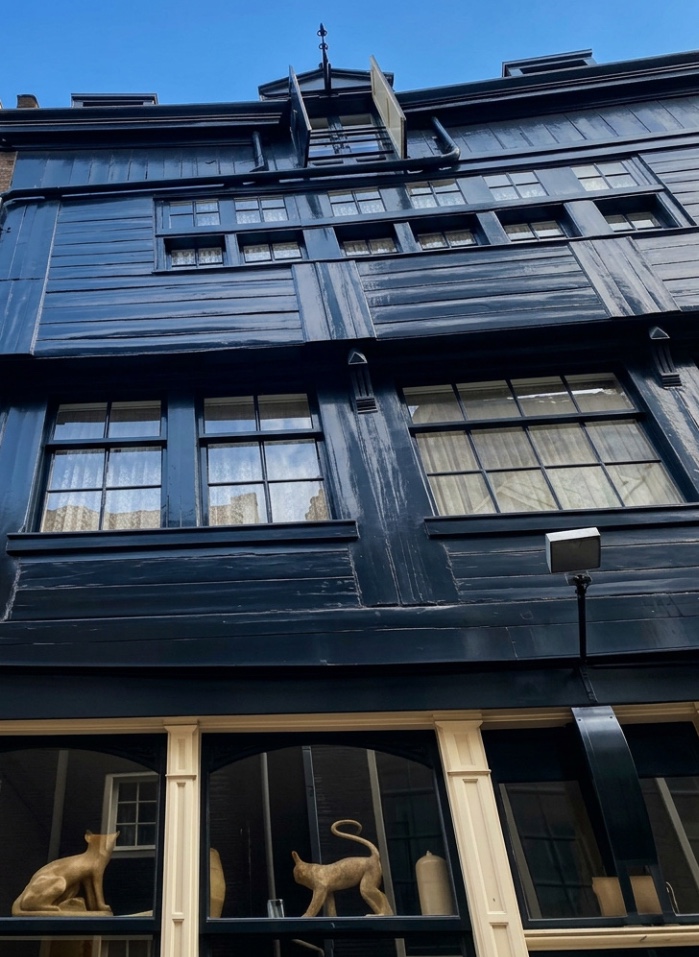
Those first brick buildings even imitated their wooden predecessors and leaned out over the street – and not because of shoddy workmanship or gravity. Medieval timber houses had already jutted each story out over the one below to drip rainwater clear of the walls, and the brick buildings inherited that trick. The same forward wonkiness lets you hoist a beer barrel to the attic without punching out a window. Win-win.
Brick-faced
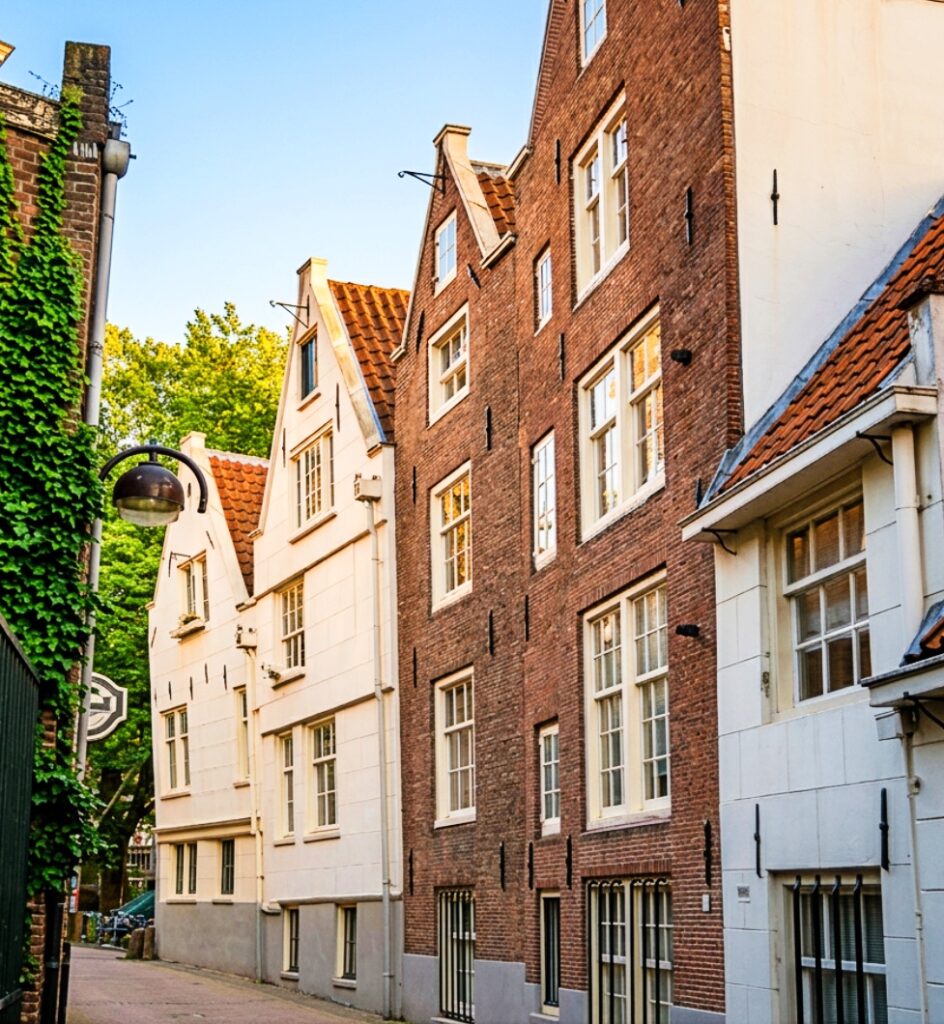
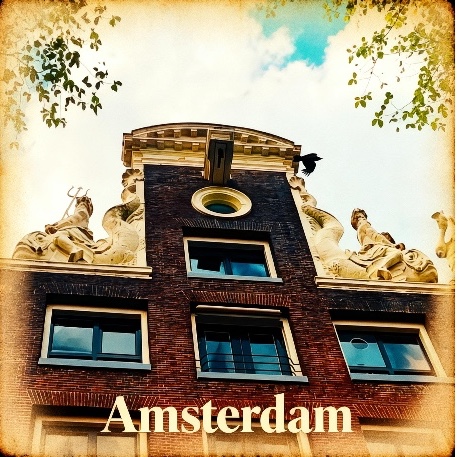
Property along a canal was taxed by the width of your frontage, so merchants built narrow, deep and tall – then crowned the result with a fancy top gable to show off. And the shapes followed fashion: plain spout, stepped, scrolled neck, flouncy bell, and then the flat cornice that called the party off. Read them in order and you watch European taste dress up, get drunk, and sober up again.
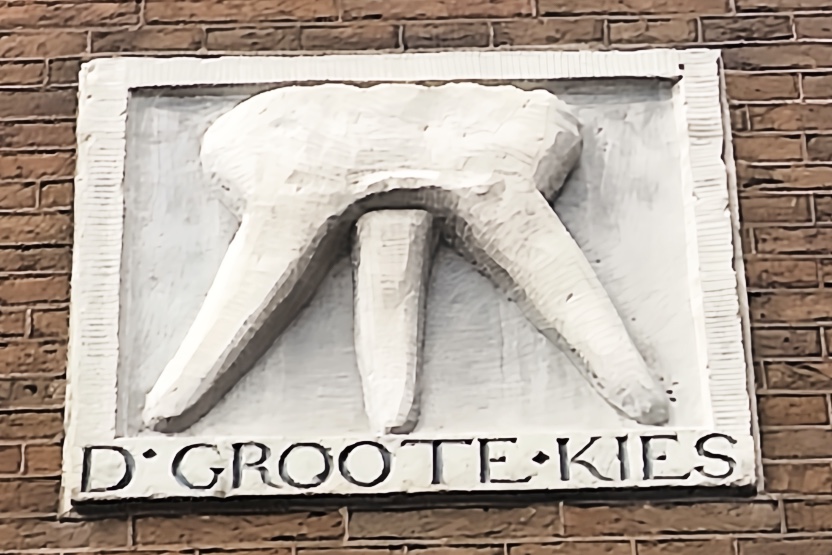
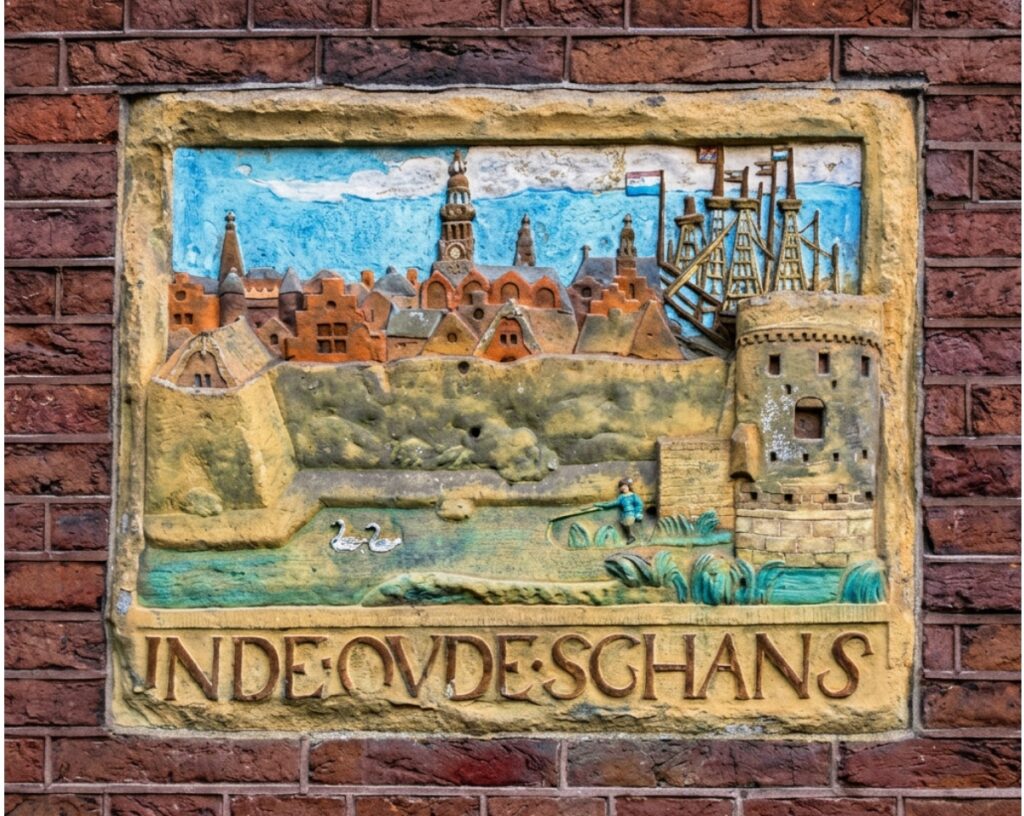
While the gables up top were adorned with vases, masks, sea serpents, and such, the lower stretches were also pimped up – it’s a good moment to note that the Dutch word for gable, gevel, actually means the whole face of the building, not just the happy hat on top. That full face often came striped: red brick laced with white sandstone, which the Dutch deliciously call speklagen, or bacon layers. Set into the wall, you’d also often find a gevelsteen, a carved wall plaque advertising the trade of whoever lived there – a tooth, say, for the household that owned pliers and restraining straps. All this glam was useful in other ways: before the city numbered its houses in the 1700s, your gevel or the stone set into it was your address.
But let’s stay real: all this goddam prettiness evolved from scamming the taxman.
Not so golden
When the money really poured in (spice trade, slave trade, plunder) in the 1600s, Amsterdam ran out of room and planned its own expansion. Three grand canals – Herengracht, Keizersgracht, Prinsengracht – were dug in a ring around the old town, with its own medieval heart now being the Red-Light District.
This Canal Ring may now be a UNESCO World Heritage site, but it basically began as a speculative property scheme sold off plot by plot to the newly rich. The prime real estate, the Golden Bend, is where the banks and deepest pockets lived: they could afford to be taxed on two or more plots of land.
Beyond it, more modest neighbourhoods like the Jordaan went up to house workers and the stinkier industries.
The blubbery soil still meant that more monumental buildings risked sinking back into the muck. Besides, this was a pragmatic merchant state. There was no royalty to project their monstrous egos through palaces and such nonsense.
One world wonder, many miracles
There was one enormous exception to this lack of nonsense. On Dam Square, the city spoiled itself by building a monument to itself: a Town Hall so vast it was hailed as the eighth wonder of the world – and to keep it from sinking into the swamp, it drove 13,659 wooden piles into the muck beneath it. (Dutch schoolchildren remember the number by cheating: the days in a year, 365, with a 1 in front and a 9 on the end.) The merchants eventually handed it to a king, and it’s the Royal Palace today: an ego-monument standing on a forest hammered upside-down into a bog.
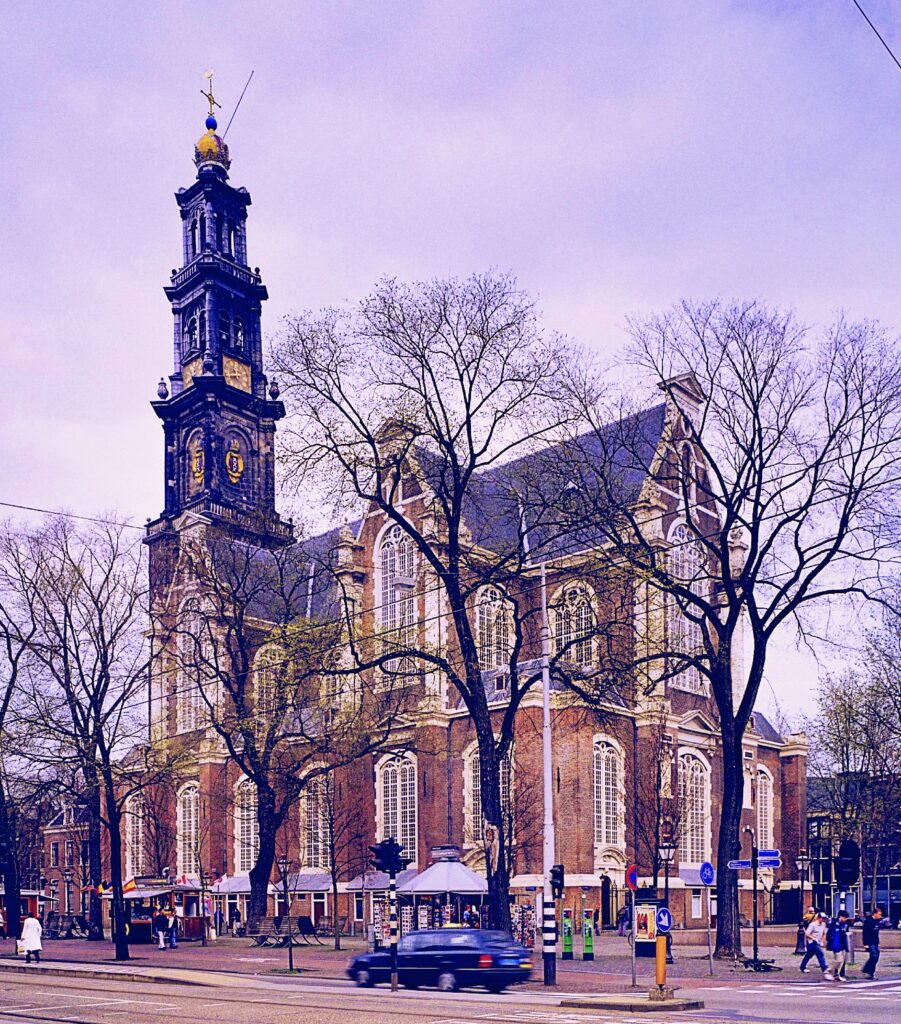
The churches have their own stories, with their massive organs and improbable miracles. Under Protestant rule, the Catholics weren’t allowed to worship in public – so they built hidden churches. Our Lord in the Attic, for instance, is a full chapel, folded invisibly into a canal house, hidden in plain sight. Meanwhile, the Protestant towers went up loud and proud. Today, these towering fuck-yous still define the city’s skyline.
Not everyone had to hide. Amsterdam’s Sephardic Jews – refugees from the Inquisition and, by the boom years, one of the richest Jewish communities in Europe – built the largest synagogue on earth, right out in the open. The Esnoga (1675) is a vast brick hall modelled on Solomon’s Temple. It remains lit by candles to this day, and highlights the city’s famous tolerance: real, lucrative and entirely selective.
Take that, you Protestant bastards
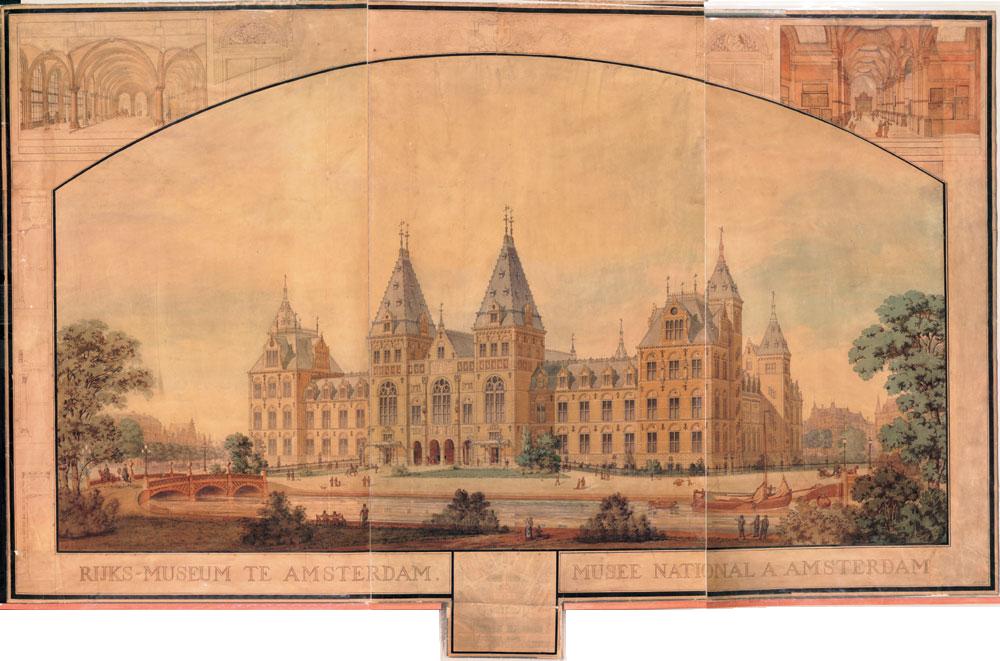
Amsterdam’s second flowering came two centuries later, when a Catholic architect exacted his revenge on the skyline. Pierre Cuypers built the twinned Rijksmuseum and Centraal Station.
The Protestants were outraged. These buildings were too Gothic, too Catholic, too much. Wits nicknamed the museum “the Bishop’s Castle” and the station “the French Convent.” Both buildings were scandals fueled by bigotry. Now they’re postcards.
Centraal Station also walled the city off from the very water that had made it rich. That separation left Amsterdam Noord, across that water and the latest home for the city’s stinkier industries, largely ignored for over a century.
Architecture in an apron
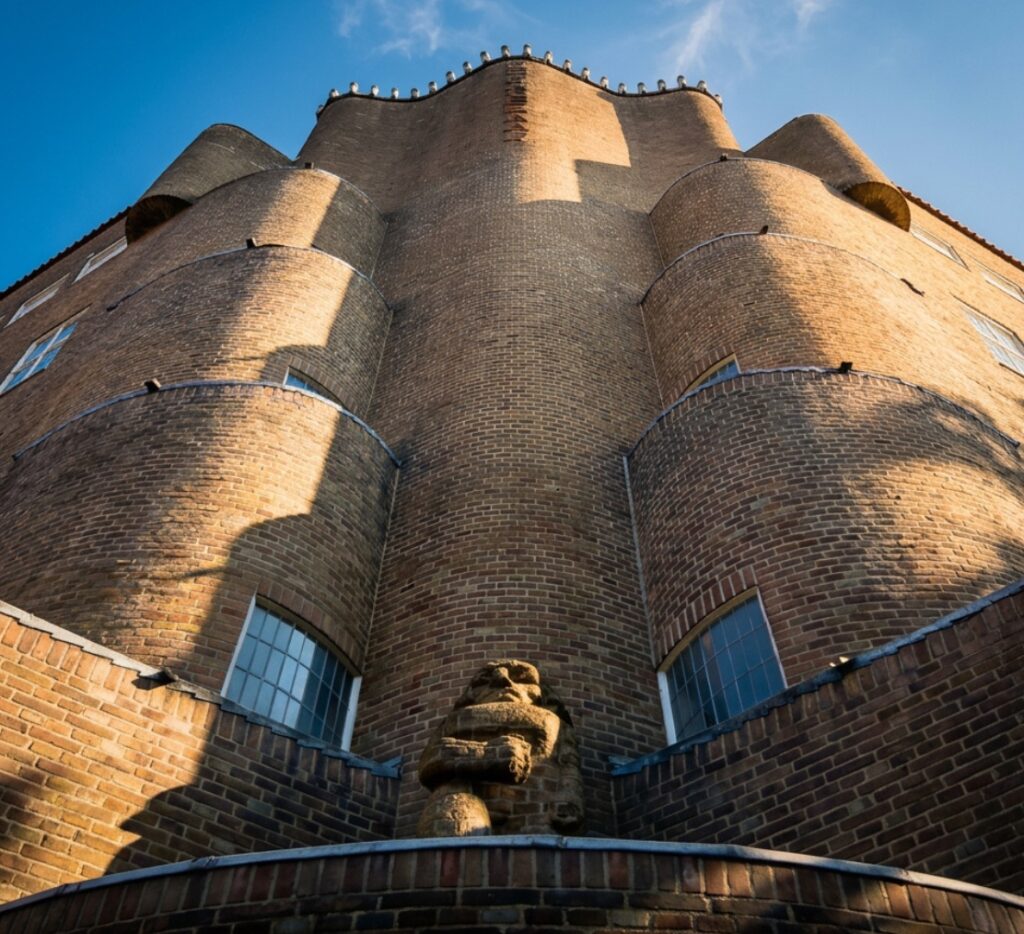
As the supporting poles grew longer and stronger, Amsterdam could indulge more. Berlage’s stock exchange helped inspire the Amsterdam School – aka ‘Apron Architecture’, because the brickwork billowed like fabric. Reinforced concrete – the emerging tech that rewired modern building everywhere – now provided the structure, freeing the brickwork for swoopy, expressive exteriors. Elsewhere, that freedom bought glass towers; here it bought social housing as a fever dream. Respect.
Then the Depression hit, and the need to cut corners turned the swoops into right angles. The school had to bow to pure functionalism – ‘New Building‘ – which was already stripping everything down to clean lines, glass and zero extras, especially after WWII, when there was a lot of building to do.
Building, then dynamiting utopia
The most ambitious version of pure functionalism wasn’t a building but a vision. In 1935, Cornelis van Eesteren’s General Expansion Plan mapped out entire new districts to the west – the “Garden Cities” – and dictated where the city would grow for decades: light, air, and green, all by the numbers. It became a textbook of modern city planning before the neighbourhoods became textbook examples of urban decline.
Urban plan for the Bijlmer by Siegfried Nassuth (1922-2005), photo by Joost Evers / Anefo. Under CC license.
In the 1960s, the city pushed the plan’s logic to its limit with the Bijlmer – a honeycomb of identical high-rises set in green, meant to be the future, the same future that went up and then back down, from the dynamited towers of St. Louis to the Paris banlieues. Lesson learned: buildings can carry a dream and still fail miserably.
And then it fell quiet
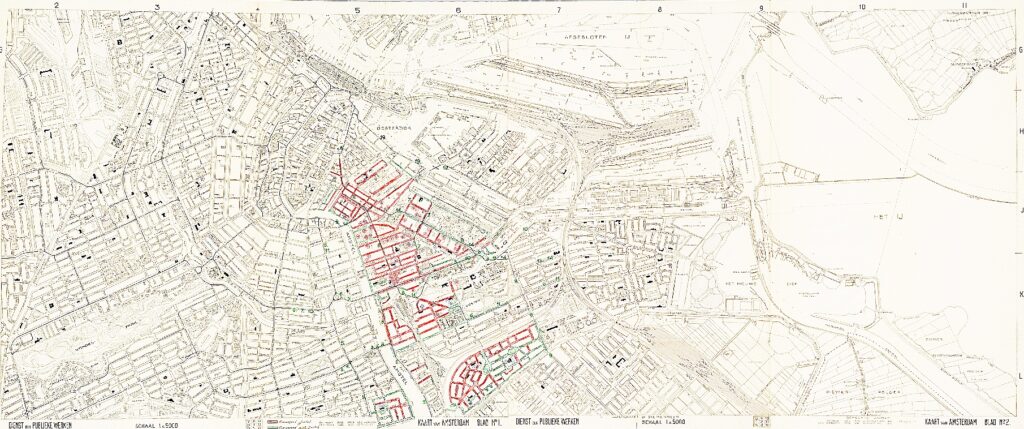
The darkest demolition, though, wasn’t a failed dream or one of the city’s charming mistakes. It was a choice – made twice. First, the Jodenbuurt, the old Jewish quarter, was emptied by deportation: roughly three-quarters of the city’s 80,000 Jews were murdered, and never came home. Then, in the 1970s, the planners came for the buildings, bulldozing what was left to push a metro line through.
City Archive, Amsterdam. A public works map from 1942 that marked neighbourhoods that were “mainly” Jewish in red.
The 1975 Nieuwmarkt riots – water cannon, tear gas, barricades – came too late to save the quarter, but they killed the broader plan: the motorway, the office towers and the metro lines meant to follow. The station beneath it is now hung with art remembering the houses that no longer stand above ground. The Esnoga survived the war; the neighbourhood didn’t survive the peace.
Cities are good at paving over their biggest mistakes – and drowning out the past with their own noise. For instance…
Overengineering, one of many Dutch diseases
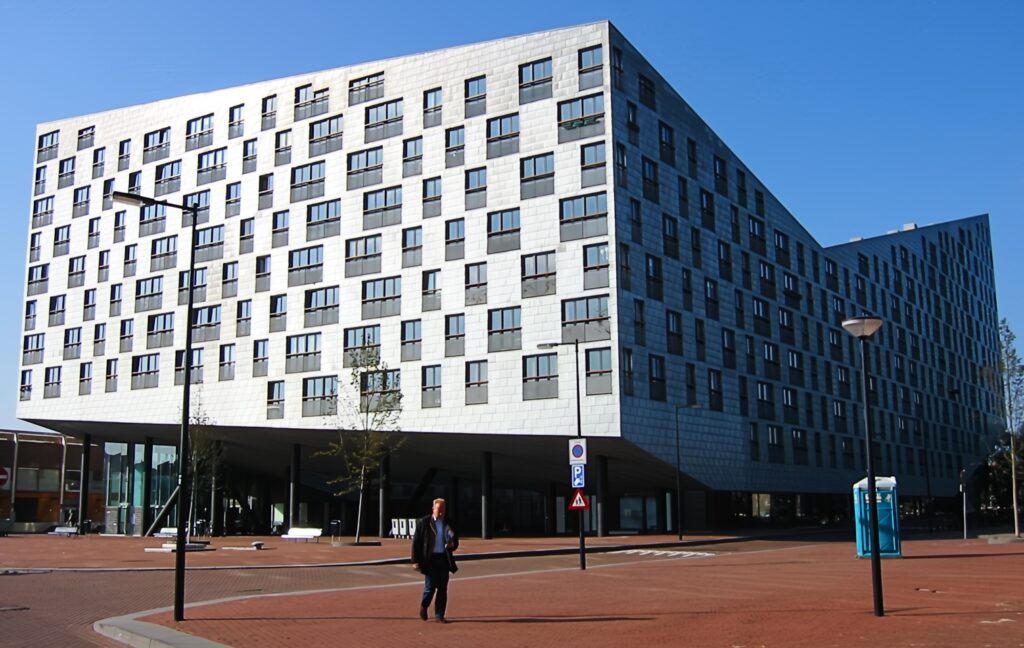
By century’s end, showing off was definitely back. The Dutch pavilion at Hanover World Expo 2000 stacked ingredients such as dunes, forests and tulip fields like a “Dutch Big Mac” – the Netherlands as a theme park of itself.
It was a sign of the SuperDutch times, with Amsterdam and its Eastern Docklands very much included as everyone sought to blur the boundaries between buildings and landscape, work and play, land and water. Everything was planned down to the centimeter, including nature.
Sometimes it worked; sometimes it resulted in a sleek designer-prison vibe.
Reduce, reuse, rezone
It had always been cheaper to demolish and start from scratch – the Bijlmer lost half its high-rise grid barely a generation after it went up. But the city learned to think long-term, and turned to second acts. A building that began as the departure point for East European emigrants sailing to South America, then served as a wartime prison, reopened in 2004 as the Lloyd Hotel, complete with sleeping pods by Atelier van Lieshout – and in 2023 reinvented itself yet again as The Hoxton. Libraries became hotels. Drawbridge houses became hotels. A lot of buildings became hotels. So many pretty buildings, so many tourists.
And round it goes…
There are other stories… How a trading-house-turned-bank designed by a math-loving spiritualist was repurposed as the new City Archives. A shipyard is now a post-apocalyptic wonderland where squat culture and commerce commingle. And the surrounding Amsterdam Noord, once the part you avoided, is now an architectural hotspot, with the original working-class population being pushed out due to rising prices.
I can certainly go on. And on. About what made people build the way they did: the mud, the money, the lack of money, the fires, the fever dreams, the need to fix past mistakes, the need to make new mistakes. But this is how buildings stop being buildings and start being stories. Look up, look around, go wow, and raise a beer. I do it all the time: I may be jaded, but I still love this town. Never take a building, or a good story, for granted.
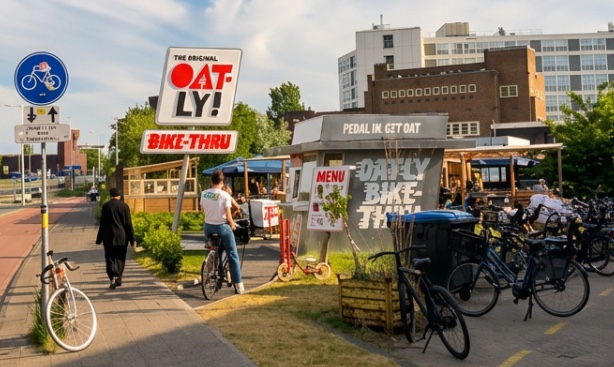
I was editor and co-writer of a bike book published by the esteemed SNOR and designed by Studio Boot. Specially formulated as a crash course in surviving Dutch bike traffic, it features ‘Top 10 Rules!’, DOs & DON’Ts!’, ‘How to swear back at locals!’ and all the cultural weirdness around these most democratic of iron beasts. Become a neder-cyclist today!
Now available in the world’s best book and museum shops…
Welcome to the Netherlands, where the bikes outnumber the people and even the windmills need a bell. Whether you dream of gliding effortlessly through tulip fields or simply surviving your first rush-hour roundabout, this guide is your passport to pedal-powered freedom. Packed with tips, tricks, and general smartassery, Dutch Biking – Survival Guide For Beginners will help you dodge dodgy cyclists, master the art of dealing with “shark teeth”, and discover why the humble bicycle is the real king – and queen – of the road.
And yes, retaliate against any rude local cyclists by learning the phrase: “filthy porridge-slurping, tuberculous-suffering pancake of a cancer dog!”
Learn some amazing facts!
Bikes were formulated initially as “iron horses that need no feeding”.
Thanks to a bicycle’s mechanical nudity – the artist Saul Steinberg called it an “X-ray of itself” – bikes are very easy to maintain.
“Bicycle bread” refers to raisin buns that are so skimpy on the raisins that you need a bike to ride between them.
Half a million bikes are stolen every year in the Netherlands.
Bicycles had starring roles with the emancipation of women, the mind games of hippie absurdists, and the photo opportunities of craven politicians.
Making an “asshole-proof” bicycle is more complex than you might think.
Perfect gift idea!
Okay, it’s not the definitive book on biking in Amsterdam – that’s still City of Bikes: The Story of the Amsterdam Cyclist by Pete Jordan. But this is still an entertaining and educational book. And the perfect gift idea!
Did I mention you can learn the phrase “filthy porridge-slurping, tuberculous-suffering pancake of a cancer dog!” in the local lingo?
“Covering 5 years, the Medical Data + Pizza event series has followed a compelling timeline, encompassing the period when AI came of age, and became sexy. We spoke with AI professor and co-founder Mark Hoogendoorn about the challenging task of bringing AI to the bedside – in Amsterdam and across Europe – and about the power of pizza to get things moving.”
Thanks to EdenFrost and the Amsterdam Economic Board, I received a free education in AI by reporting on nearly every edition of the Medical Data + Pizza event. After 25 editions, it was a good time to chat and reflect with cofounder Mark Hoogendoorn, a professor of artificial intelligence at the Vrije Universiteit Amsterdam’s Department of Computer Science.
“It began as a simple concept: to play cupid between two very different beasts. On one side you have the data scientists – always hungry for pizza, but also for real-world problems to solve. And on the other, the medical professionals – who share the pizza hunger, but already have plenty of very real-world problems on offer.”
“Together with medical counterpart Paul Elbers, intensivist and associate professor of intensive care medicine at Amsterdam UMC, Mark formed the Amsterdam Medical Data Science (AMDS) network. Supported by Amsterdam UMC, OLVG, Vrije Universiteit, PacMed, and Amsterdam Economic Board the network grew rapidly to 2,154 members and counting.“
“…What shines through at each Data + Pizza event is this: people want to make a positive impact on the world, even though they are aware of the monumental task at hand – technically, ethically, regulatorily. There’s a certain shared belief in a happy ending if we all just get to work.”
“It’s true, I’m a fairly optimistic person by nature,” Mark smiles.
Onward and upward
The event snowballed from data scientists and doctors to attract a remarkably diverse crowd in terms of age, gender, nationality, and profession. And of course, as AI became an increasingly hot topic, it only snowballed further.
“Meanwhile, Mark is looking forward to seeing how Europe forges ahead with a more people-centred approach to AI – in contrast to the US, where corporations tend to control patient data, or China, where the government calls the shots. Hoogendoorn believes the EU approach is the way forward, even as critics say the required infrastructure will work to slow innovation in the region.”
“We need these safeguards in place. We have to be careful with potential downsides,” says Mark. “In the long run, I think it will prove beneficial, because you’ll have more support from the public. I don’t think patients are against sharing their data if it helps the next patient. People’s distrust is more directed at the government and policymakers.”
My first ABC book! With the fine folk at Snor Publishing, I wrote the freshly released book ABC Holland. It covers 26-plus things that visitors find delightfully eccentric about the Netherlands – such as bitter balls, wooden shoes, drugs, herring and Hazes. Indeed, it’s the perfect gift. (But not for me because I already have a copy.)
Below, I pasted a few write-ups that didn’t make the final cut (for obvious reasons).
F is for Flowers Holland is an economic floral powerhouse, controlling almost half of the global trade. The Dutch are bud-obsessed. Holland’s ‘Tulipmania’ of 1636-7 saw single bulbs get traded for real estate, heaps of cash or endless kilos of cheese, before crashing into a chaos of bankruptcies and suicides. Let’s hope they learned their lesson.
V is for Vindmill Oops, typo! Anyway… Windmills have made a deep impact on the Dutch landscape and psyche. Many Dutch sayings describe insanity and general absurdity in relation to windmills or ‘windmillies’, as a child’s wind wheel is called. This toy twirls without any true function: like the brains of the insanely drunk. Ironically, most still existing windmills also serve no function. They twirl on government subsidy.
Y is for ‘You’re Not Normal’ Yes, the Dutch exhibit wildness and diversity on King’s Day (see K) and Gay Pride (see G), and with their appetite for XTC (see X). But the rest of the year is more about: ‘Do normal, then you’re crazy enough’. Conformity is important: people should just relax, fit in, and not act as if they ‘got hit in the head with a windmill blade’. ‘Y’ is also for yodeling (just kidding: we hate yodeling – it’s just not freaking normal*).
* Apologies to friend and yodel scholar Bart Plantenga. I’m shameless when it comes to low-hanging fruit.
I was asked by the wonderfully quirky Atlas Obscura to write a weekend guide for Amsterdam. So I visit a nun. I visit a parrot. I cruise through primordial soup. I get all esoteric. I play a pianola. I indulge in a bit of bio-hacking. I sleep in a bridge house. And yes, I do pound back a jenever. Or two.
Last year I was asked to write a piece for the ‘City Hotels’ exhibition at Amsterdam’s architecture centre Arcam. My story ended up being about Andaz Amsterdam from Dutch design icon Marcel Wanders. But I also managed to slip in references to being a doorman, eel-pulling, lion shit and being snotty about fringes…
Mucus in mid-air
A few decades ago my first job in Amsterdam was as doorman at the Melkweg. It was a different time; it was an educational time. I learned how to tear a ticket while having a beer in one hand and a smoke in the other. I listened to stories from my hardcore Amsterdammer colleagues about when the city was one big rafelrand – a giant fringe bursting with fringe activities. About sniffy squatters building giant robots to battle police. About lion shit being thrown around to freak out horses pulling royal carriages. And about other things that appealed to my stunted sense of humour – a sense I seemed to happily share with my colleagues. Good times.
By day, I continued my education at the old OBA library on Prinsengracht. Compared to its present location by CS, it was an ugly mess. But at least it had books. In the sprawling section dedicated to Amsterdam, I would leaf pages and scan indexes for appealing terms. That’s how I found out about the ‘Eel Riot’ of 1886. About ‘tobacco-smoke-enema-applicators’. About all the rafelranden of the city’s past. Back at the door, I would share these stories with my appreciative colleagues. Points scored.
Years passed. Amsterdam gentrified. I joined my colleagues in complaining about having to bike further and further out from the centre to discover any quality fringe activities. Some bona fide post-apocalyptic-vibed weirdness. Some updated version of ‘eel-pulling’.
I also gentrified. I applied my accumulated Amsterdam lore to writing guide books and travel pieces. One day, an international style mag sent me to review a newly-opened hotel called Andaz Amsterdam. The location was the old OBA library where I had learned about the city’s deep connection with rafelranden.
Now it was a ‘tribute to the city’ by design wonder boy Marcel Wanders. Naturally, I totally enjoyed the free room and food. But it was all too slick. This wasn’t my Amsterdam. It lacked grit.
After dinner I went downstairs to go to the washroom. There, down a red Lynchian hallway was a display of Wanders’ ‘Airborne Snotty Vases’ based on 3D scans of sneeze mucus in mid-air.
Sure, it was a very small rafelrandje. But at least I didn’t have to bike far to find it.
The spring/summer 2012 issue of CODE magazine has been out for a while. Besides managing as managing editor, I wrote a travel feature about grey – but mighty and magical – Kaliningrad. This city-formerly-known-as-Königsberg is now a dislocated blob of Russia in the heart of the EU, and offers crash courses in Teutonic Knights, WWII, the Cold War and how to build arts scenes out of freaking nothing. It’s also got killer beaches and drunken pine trees.
I also had the honour of interviewing Magnum Force of Street Style (and cover boy) Nick Wooster, as well as the Dutch artist/designer Joep van Lieshout. As founder of Atelier van Lieshout, Joep has brought the world fully-realised ‘Free States’, slave camps and rectum bars. Now he’s just come out with a line of unisex handbags. So I asked him if he was undermining his past work, playing with people’s minds or just being hilarious – he definitely proved to be hilarious. He also had interesting things to say about order vs. chaos.
This issue also has features from two of my favourite writers: Sarah Gehrke (on Noses) and Floris Dogterom (on doodle tattoos). And the design is by the inspired lads of Het Echte Werk. So check, check, check it out. It’s now available at the world’s better mag shops – including Athenaeum Nieuwscentrum in Amsterdam.
[Spoiler alert: Not recommended reading for those who believe in Santa Claus.]
Each year in the Netherlands during the Christmas season, the tone around the debate on whether Zwarte Piet (‘Black Peter’) is a form of racism gets darker. This year, the discourse was further inflamed by the rather violent arrest of ten protesters with ‘Black Peter is Racism’ t-shirts and the news that the Dutch-Canadian community in Vancouver decided to no longer allow Black Peters in their annual Sinterklaas (St Nicolas) procession. Meanwhile many of the Dutch-Dutch just get increasingly defensive as they treat such talk as a threat against their culture.
For the outsider, it remains a curious tradition: countless Dutch adults putting on black face, smearing on red, red lipstick, popping on a wig of kinky hair and adorning their ears with large golden hoops – and doing all this without any sense of malice. Then they hit the streets like a pack of highly caffeinated Al Jolsons to help St. Nick distribute sweets to children.
Years ago, a visiting friend and I came across such a posse. I was long used to it, but my friend’s jaw hit the ground in disbelief – and this is a man who has witnessed much weirdness worldwide. ‘What is this minstrel madness?!?’ he asked flabbergasted. (Not long after while in Russia our roles were reversed in a strange and convoluted way when we were waiting at a backwoods train station and some skinheads came to confront my friend about the colour of his skin. He stayed cool and dealt with the situation. I just stood there. Totally flabbergasted.)
Local Dutch cultural history only goes so far in giving my friend a reasonable explanation behind the Black Peter tradition.
Once upon a pagan time, this was slaughter season when meat was both stored for the long winter and sacrificed to Odin – the Germanic God of War, Sea and Hunt. It became a celebration of life and done, one assumes, with lots of blood and bonking. So when the Church came to town to wimpify the whole process, they decided the party should be rebranded around Saint Nicholas, patron saint of children and whose birthday conveniently fell on 6 December.
The Dutch were forced to repress their natural urges for communal butchery by aggressively baking huge mounds of animal-shaped cookies and chewing on marrow-textured marzipan. Later Sinterklaas mutated further by going to America with the settlers, eventually getting drawled out to become Santa Claus and having his special day shifted to 25 December to compensate for Jesus’s failing of character when it came to the spirit of gross revenue. Then in 1931, that darkest of beverages, Coca Cola, produced an advertising campaign that gave Santa his current look.
Meanwhile here in the Old World, St Nick with his white beard, bishop’s robes and ridged staff remains every Dutch kid’s favourite uncle, playing the good cop by controlling the distribution of sweets. Meanwhile, his assisting and equally beloved bad cop Black Peters represent the threat to the naughty kids. The blackened faces are explained away as resulting from Black Peter’s assigned job of delivering the sweets to the awaiting shoes via that dirtiest of orifices, the chimney. (But of course this does not explain Black Peter’s exaggerated lips, kinky hair, golden-hooped earrings and, often enough, Surinamese accent.) Another rationalisation has the tradition going back to when darkness represented evil; that Black Peter is actually the conquered devil, and that his colour and joy of mischief are the only leftovers of an evil beaten out of him by St. Nick. Either way – may it be through soot or sin – blackness tends to cling. As does St. Nick during the rest of the year as the official patron saint of not only Amsterdam itself, but also other favourites of Odin such as merchants, prostitutes, thieves and sailors (who, interestingly, paid tribute to their saint for centuries by using the term ‘doing the St. Nicholas’ as slang for intercourse).
The historical Nicholas is not precisely traceable. He is likely a mixture of many Nicholi. One of them, Nicholas of Cusa (1401-64), was eventually disowned by the Catholic Church for promoting the idea that all of the world’s gods were actually the same and therefore all deserving of equal respect. And in many ways Odin and St Nick are still the same: Odin not only shares the same followers as St Nick, but also rides the same kind of white horse and, in some stories, has some dark sidekicks chained to him… So with such similarities it’s easy to assume that St. Nick is simply Odin cross-dressed as a bishop. And in turn, Odin is the devil – or so said the Church when they came to town. But as long as Satan continues to bring joy to the hearts of millions of kiddies each year, I’m pretty alright with it.
As for the Black Peter phenomena – a tradition that was only formalised during the last half of the 19th century… That just stays weird. And anything weird should be confronted. I’m just brainstorming here, but would it help if next year Black Peter was rebranded as a Jew? Or perhaps as a Canadian?
Yesterday I had a night full of holes. And it wasn’t about drinking to excess, but about attending the ‘On Portable Holes and Other Containers’ night at Felix Meritis organised by Paleisje voor Volksvlijt. Artists, philosophers, musicians and writers gathered to present and ponder such questions as ‘Is a hole a container?’, ‘How do we talk about something that does not exist?’ and ‘If you buy a donut, are you also buying the hole?’
The evening was actually quite enlightening. Lately I’ve been looking for new ways to perceive reality, and holes might just be the ticket. But I must admit I am still a little stuck on: ‘How do you successfully describe a knotted hole without refering to the immaterial?”
The night was partially inspired by the excellent and often hilarious book Gaten & andere dingen die er niet zijn [‘Holes and other things that are not there’] by the Easy Alohas. This DJ duo, comprised of Bas Albers and Gerard Janssen, were on hand for what must have been one of their easiest gigs ever: playing silence – or rather a mash-up of John Cage’s ‘4’33”’ and Mike Batt’s ‘One Minute Silence’. Because there was no turntable, the Alohas were forced at the last minute to download these tracks of nothingness from iTunes. This also meant we could not listen to the album they had brought along called The Best of Marcel Marceau – everyone’s favourite mime.
Later I confessed to Gerard of the Alohas that my life is filled with huge, gaping holes. He reassured me as only a holy master of holes can: ‘You shouldn’t see that as a problem. These holes are just spaces that you can fill up with new people and ideas.’ I was suddenly filled with a huge sense of belonging. I was now truly part of the silent majority.
[Full disclosure: You remember when the CERN Large Hadron Collider particle accelerator was first turned on in 2008 and it mysteriously shut down almost immediately, and it was theorised that a particle from the future had travelled back in time to do this in order to ensure that the accelerator would not form a black hole? I am that particle.]
Recently I acted as managing editor for the fall/winter issue of a fashion magazine. Yes, I entered the world of style.
[I’ll pause for effect…]
Of course this gig should come as no surprise to those who already know that I get my savvy selection of seasonal clothes here and my 1960s welfare-recipient glasses here. But for some reason whenever I mention this whole ‘Steve in fashion land’ concept, friends generally break down into hysterical laughter. Why do they do that? During the whole process, there were really only a few moments of complete Mr Bean-like slapstick.
But anyway, the periodical is CODE (‘documenting style’), and the issue’s theme is an enticing one: ‘2012Survival Kit’. It poses the question ‘What would you design for a hypothetical toolbox meant to help you survive the apocalypse?’ It’s also an international creative call to artists, architects and designers of all stripes to come up with their own ultimate survival products. The results of this ‘co-creation’ will be touring the world as an exhibition through 2012 – from Amsterdam to Kobe, Japan. You can find more information about the project and how to get involved here.
The issue’s main features focus on the survival tactics ofsideshow circus freaks, new agers, off-grid pioneers, emerging tech gurus, urban warfare clothing designers and the brave and delightfully eccentric characters who fish off the decaying piers of Brooklyn.
CODE’s ‘Survival Kit 2012’ magazine is distributed worldwide (check out this week’s window display at Athenaeum in Amsterdam).
See you in the hills! Looking sharp! And sustainable!
I am in a perfect position to imagine the setting of the Eel Riot of 1886: a window seat at cafe De Kat in den Wijngaert overlooking Lindengracht, a former canal that was filled in shortly after this tragic event from almost exactly 125 years ago. But sadly I cannot have a ‘perfect Amster-moment’ since the café’s otherwise stellar menu – their tostis are justifiably legendary – offers no eel-based snacks.
The enigma that is eel
As deeply enigmatic tubes, eels are 100-million-year-old slime wonders with authentic phallic mystique. A connoisseur no less than Freud spent a summer as a medical student slicing and dicing hundreds of eels in what proved to be a failed search for their sex organs. And to this day, their sex rites remain shrouded by the bottomless Sargasso, leaving scientists to hypothesize about the actual nature of the orgy of lust that climaxes the eels’ journey of thousands of miles.
Indeed, this mysterious beast generates more questions than answers. How can a decapitated eel still find its way to the nearest water? How can they so effortlessly alternate between salt and fresh water? Is it true that a ‘drinking wine suffused with fragments of its skin might turn a drunkard into a teetotaller’? And why would Sophia Loren, at the height of her loveliness, choose to play an eel factory worker in the film La Donna del Fiume?
From eating to pulling
But of course the fundamental question remains: why are they so darn tasty? Aristophanes rightly described their gustatory delight as ‘oh my sweetest, my long-awaited desire’. It was certainly easy for eels of yore to suavely slither into Amsterdam’s mass culinary consciousness by allowing themselves to be smoked and then sold from fish stalls.
People can say I’m full of brown trout, but I believe that the eel – intent on becoming Amsterdam’s spirit animal by broadening its appeal to politics – allowed itself to get caught up in a local sport popular in the 19th Century called palingtrekken (‘eel pulling’). This game involved dangling a live-eel-on-a-rope over a canal and trying to jerk it off from a wobbly boat below. Our slippery friend ‘won’ whenever a puller failed and fell into the canal.
Yes, there was an eel riot
It was this sport – one that can be argued as the evolutionary missing link between dwarf-tossing and Ajax football – that led to the Eel Riot. By that time the sport had been banned but it continued to be practiced in the Jordaan, then a staunchly working-class district. One day, when the police attempted to break up an illegal game of eel-pulling, the people decided to fight back – not for the right to pull eel, but to live life in less poverty. The army was called in to enforce the peace, with usual tragic results: 26 dead.
The newly united neighbourhood went on to organize peaceful social change. And according to Amsterdam, een lastige stad (‘Amsterdam, An Awkward City’) by JM Fuchs, the eel that sparked it all was later sold in 1913 at an auction for 1.75 guilders before disappearing from view.
Let’s take a moment to remember this working-class eel-ro.
The Guardian just published their online guide to Amsterdam. It’s quite fine indeed and features some fine local contributers — including the folks behind Unfold Amsterdam. My contribution involved asking the Dutch gibberish-hop collective De Jeugd van Tegenwoordig about their favorite Amster-songs. The interview was both hilarious and exhausting. Sadly much of what they said proved to be too racy for a family newspaper. My favorite part was when they claimed that volkszangerAndre Hazes was the nation’s Tupac and was actually black — ‘but you know how the history books always change everything.’
It’s currently a pretty sweet deal for tourists in the Netherlands. They can strut through the front door of a coffeeshop, smugly engage in a simple transaction, and then smoke the sweet smoke. They can exit the same front door: wiggly, wasted and most importantly — for they have done no wrong — free of paranoia. The glitch is that the wobbly law that allows them this simple pleasure neglected to deal with how the wacky weed got there in the first place. The ‘back door’ where the produce arrives by the kilo is still a gateway to an illegal distribution system.
It’s a typical situation in the Netherlands. It may not be legal but it’s ‘tolerated’. This is why the Dutch national government has been regularly re-introducing the debate of how to deal with this situation — and all those silly, stoned tourists. Whenever this debate reared its head an editor from a foreign newspaper would call me and ask ‘Hey what’s going on? Are they really closing the coffeeshops?’ And then I would have to kill any work opportunity by going ‘No it’s all just talk’. But now the national coalition seems more serious. Crazy. But serious. They plan to institutionalise a ‘weed pass’ whereby only locals would have access to coffeeshops. Were these zealots stoned when they came up with this idea? Now don’t get me wrong, I would love to have a weed pass. I could then show it off to friends back in Canada so they can go: ‘A weed pass!?! You’re kidding right?!?’
Naturally the national government did not consult with the local city governments that have to actually implement such a policy and also deal directly with the inevitable rise in street dealing and criminal control. While Amsterdam has been very busy in the last years to lower the number of coffeeshops, the vast majority of local politicians think the weed pass is a batshit crazy idea. So things won’t change much here in the short-term. But just in case, here’s a tribute to that species that may just be one step closer to extinction: the batshit crazy stoned tourist.
Cheech and Chong’sStill Smokin’ (1983) has the dopehead duo visiting their spiritual Mecca and being consistently confused for Burt Reynolds and Dolly Parton. Yes, they were probably stoned when they came up with that scenario. They end up partaking in a long list of local activities in such landmarks as the Tuschinski Cinema, Hotel Okura and a gay sauna. While the movie features cameos by such future luminaries as Arjan Ederveen and Kees Prins, the movie is still really, really bad – and sadly, it’s not even badder-than-bad-that-it’s-good-again. A lost opportunity.
The sheer badness of Still Smokin’ has one advantage. It makes Deuce Bigalow: European Gigolo (2005) more digestible. However not nearly as digestible as waffles and chicken.The movie has more stoner-esque moments but the above scene stands out for actually being funny.
Harold & Kumar Escape from Guantanamo Bay (2008) is also packed with Amster-scenery – the most scenic being a cameo by Boom Chicago’s Rob AndristPlourde as the toking fifth wheel to Harold and Kumar’s double date on a canal boat (watch the unembeddable scene HERE). AndristPlourde appeared earlier in the movie as the bag of pot in the threesome scene. The dude is a chameleon. A freaking chameleon.
Large parts of Ocean’s 12 with Clooney, Pitt and the gang were set and filmed in Amsterdam. While the local response quickly soured to having Hollywood filming here, the Dampkring coffeeshop did extend their thanks for being chosen as a location by adding a special ‘Ocean’s 12 Haze’ to their menus. Now put that in your pipe and smoke it. Or perhaps you shouldn’t… Because if there is an overall lesson to be learned from the above clips it is: drugs are bad. Very, very bad. And worse: very rarely funny. So perhaps the weed pass is not such a bad idea after all. And as bonus, people could use the card to cut up their coke. Now that could make for a hilarious scene. Hmm, perhaps the powers-that-be thought this idea through after all…
For some reason I’m enjoying chase scenes set in Amsterdam. Perhaps I am being chased? Or am I chasing something? Or I just want to experience this city in a more speedy way? Regardless, I’ll try not to read too much into it. Meanwhile, Hollywood seems to filming a lot of chase scenes in Amsterdam’s canals. It turns out they belong to a long tradition that began with Hitchcock…
The oldest clip comes from Alfred Hitchcock’s Foreign Correspondent (1940). Since he was filming it at the dawn of WWII, Hitchcock was forced to ask Hollywood set-builders to build a fake Amsterdam complete with ‘a few hotels, a Dutch windmill and a bit of the Dutch countryside’. It resulted in an 80-metre windmill and a 10-acre reconstruction of an Amsterdam square (with Hotel L’Europe becoming ‘Hotel Europe’), complete with sewer for the simulated storm scenes. The cameraman sent to get background footage in the real Amsterdam lost his equipment when his ship got torpedoed. But he did eventually film the Jordaan for the chase scene. Unfortunately after a jarring left-turn, the viewer lands in a countryside with an oddly Spanish-styled windmill (sadly, this lack of research also flawed the windmill scene in the South Park movie’s ‘Kyle’s Mom is a Bitch’ segment). However Foreign Correspondent does retain a realistic sense of location thanks to all the cheese references.
Another thriller that used Dutch stereotypes effectively was Puppet on a Chain (1971), a tale of illicit drugs and apathetic Amsterdam cops based on a book by Alistair MacLean. The chase scene begins at Muiden Castle and crosses the IJ before entering the city proper. If I remember correctly, the movie has its true climax when traditionally-dressed Volendammer ladies do a murderous clog dance all over someone’s face. (Will someone please load that scene onto YouTube? Meanwhile, you can watch the full film here).
The Puppet on a String boat chase obviously inspired director Dick Maas for his Amsterdamned (1988). Maas’s boat chase is only marred by similar continuity problems as those found above in Hitchcock’s Foreign Correspondent. Can you spot the scenes that are filmed in Amsterdam and those filmed in Utrecht?
Over at Unfold Amsterdam, they published a Q&A I did with Crafting Temptress and Country Cleave Queen Katie Holder about her Cosy Craft Corner she hostesses at Nieuwe Anita every second Thursday of the month. The evening is a fun and honest way of exchanging needles — and talking crap! Illustration is by Joshua Walters of the deeply curious shop and wunderkammerThe Otherist.
Photographer/film-maker Ed van der Elsken (1925-1990) used Amsterdam as his ‘hunting ground’. And what he shot on the streets of Amsterdam back in his day, is very different from what can be shot today: it was more chaotic, and less UNESCO-acclaimed world heritage site. Van der Elsken was also into jazz, biking, hippies, Paris, punks, travel and filming his own decline to death from cancer. He was old school. Watch this film!
Johan Cruijff was not only the Netherlands’ most acclaimed footballer but also a philosopher king with a gift for freestyle language – his initials are JC for a reason. As he said, ‘If I wanted you to understand it, I would have explained it better.’
Most of the work of Dutch philosophy’s major figures can be handily summed up with one of their catchphrases – Erasmus with his ‘In the land of the blind, the one-eyed man is king’, Descartes with his ‘I think therefore I am’, and Spinoza with his ‘We are a part of nature as a whole, whose order we follow’.
But Johan Cruijff is a case apart. First off: he’s a football player. But he was perhaps the best footballer of the 20th century and remains the most famous Dutch person alive. As a member of Ajax and the Dutch national team in the 1960s and 70s, he developed and became the personification of ‘Total Football’ which he later fine-tuned as the coach of Barcelona FC and applied at his own Johan Cruijff University where pro-footballers learn how to deal with life after they’ve hung up their shoes. He remains a favourite commentator at major football matches. His catchphrases – equally applicable to football as to life – keep filling books and invoking wonder in the way they make perfect sense in a strangely nonsensical way. After meditating deeply on the following Zen Slaps of insight, you will understand why it’s not only his initials JC that earned him the name of ‘The Redeemer’.
‘Football should always be played beautifully.’
‘If you don’t score, you don’t win.’
‘You should put the point on the ‘i’ where it belongs.’
‘Every disadvantage has its advantage.’
‘Coincidence is logical.’
‘You should never cheer before the bear is shot.’
‘The game always begins afterwards.’
‘He heard the clock strike but didn’t know what time it was.’
‘A balloon keeps going deeper into the water until it bursts.’
‘Whenever things do not work, you realise the importance of details (details that have gone wrong in the detail).’
‘A mistake begins where it’s supposed to begin.’
‘Either you are on time or late; therefore if you are late you must make sure you leave on time.’
‘When my career ends, I cannot go to the baker and say “I’m Johan Cruijff, give me some bread.”‘
‘If I wanted you to understand it, I would have explained it better.’
Over at Unfold Amsterdam I just started a new column Are You Finished With That? about food and Amsterdam. At first I wanted to write a column about ‘chairs’ but I think ‘food’ gives me more freedom. After all, while we often sit down to eat, we rarely eat chairs. The column’s first episode begins with the following paragraph:
ARE YOU FINISHED WITH THAT?
Episode 1: Cafe Plop A large orange mushroom has popped up on Mercatorplein. It’s the newly-opened Cafe Zurich and it’s meant to bring more glam to the gentrifying De Baarsjes neighbourhood. Many locals already call it ‘Cafe Plop’, a reference to a deeply odd children’s TV show starring the singing gnome Plop, who deals milk from his cosy little ’shroom shack…. [READ THE REST HERE]
Unfold Amsterdam has officially hit the streets. Every two weeks, Amsterdammers will be able to pick up this free English-language poster/mag highlighting the work of local artists/designers and covering the best of what’s going down around town. Hopefully it will fill the gap left since the demise of alternative weekly Amsterdam Weekly. In fact, Unfold Amsterdam arises from the luminous efforts of some of the more luminary ex-Weekly staff and freelancers. So I dig it indeed. Especially this edition’s poster by Simon Wald-Lasowski. So check, check, check it out — or at least put your finger on the pulse by checking regularly at their sweet-looking website.
Also keep your eyes out for the Unfold special edition covering the mighty Klik Amsterdam animation festival coming up on 15-19 September.
BEST. COPSHOW. EVER. It’s called Baantjerand it’s set in Amsterdam, a gloriously scenic Amsterdam where it rarely rains and its inhabitants – a rich interactive tapestry of cops, penose, squatpunks, Suri-Vlaamse hipsters, Yugo mafia types, e-clubbers, admen, real estate speculators, prostitutes and fishmongers – all run the risk of being murdered at any moment.
Happily those Amsterdammers that do get offed can rest in peace with the knowledge that police detective De Cock (‘ceeooceekaa‘) – played by Piet Römer using a static minimalism that he fine-tuned as a celebrated interpreter of Beckett plays – will unmask the perpetrator through sheer doggedness and a Zen-like tolerance of all who he encounters within the victim’s milieu. Watching Baantjer is like putting on an old comfortable sweater: one that begins with a bloody corpse and then ends with a flashback of the bloody act while De Cock explains to his wife and colleagues, during a gezellig dinner at his home, how he managed to put his finger on the pulseless pulse.
But the most charming part of the show occurs about 37 minutes in when De Cock goes to his favourite Red-Light local (Cafe Lowietje which is in fact located on a very quiet Jordaan street, 3e Goudsbloemdwarsstraat) to ruminate over a ‘cognackje’ and to shoot the shit with his pal the bartender who acts as a local gossip encyclopaedia. At one point, a usually inane comment from this bartender triggers a dramatic swoop in the soundtrack and a subtle glimmer in De Cock’s eye that works to tell the now happily hypnotized viewer: EUREKA!
Other recurring elements that makes the show more about blissful familiarity than elbow-chewing suspense are: De Cock’s smartass sidekick Vledder nursing a hangover, De Cock’s petty-minded boss screaming ‘Get Out!’ after De Cock subtly makes him aware of his own stupidity, and product placement in the form of Yakult yoghurt drink (in earlier seasons) or Lipton Cup-A-Soup (in later seasons). As bonus, the acting is in fact quite fine and the script quite well researched – though the latter is probably aided by the fact that many of the shows are based on the books by a former Warmoesstraat cop Appie Baantjer (books that in the English translations curiously transform ‘De Cock’ into ‘De Kok’).
But the real star of the show remains the setting: Amsterdam rarely looks sweeter. It makes you proud to be an Amster-burger. Perhaps it’s just the pacing: the calm slow pans of gables, water, parks and trams that actually hold to the speed limit. It’s an idealized vision of Amsterdam you can turn to when you are too lazy to bike through the rain to see it for yourself.
Usually, I don’t have a lot to say about orange. And certainly my football strap starts twanging hollow as soon as I have played out my two basic one-liners:
‘Wouldn’t two balls solve the whole problem?’
‘If two teams can’t get it together to share, what hope is there for the bleeding billion different teams that make up this planet?’
It would be easy to smirk my way through some smart-ass facts like orange being the colour of the sex ’n’ spleen chakra, or that orange was considered by Goethe as the colour of the rough and uneducated, or that orange is the favourite colour of everybody’s favourite god of wine ’n’ bonking, Bacchus.
I could even dwell on the irony of orange — despite advertising’s Golden Rule: ‘Never Use Orange’ — becoming a marketing phenomena where seemingly everything that is now currently being sold in this country, from condoms to contact lenses, is orange.
But actually I’ve been getting into the spirit of things and now when those orange guys score, I even catch myself jumping to my feet as if an industrious fart of mine has suddenly harnessed the secrets of rocket science. So out of respect, I choose to discuss the aesthetics of football. It is such a purty sport after all…
For instance, when the mass psychosis surrounding the game gets too much for my weak and dicky ticker, I let my eyes glaze over and randomly follow the lil’ orange blobs darting about the green field until the sport takes on the vibe of fireflies darting about in a kid’s glass jar (or flames randomly darting about in a campfire…). It is all so very relaxing and probably similar in effect to staring into an orange hypno-pinwheel and getting very, very sleepy.
But before I get too lost in these visual games and a dull-voice inside my mind starts chanting ‘Must… Buy… Orange… Products… Must… Buy… Orange… Products’, I redirect my focus to take in the equally pleasing rhythmics of relaxation to be found within the stadium crowd scenes. The texture reminds me of those scrambly computer-generated pictures that you stare at until a 3D image pops out at you. And yes, invariably out of the sea of distorted orange comes a freaking huge orange clog to kick me upside the ass and onto my feet again and thereby forcing me — albeit happily — to start the whole process again of trying to regain my preferred state of freestyle floating.
But I wouldn’t dare to come across all flaky like psychic spoon-bender Uri Geller who has spent a lot of energy trying to convince people that if enough fans of a particular team focus on an orange dot placed on their TV screen, the resulting convergence of cosmic energies will lead to certain victory for your team… I’m no jock pundit, but that sort of stuff doesn’t strike me as very sporting.
Squatting has been declared illegal by the national government. Is it really the end? My friend Lennart Vader of Nepco, who I used to hang out with in squats building UFOs (long story), wrote an excellent editorial last week in Het Parool newspaper where he argued that the ban was a blow against creative culture. Read it here (Dutch only). It’s simple really: free space begets free thought which begot all the things that make Amsterdam great. Including some really freaky UFOs. Below I’ve pasted my long-evolving Squat Time Line which has been published in various forms over the years.
~1000 AD – First inhabitants (i.e. fishing squatters, homo squatus) come to the boggy mouth of the Amstel to settle what is to become Amsterdam…
1275 – By granting toll privileges for beer to the hamlet, Count Floris V establishes a viable business climate.
1342 – With the building of the first city walls, the economically-challenged must now squat outside the wall’s perimeter. This establishes the trend of the poor ever moving outward as the city expands.
1613 – With the Golden Age in full effect, the canal ring is being dug and built for the housing of the prosperous. Squatters are pushed outward again…
1965 – The first squatting (in the modern sense) occurs when a young family moves into an empty living space on Generaal Vetterstraat. The general populace — not sympathetic to the way speculators held on to their (empty) properties to drive up rents and property values — begin regarding it as a viable way of dealing with the housing shortage.
1969 – ‘Handbook for Squatters’ becomes national best-seller
1970 – May 5th first national Squatters Day
1971 – The High Council determines that squatting does not conflict with the law — namely, entering an emptied house is not trespassing on private property. May the squatting begin… but with the extra danger of property owners now doing the evicting themselves with the aid of knokploegen (‘fighting groups’).
1975 – Ruigoord is squatted as an artists’ village of eco-hippies. Even though it was threatened to be submerged as part of the new Africa Haven, it exists to this day as a kind of snow globe for a lost age.
1978 – Groote Keyser (Keizersgracht 242-52) was established and became the focal point for the city’s 10 000 squatters.
1980 – Regarded as the most violent year since World War II. In February, hundreds of by now highly organised squatters retake Vondelstraat 72 by constructing barricades — until tanks deal with the situation. On April 30, the date of Queen Beatrix’s inauguration, huge riots break out — until tear gas deals with the situation. Squatting becomes yet more highly politicised with as a result, factions emerged and infighting occurred — just like in the real world. The beginning of the end…
1981 – A bailiff who had regularly tipped off squatters with the ‘removal’ dates of squats (so they could be ready and barricaded…) receives a gilded crowbar as thank-you.
1986 – The heyday of hard-core squatting considered over.
1998 – Two mega-squats who represented more the cultural/artistic side of squatting are emptied. After 10 years, De Graansilo, with its bakery, cafe-restaurant, dozens of artist residents and 100 000 visitors per year is emptied for high rent housing. The 1994-established Vrieshuis Amerika — home to regular parties, the largest indoor skateboard park in the country, and 75 artists and businesses — is emptied and destroyed in the name of the Sydney-fication of the harbour front…
1999 – The former Film Academy, OT301, is squatted and granted a sense of permanence as the city belatedly realises that there are no affordable inner-city spaces left for artists. The concept of establishing broedplaatsen— ‘ breeding grounds’ of the arts — enters local politics. Tax money is found to basically rebuild what had already existed at no cost…
2000 – The concept of broedplaatsen establishes itself over next decade with NDSM in Amsterdam North as poster child. Some keep the political squatting dream alive. While other more culture-oriented squats such as ADM, Societeit de Sauna, Service Garage and Schijnheilig continue to do wacky things in wacky places.
2010 – Squatting declared illegal by national government of the Netherlands. Meanwhile most city governments (the ones who actually deal with squatting) will likely just ignore this ban for the short-term anyway.
Today is Liberation Day. And it was 65 years ago that Canada liberated the Netherlands from Nazi German occupation. Sure, it was more of an “Allied” operation and the Poles did their bit to help out, but Canadians soldiers truly left their mark as they lingered in Amsterdam for months after. They even had their own Amsterdam guide book (pictured below left, see full scan here).
By early 1946, venereal disease was skyrocketing and over 7000 babies were born out of wedlock (which is coincidentally around the same number as those Canadians who had died). Even today, when Canadian soldiers return to take part in the Remembrance Day ceremonies they are greeted by aging women with signs asking ‘Are you my Daddy?’.
I was clued into the raw sex appeal Canadians enjoyed back then by a friend’s octogenarian grandmother. She had been there to welcome the Canadians when they came marching into town. She described how handsome and muscular they looked, especially when compared to the local lads who had just come out of the ‘Hunger Winter’. She also mentioned how great it was to get chocolate and fresh stockings. She really went on and on… Then I got a little creeped out when I realised she was actually reliving the raw lust she felt back then for these strapping Canadians. Talk about living memories!
Later I heard that a lot of those ‘Hunger Winter’ Dutch boys remembered something else: how when the Canadians rode through the cheering masses, the soldiers would lift up women onto their tanks and trucks by picking them up like a 10-pin bowling balls… (Which is kind of weird since one of the marks of Canadian identity is a preference for 5-pin bowling.)
But anyway, I decided to just focus on the purely liberation part of the story. I started to bring my Canadian passport with me on Liberation Days in the hopes of scamming free beer for the sacrifices my country had made. Actually, I just tried it on a befriended bartender. And when he wasn’t immediately forthcoming with the free beer, I tried to suggest that he really owed me: after all, maybe I was his Daddy. After a brief lecture in mathematics he finally relented and gave me a beer. But his true gift came later. As I exited I shouted goodbye to him across the crowded bar. He returned with a: “Hey man, thanks for the liberation!” And just before the door swung shut behind me I had time to yell “Hey man, anytime!”.
It was the best bar exit scene ever. So of course I tried to relive this magic moment every year. Until a regular who had witnessed my ploys pointed out to me: ‘Yes, liberation is all fine and good, but occupation is not.’ I knew then that I had worn out my welcome as Canadian Beer Liberator.
But it still felt like destiny a couple of years ago when I was cast as a Canadian major liberating Holland in the film Snuf de Hond in Oorlogstijd [‘Snuf the Dog in Wartime’], which was based on a children book series about a Lassie-like dog who became a hero of the Dutch Resistance. Basically I played a gullible Canadian peckerhead who falls for the stories of a traitor who is supposed to show us the enemy German positions but is instead setting us up for a trap. Luckily, Snuf comes in just in time to save the day. You could say the Canadians came off quite badly in this movie. Or you could say I was being typecast as usual.
But my favourite story related to the Liberation by the Canadians I heard while taking a cab to Schiphol airport. The cabbie was an old Dutch guy and after I told him that I was heading back to Canada to visit my family he said: ‘I got a story you will just love.’
He told me how he was born a few years before WWII in the south of Holland and how during the war he acted as his blind grandfather’s seeing-eye dog. One night, his Opa and he were walking under the cover of darkness to a nearby village to trade food, milk, tulip bulbs, whatever. Suddenly his Opa heard some sort of heavy transport coming in their direction. Worried that it was the Germans, they hid behind a fence. But as it came closer, his Opa realised that the engines sounded different. So they came out of hiding and saw a whole procession of tanks and trucks. The leading tank stopped in front of them, the top popped up and a soldier appeared and asked in English: ‘Is this the way to Arnhem?’ Opa replied in the affirmative and then asked back in English: ‘Are you Americans?’
The soldier looked down at blind Opa with disgust and answered “No way old man. We’re fucking Canadians!”
Now isn’t that a heart-warming tale? Isn’t it nice to know that such a well-developed sense of Canadian-ness already existed back in 1945? Isn’t it enough to make a Canadian nationalist out of you?
Of course, I became a fierce Canadian nationalist once I stopped living there 20 years ago. For a long time, I would always be ready to natter on about Canada’s natural beauty, expansive spaces, nice folks, un-American-ness, reasonable immigration policies, multiculturalism as a matter-of-fact and not a matter of endless circular discussions…
However my nationalism eventually got dimmed by a friend in Amsterdam who happened to have an estranged Canadian lumberjack father. He once interrupted one of my pro-Canadian rants with: ‘You want to know what I think about when I think of Canada? I think of a drunk that used to beat me.’
Traditionally, conductors have had a certain reputation. Arturo Toscanini and Gustav Mahler were untouchable gods alone on their mountains. Artur Rodzinski was said to bring a revolver to rehearsals to help with motivation. For me, the image of a conductor was formed by my 200-kilogram school band teacher who would bash her baton and munch on rum cake, hunks of which she would regularly tear off to throw at the head of whoever hit a bad note. She was very scary.
So it was refreshing to talk to conductor Otto Tausk about control for Nyenrode Now (pages 16-18). He’s not only the most acclaimed Dutch conductor of his generation, but also a nice inspired guy. And he could put things into perspective: “Having a conductor is like using a condom, it might be better without one but it’s definitely safer.”
Our talk made me realise how my musical development was perhaps somewhat stunted by my scary school teacher. Thanks to her I moved away from classical and took on a more rock’n’roll direction. But who knows? Perhaps there’s still time to take control. Thanks Otto.
And thanks to my conductor friend Greg Hubert who gave me a crash course on how to conduct a controlled interview with a conductor about control — he was my Deep Throat with a baton.
It turns out that the painting of a windmill Le Blute-fin in Montmartre is a bona fide Van Gogh — one of only five ‘new’ paintings attribruted to the master since 1970. For decades, the painting has been in storage at the Museum de Fundatie in Zwolle. The reason why it took so long to verify this painting is that it once belonged to the collector Dirk Hannema (1895-1984), a man famous for buying De Emmausgangers for Museum Boijmans Van Beuningen in Rotterdam. Hannema thought he was dealing with a true Vermeer, but actually it was a true Van Meegeren…
In 1947, Hans van Meegeren died in Amsterdam. He had just been sentenced to a year in jail for forging Vermeer paintings. Under the original charge of collaboration, this sentence would have been death. His downfall began during World War II when the stagnant art market was being revitalised by the German special units commissioned by Goring to buy, trade and/or plunder as many of Europe’s art treasures as possible. After the war when Goring’s prized booty was unearthed in an Austrian salt mine, the Allieds found a Vermeer entitled Christ with the Adulteress. Investigation led to Meegeren, a renowned art dealer. After his arrest, he proved in court that he himself had painted it and should therefore be treated like a hero for scamming Nazi scum. Goring apparently cried the salted tears of a knee-scuffed child when he heard about it while on trial in Nuremberg. This story spread and Hollywood began planning a film version of this remarkable story.
Van Meegeren had actually pulled the same scam many times before the war. Ironically, one of the 200 paintings he received from Goring for Christ with Adulteress was one of his earlier Vermeer forgeries. He also sold another early ‘Vermeer’, De Emmausgangers, to a Rotterdam museum via Dirk Hannema for millions. But it wasn’t just pure artistry that made Van Meegeren rich. When looked at today, the faces he painted look less 17th Century and more like Valentino and Garbo (since he recruited his models by ripping them out of movie mags). His success seemed to be mostly derived from an obsessive desire for revenge.
Back in the ‘20s, Meegeren’s own original efforts — of cuddly fawns and such — was dissed by many critics, one of whom happened to be the country’s Vermeer authority who had devised a whole theory around the artist’s ‘missing ten years’. So Meegeren chose themes and a style that echoed these speculations. It was bait and then checkmate as the ‘authority’ happily authenticated his ‘proofs’. With money rolling in throughout the ‘30s to feed his alcohol and morphine habit, Meegeren kept this smug secret private while exacting a more public revenge on his other detractors by publishing articles that explained their ‘lack of taste’ in terms of their racial inferiority.
Hollywood continues to struggle with the screenplay. Now, with the proof that Hannema could also recognise a non-fake painting, the story has just become that much richer.
There is a new virtual museum dedicated to the Amsterdammer, Dr FrederikRuysch (1638-1731), who is regarded as one of the greatest anatomist and preserver of body-bits of all time. But he was not just content with potting parts in brine and suspending Siamese twin foetuses in solution. Artistic compulsion led him to construct moralistic panoramas of bone and tissue. He started simple: an ornate box of fly eggs labelled as being taken from the backside of ‘a distinguished gentleman who sat too long in the privey’.
Another had a mounted baby’s leg kicking the skull of a prostitute. But these were tame next to his later work which oozed with baroque extravagance: gall- and kidney-stones piled up to suggest landscape, dried arteries and veins weaved into lush shrubs, testicles crafted into pottery, and these whole scenes animated with skeletal foetuses who danced and played violins strung with strings of dried gut.
A visiting Peter the Great (1672-1725), who was passing through to learn shipbuilding and how to build a city on a bog (which would inspire his pet project St Petersburg) became fascinated with this collection of preserved freaks — not surprising for a seven-foot giant of a man. After kissing the forehead of a preserved baby, Peter paid Ruysch f30 000 for the complete collection and brought it all back to St Petersburg with him.
You can still get a flavour of those heady times by visiting the Waag which once served as Death Central as the place where criminals were executed and later dissected in its Theatrum Anatomicum, a spot immortalized by Rembrandt as the setting for his goriest paintings The Anatomy Lesson of Dr. Tulp (the guy who had Ruysch’s job before him). You can also check out the painting The Anatomy Lesson of Dr. Frederick Ruysch by Jan van Neck (pictured) at the Amsterdam Historical Museum. And for another impressive collection of dead bits, be sure to visit the frolicsomely named Museum Vrolik that is located in the Amsterdam’s largest hospital and features a bona fide Cyclops in brine.
London’s National Gallery now features its own bit of Amsterdam Red Light District. The Hoerengracht is a life-size installation of some winding streets by Ed and Nancy Kienholz.
But ironically in Amsterdam itself, it’s more about dismantling the Red Light District in the name of frumpification — in particular in the area directly around the Old Church (famed for its massive organ). For example at Oudekerksplein 20, Super Sex Cinema Venus’s days are apparently numbered and that inspired the excellent FOAM to put on an excellent exhibition by photographer Jan-Dirk van der Burg on the subject (picture). It’s a shame that this cinema, the oldest in the district, might be bought out by the city since it is very old school: playing very old Super 8 films for an even older trench coat-wearing clientele.
This place also used to be one of my two standard stops when hosting visitors who desired a quick taste of the Red Light District. Because I had seen it all often enough, I strove to make these tours as short as possible. My technique was simple… Upon entering Venus, I’d lay out some Dirk van der Broekshopping bags, I had especially brought to protect my guests’ bottoms from whatever nasty germs may have gotten into the chairs. I would then quickly rationalise the watching of these colour-faded Super 8s as an excursion into global kitsch. After all, you haven’t seen wallpaper until you’ve seen the stuff that decorated the walls of Danish hotels back in the 1970s where a lot of these flicks seemed to have been filmed… And the German over-dubbed grunts worked a treat as well…
And then as sure as clockwork, within seven minutes my guests would greet my suggestion to move on with great enthusiasm. I would then lead them down the incredibly narrow alley Trompettersteeg which has traditionally always tended to specialise in anorexic-types. While this action can be interpreted as kicking someone when they are already down on the ground, afterwards my guests would then actually be grateful when I asked them if they wanted to move on to another neighbourhood with a more traditional brand of dive bar.
In the end everyone was happy. My guests had their Red Light District story and I didn’t have to spend more than 10 minutes there. Win-win.
Brussels Goes Brel/ The Face of Brelssels/ Oui, I’m Talkin’ to Jou: Brel is Belgian!
The Globe & Mail, 2003
Brussels is out to remind the world that the king of French chanson, Jacques Brel, was in fact as Belgian as fries, waffles, comic books and bilingualism. This chain-smoking icon of heart-on-your-sleeve expressionism died from lung cancer 25 years ago and his hometown is now spending 2003 striving to commemorate him with an intensity that befits a man of such walloping charisma. By organizing hundreds of events such as concerts, cabarets, exhibitions, guided tours, sculpture competitions and outdoor screenings of concert films, it’s as if Brussels wants to overshadow its perceived facelessness brought on by being home to EU bureaucracy with Brel’s horse-toothed and handsome face convincingly twitching between tender romanticism and spitting vitriol within a single wheeze of a melancholic accordion. And indeed, Brel can be seen as worthy poster boy for the dream of what the EU should be. His songs and performances – both singular in their urgent need to shake the world free of hypocrisy – transcended language barriers and made for large rapt audiences whenever he toured across Europe, USA, USSR and the Middle East. As one of the most covered songwriters in history, Brel’s message was also echoed in such diverse English interpreters as David Bowie, Leonard Cohen, Scott Walker, Ray Charles, Frank Sinatra, Petula Clark, Shirley Bassey, Nina Simone and Mark Almond. He also came up with a concept for Belgium that seems equally applicable for across Europe (not to mention, Canada…): “If I were king, I would send all the Flemings to Wallonia and all the Walloons to Flanders for six months like military service. They would live with a family and that would solve all our ethnic and linguistic problems very fast. Because everybody’s tooth aches in the same way, everybody loves their mother, everybody loves or hates spinach. And those are the things that really count”.
But what really counted for Brel was to follow his heart and that meant that he was quick to forsake his family’s suburban Brussels cardboard factory – as well as a wife and two daughters – for the chanson clubs of 1950s Paris. Here he paid his dues with years of heckling from the black turtleneck set who could not quite get their beret clad head around this rather odd and emoting foreign entity. But with the help of the business brain of Jacques Canetti (brother of the Nobel Prize winning writer, Elias) and an immortal song, “Ne me quitte pas”, Brel entered the 1960s as France’s most shining star. With the mastery of his art, he could now nail audiences to their seats with his sweaty and intense sincerity. But just as American journalists were hailing him as the “magnetic hurricane”, his heart told him to quit the “idiotic game” of touring and with typical dramatic flair he emphasized his resolve by coming out during his 1967 farewell concert dressed in pyjamas and slippers. But he did not rest… Perhaps spurred by the feeling of mortality brought on by a cancer diagnosis, he went on to focus his considerable energies on film acting and directing while still finding plenty of time to indulge in his passions for flying, yachting and exotic affairs. This latter obsession subsided when during his last film, L’aventure c’est l’aventure, he fell in love with the young dancer/actress Madly Bamy and together they spent the last four years of his life on Hiva-Oa island, the same Polynesian pearl made famous by Gaugain. Here Brel created a huge fan base among the natives by air taxiing much needed supplies between the islands. He only returned to Europe on occasion: once in 1977 to record his final album – managing to attain new heights with but a single lung – and the last time to die at age 49. His body was later returned to Hiva-Oa and buried a few meters from Gaugain.
Paying worthy tribute to such a dynamic legend – especially one who did not shy away from depicting his countrymen as “Nazis during the wars and Catholics in between” – has proven a challenge. For example, the contrast between an inspired exhibition of comic strip tributes and the decidedly kitsch fireworks program at the Mini-Europe theme park seems to suggest that Belgium remains a divided country. But perhaps a year’s worth of reminders to Brel’s legacy will prove unifying. As his daughter France observed: “While the French relate to my father intellectually… the Belgians feel him. Brel is somebody who ate mussels and fries and drank beer. He belongs to them, he’s one of them.” And visitors to Brussels can perhaps best express their oneness to the idea of both a united Belgium and a united Europe by settling themselves down in one of Brel’s charming old haunts to listen to his worldly tunes and to indulge in some fine mussels, fries and beer…
The local anti-vertrutting (“anti-frumpication”) action group AI! Amsterdam, who this summer successfully lobbied for the easing of terrace laws, has changed their logo after being threatened with legal action from the city since their original logo was a parody of the I Amsterdam city marketing campaign. Hmm, so not having a sense of humour is good for the city brand?
These are complicated times we live in. It was all much simpler back in the 1970s. To entice more people to visit Amsterdam all you had to do was put out some posters cajoling long-haired American targets to “Fly KLM, sleep in the Vondelpark”. Word of mouth did the rest.
And then there was the tourist board’s Get In Touch With The Dutch campaign during the 1960s. This one just gets me all misty-eyed; those must have truly been the most innocent of times.
And for the last few years, it’s been I amsterdam. I can imagine it can work to help attract tourists and business. I only start seeing red when it peddles the delusional idea that it also works to unify regular Amsterdammers. It’s as if the local government actually believes that culture is not a grassroots phenomena but rather something that can be shoved down our throats from the top down.
OK, it’s easy to criticise. Marketing a city can’t be easy. I certainly can’t come up with anything better. “Ich bin ein Amsterdammertje” would probably generate the same confusion and controversy as JFK’s grammatical gaffe, “Ich bin ein Berliner”. And “Handy Airport. Lotsa Coffeeshops”, while appealing to both the business- and leisure-minded, lacks a certain elegance.
I think I’d just opt for golden oldies like ‘Amsterdamned’ or ‘Amsterdamaged’. I regard these lines as way more effective ambassadors. After all, the visiting dope smokers of today may just hold our city’s future in their hands. I figure it was mostly sentimental ex-hippies who invested in this city during the booming 1990s. They figured it would be a good excuse to come and visit a few times a year, and maybe recreate certain perfect relaxed coffeeshop moments from decades past. (And these investments got the city thinking that they could get even more by coming up with that era’s ho-hum city marketing ploys — “Gateway to Europe” and “Capital of Inspiration” — that resulted in the building of lots of new office space that today stands largely empty…).
Anyway… it was short-sighted to force Ai! Amsterdam to change their logo. The city is losing a perfect co-branding opportunity with a group that is both grassroots and community-driven.
The Supperclub’s host-with-the-most offers the best seasonal message possible: stop whining and ‘go to the light and be happy!’
By Steve Korver, 22-12-2004, cover feature, Amsterdam Weekly
Howie is a warm, witty and welcoming Jewish-American boy who is known to embrace such distinct identities as Howie Krishna and The Safe Sex Pope. I run into him under the pretext of getting his professional views on the state of clubbing in this, the clubbing capital. He’s been hosting in the city’s clubs for around 10 years now, and if he doesn’t know, then indeed all is not right with this crazy, mixed up world.
Ol’ time religion was already in the air when I entered Howie’s home in a former Catholic school. He was busy putting the finishing touches to his darkroom-hungry pope outfit, complete with blinking lights and a silicone cast of a huge fucking cock. He was preparing the costume for the evening show at the Paradiso for the World Aids Night Love Dance.
‘I’m going to dangle all sorts of condoms from this baby and wave to everyone from the highest balcony,’ Howie tells me, appendage wobbling in hand. ‘I will bare a message of safety that will remind people that real love is never dangerous.’
Once upon a time… So how is a Jewish pope made? Well it all began on a winter’s night very much like the one on which I am writing, when a star appeared over America. ‘I was born on February 12, 1950 on Abraham Lincoln’s birthday,’ says Howie. ‘You know, the guy who freed the slaves. I was a nice Jewish boy who ended up with a nice Jewish boy job.’
In fact, Howie became a child development specialist and set up shop in various places across what he calls ‘Safe America’ — one assumes that’s anywhere where gays aren’t treated like shit — before settling down in Provincetown Massachusetts, where he treated and cared for severely handicapped babies. He also got involved with the Unitarian Universalist Church. ‘You know what they say about Unitarians; they’re the ones who burn question marks into people’s lawns.’
In 1992, he was asked to present research on HIV and child development at the first International Aids Conference in New York City. But since HIV-positive people weren’t allowed into the USA, the organisers had to change the location at the last minute to Amsterdam. Lucky Howie. Lucky Amsterdam. He decided to take off the whole summer so he could also attend the Olympics in Barcelona.
‘I also wanted to have lots and lots of safe sex while generally enjoying the non-ghettoised vibes of both Amsterdam and its darkrooms,’ Howie says. ‘But mostly I wanted to be invisible for a while and enjoy the fruits that only anonymity can bring. In many ways I didn’t really exist anymore, and there was certainly not much to leave behind in the States after that holocaust called AIDS.’
When Howie first came to town, then, he was feeling really open for anything that might happen. ‘I’d have probably gone home with a serial killer if one had come up to me and just said “Hi.”’ He gave his conference paper on the morning he arrived, ate space cake in the afternoon, and went later to the Roxy’s Hard Night expecting complete debauchery. Instead he met the man who would deliver him ‘a lifetime of domestic bliss and marriage.’
(The fact that his future husband was an established Bekende Nederlander, by the way, is irrelevant to both Howie and this story. As Howie says: ‘I’m just happy he has a job.’)
Almost immediately, Howie exchanged his hotel room for the squat where his future hubby lived. ‘It was real liberating to just go for it. Dump the fear, shut up the ego, get rid of the judgement, rewrite the script and just go for it. I felt like a gift was being presented and I couldn’t refuse. Yes, it felt like Christmas. I finally stood with my palms open ready to receive. And to think all I had to do was shut up and say thank you. I also realised that we are sometimes given gifts that are never fully opened. And this city was one of those gifts.’
This gets him onto a theme that is apparently fairly common these days among pessimists: the claim that ‘this city ain’t the same’, etc, etc. ‘OK, today there’re a lot less squats and less money around. But here are just as many parties if you look for them and it’s still sweeter than almost anywhere else on the planet. Besides, everywhere else they’re still debating abortion, gay marriage and mixed babies and all that. Here it’s all just a done deal. Sure some people might find me disgusting but at least I can sue them if they do something about it. Thank god for hate-crime legislation.’
Dam sweet hom After that pleasant summer, Howie returned to Provincetown and spent a few months tying up loose ends before returning. With his boyfriend as sponsor, dealing with the foreign police was a relative snap. He even got a free coupon to learn Dutch. And through fellow squatters he quickly scored a job. The next couple of years he spent working in the kitchen at the then very-happening West Pacific at the Westergasfabriek.
‘After that I got one of the jobs I’m proudest of in my life,’ he tells me, warming to his tale. In short, he became a toilet lady at the legendary Roxy club. ‘Who knew you could make money from piss? I’d already done that whole define-yourself-through-your-job-thing. Now I just wanted to BE.’
‘Being’ for Howie meant introducing such industry innovations as the Pissenkaart — ’10 haalen, 7 betaalen’ — and evolving into a local legend thanks to a rapier wit and an even sassier dress sense.
Even the police hoped to take advantage of his talents. ‘Years ago during that whole drug crackdown, when they were closing all those places like Mazzo because, oh my god what a shock, people were actually taking drugs, the police tried to recruit toilet ladies in the war against hard drugs. During one of their workshops, I told them that I wasn’t a drug enforcement agent. I’m a landlord. I just rent a space to people for a certain amount of time. I’m not going to search anyone and I am certainly not going to follow anyone into the toilet. If you really want me to look for drugs then I want a drug poodle!’
Unfortunately, the police weren’t visionary enough to embrace a powerful image, and not to mention the potentially highly lucrative spin-off industries that could be built on it: that of Howie and his Drug-Busting Poodle. The cops’ loss was the Supperclub’s gain. Howie became one of their favoured faces behind the door.
I’d been hoping to use the Supperclub’s evolution, from ‘artistic’ chaos to ‘professional’ enterprise, as a metaphor for how Amsterdam has changed in the past decade. But Howie is quick to put me in my place.
‘The city hasn’t changed,’ he says. ‘People have. Don’t blame this sweet and innocent city for your own troubles! In fact, there are just as many parties as before, if you actually look for them. OK, there’s no pill-testing at parties anymore — that’s something that has changed — but that’s more about Amsterdam trying to become like Europe. But what’s Europe? Amsterdam may have been more of an isolated island in the past, but it’s still totally happening.’
I agree with Howie. I’m the one who’s changed. I admit to Howie that I’m one of those who don’t upholster the town plaid as much as they used to. He responds with a message that doesn’t exactly fill me with seasonal cheer. ‘Yes. People change. That’s natural. But the scary thing is that it means that you’re aging.’
Thus the still-kinetic fifty-something host’s advice to the already decomposing thirty-something writer. But he tries to cheer me up again: ‘Aging, like partying, is a learned behaviour. You need practice to get good at it.’
Yes, it’s practise, practise, practise…
‘Moving here when I was 42 saved my life,’ Howie continues. ‘I started here fresh without history and without bad press. At first I knew no one here who had died from AIDS. There was no sadness because there were no houses that I could walk by that belonged to friends who had died. And that was very nice for a change. Really, travel is the ultimate way to avoid a midlife crisis. Do you want to stay young? Then travel. It’s too bad travel is wasted on the young because if I wasn’t in a happy relationship, I’d be desperate to get out. Be young again in India or somewhere. Find some more tension to feed off and be forced to wake up…’
On the job What is his job these days at the Supperclub, then? He’s ‘a host’ he says. ‘My job is to make sure everyone is relaxed and to break down the expectations of people who are nervous, or who confuse being hip and happening with being chic and arrogant. I just check to see if you’re happy and up for it. My role is to say: welcome and now go towards the light and be happy. If you don’t want to be happy then just stay away. I can guarantee one thing. Grumpy. People. Will. Not. Get. In.’
The Supperclub, he says, is about the relationships between the guests and the staff. Everyone participates in the experience. ‘We provide a lot of the ingredients, but it’s up to you whether you want to bake matzo or krentenbol.’
Am I starting to smell an all-inclusive seasonal message coming from the kitchen?
‘I also check reservations, arrange seating and return to my medical roots as a nurse fighting on the front line of that other drug war: the one against too much space cake,’ Howie continues. ‘It amazes me how hard soft drugs can be for some people. But I’m still learning. A while back I got into big trouble with a German lady who asked where the ladies’ room was and I answered “uni-sex, uni-sex.” Well, we have uni-sex bathrooms at the Supperclub. But she mis-heard me and started screaming: “How dare you? How dare you say: ‘You need sex?’ What do you mean, I need sex?”’
But in general, Howie speaks very glowingly of cross-cultural relations. ‘In the old days I used humour, but when there’s no shared first language you have to find other ways to communicate. I can be bitchy and horrible in English but in Dutch I just don’t have the nuances you need to be truly cruel. The other day, I almost got run over by a speeding car but I managed to catch up on my bike at the next stoplight. I started to scream: “Je…bent…een…onzettende…” — and then I couldn’t think of the right word, so I just yelled “douche bag”… But in general two different languages can be a real diplomatic boost to any long-term relationship. And who wants to go out with themselves anyway? Would you ask yourself out for a date?’
Hey, we’re talking about you, Howie.
He admits that he went through a difficult period when the Supperclub changed ownership a few years back. ‘It was extremely stressful. But it was inevitable. Supperclub wasn’t just an artists’ hangout, it had to support itself. And that meant wine had to be bought and toilets cleaned. Maybe we just took it too seriously back in those “good old days”. It was all fun and romantic, but it was just fun. It’s not as if masterpieces were being created every night at the old Supperclub.’
As he puts it: green mashed potatoes are fun but they aren’t the heights of artistic expression. ‘The old Supperclub days were wild and crazy, but every party ends,’ Howie says. ‘In today’s economic climate it’s difficult to have a creative platform that’s self-supporting. One of the things I always loved the most about this city is its free-flowing creativity. But at some point we could no longer live the millionaire’s life on one euro.’
Artists have to develop more business sense, Howie believes. The days of patrons and popes supporting the arts are over. Gertrude Stein is long dead…
Family values A certain sense of family permeates the whole Supperclub experience — a vibe that can only be accentuated by the fact that everyone’s in bed together. Certainly the employees feel part of a larger family and this attitude has been extended to their upcoming New Year’s Eve party. Instead of asking a party promoter, they’ve decided to organise this year’s in-house. Is there any extra seasonal cheer being planned?
‘It’s not a heavy trip, just laidback fun,’ says Howie. ‘It’ll be about freedom and respect. Is that inclusive enough for you? Guests will get a party bag with mask, fan, name-tag and all that goodness. You’ll also get me, Host Howie, a Howie Krishna lounge with Yoga instruction, a Salon Social, clean uni-sex — or should I say u-need-sex — toilets, an attitude-free coat-check, an early DJ-free area with environmental sounds ‘n’ images.’
‘The door people will also not treat you like a criminals,’ adds Howie. ‘There’ll be no negative vibes, no foreign police, no Madonna. Well OK, Madonna can come. But she has to buy her own ticket.’
The only rule for the New Year party will be that party-goers show enthusiasm. (Oh, and the usual one: don’t be rude.) ‘If you want be nude, be nude,’ Howie says, a glint coming to his eye. ‘Or wear a tux. Just come and express yourself. Matza. Krentenbol. Pick your own dish. Wearing your own skin might be an excellent start to creating your own happy new year.’
Amsterdam’s new city archive on Vijzelstraat is one of the largest in the world and is now open for business. Can you feel the excitement? Well, some folks can—especially when the numbers and the details turn into some hardcore stories.
By Steve Korver, 13-09-2007, cover feature, Amsterdam Weekly
‘So can archives be hot and thrilling?’
‘Very,’ replies Hans Visser (1958), head of information services at Amsterdam’s Stadsarchief, as his eyes begin to glimmer. His response was not quite a ‘hell yeah!’ but it was very close.
Of course, part of the excitement stems from the archive’s new location, the epic De Bazel building, a former bank built between 1919 and 1926, which is now, after a ‚¬65 million renovation, as light-infused inside as it is in-your-face imposing from outside. Open since August, the Stadsarchief this week unveils, complete with Queen, pomp, and much circumstance, its Schatkamer or ‘treasure room’.
This intricately designed and restored two-floored hall—really the ultimate hang-out for the Egyptian mummy crowd—will feature such prizes as the paperwork that shows how Amsterdam bankers helped finance the ‘Louisiana Purchase’ in 1803, when the US doubled in size by making the largest land deal in history with a cash-strapped Napoleon. But it will also have seven-inch singles from the great Rotterdam singer of Amsterdam songs, Louis ‘De Kleine Man’ Davids (1883-1939).
But the true richness of this collection is its 35 kilometres of files—and it ain’t just knipsels. The stored memory of Amsterdam and its millions of residents also includes books, magazines, newspapers, letters, drawings, prints, photos, films and sound recordings. Visser himself began working at the archive as a librarian in 1991, when it was still the Gemeente Archief and located on Amsteldijk. In 2000, he took on his present job of making the archives as accessible as possible to the public. He can still get all worked up about the role. ‘I can’t imagine anything more suspenseful. The whole of life, and especially society, is locked up in the archive. It’s not just official government records, but also private collections from cultural institutions, businesses and famous Amsterdammers. Pretty much “everything” tussen haakjes.’
‘Now, thanks to digitalisation and a proper organisation of the collection, a lot of it is easily accessible through the website. We have two million scans online already. If we continue at the rate we’re now going at—ten thousand scanned documents a week—we should have the most important parts of the collection, which number approximately two hundred and twenty five million pieces, online in the next ten years.’
Good God. These ambitions sound near Mormon-like.
Mormons as the archivist’s archivist The Mormons come up a lot in conversations with archive aficionados. A quirk in the religion has members tracing their family trees to find the names of ancestors who had died before benefiting from being saved, Mormon-style. Once documented, these past relatives can be baptised by proxy in the temple. Currently, about 2.4 million rolls of microfilm containing two billion names are stored behind 14-ton doors in the Granite Mountain Records Vault, a climate-controlled repository built into a Utah mountain range. And, yes folks, it was designed to withstand a nuclear blast.
‘We know the Mormons well, of course. They started coming here in the 1960s to copy huge amounts of information. There’s nothing childish about their approach,’ says Visser. Of most interest to the Mormons, and anyone wanting to do a bit of carving into their family tree, are the Stadsarchief’s identity records. Currently all 1.1 million ‘person cards’ from between 1939 and 1964 have been digitalised, along with about 600,000 ‘family cards’ from between the late 19th century and 1939. And before 1811, people were registered through the church via ‘birth books’, ‘wedding books’ and ‘grave books’. The database now has five million names and counting.
Numbers into stories But numbers are numbers that only get exciting when they become a story. Visser comes up with a serious one: ‘There was a Jewish man, who came from a family of market traders, who was given away during the war by his parents, who were being transported to concentration camps. He ended up in the countryside, being raised by [another] family. After the war, no one from his [birth] family returned and he had no mementoes of them. About four years ago, he had heard about our files of market licences, and that on these licences are photos. Through them, he actually found photos of not only his parents but also his grandparents. That had an impact, let me tell you…
‘Or it can be more trivial. A friend of mine who lived on Westerdokstraat during the 1950s looked it up in our image bank [the online beeldbank currently has over 220,000 photos] and not only found a picture of his house but, in front of it, his mother and aunt, along with his father’s VW Beetle. If you look closely, you can even make out his grandmother in the window. That’s just fantastic. Imagine that moment of recognition! And it’s exactly those instances of petit histoire coming to life that makes this great work.’
The glint in Visser’s eyes is now turned up to 11.
Murder and manslaughter ‘Well the gleam in my eye is from the fact I’m allergic to dust—not really the best start for someone who spends so much time in archives,’ states Eric Slot (1960), journalist and crime historian, who was recommended by several archive users as the best person to help find a nice, hot archive story. In his favourite bar—Cafe De Zwart on Spui—he is smoking cigars. We drink beer. It is old-school journalism at its best.
Slot is naturally happy about the squeaky clean and freshly dusted Stadsarchief. ‘The only thing I miss is Louise’s soup, now that the staff canteen is separate from the public one.’ Slot made a splash last year with the book De dood van een onderduiker (Mouria, 2006) which used archival research to question film-maker Louis van Gasteren’s claim that, in 1943, he had beaten to death the hiding Jewish man, Walter Oettinger, because Oettinger’s erratic behaviour threatened resistance people. Whenever anyone suggested other motives besides this relatively noble one, Van Gasteren would initiate a lawsuit, as he did against Slot himself when the ‘Murder on Beethovenstraat’ was featured as one of 100 murders covered in his 1998 book Wandelingen door moorddadig Amsterdam [‘Walks through murderous Amsterdam’].
Slot’s publisher decided to remove the book from the stores. Understandably resentful, Slot was motivated to dig deeper, and spent a total of three working years—spread over the next seven—doing just that. When Van Gasteren took him to court to stop the product of his toils, the judge saw no reason to ban the book, since it was based on documentation and made no mention of what could have been the real motive.
Slot has also dug deep into other affairs. His first book Vijf gulden eeuwen. Momenten uit 500 jaar gemeentefinancien, Amsterdam 1490-1990 (Gemeente Amsterdam, 1998) was commissioned by the city itself to investigate its own financial dirty laundry. Not surprisingly, Slot found lots of fraud.
Mixing it up ‘The Stadsarchief is especially interesting since it’s so impossibly huge,’ says Slot. ‘When taken separately an archive may only be of passing interest, but when you use it with others you can really get somewhere. Of course those “family cards” and “residence cards” are incredibly boring stuff, but by combining that with other information, such as from the police archives, which you need special permission for, or from some other private or business archives—not to mention the newspapers and magazines. ‘Newspaper clippings alone are an incredible source of information, and at the Stadsarchief that’s all thanks to some crazy guy who started to preserve newspaper clippings in 1840 on every imaginable subject. So now if you want to know something about bathhouses in Amsterdam—I wouldn’t know why, but just imagine—you now have in one handy a place all the articles on bathhouses since 1840. And it’s the same with murder and manslaughter. Very handy.’
Another amazing feature of the archives is the staff. ‘There’s a specialist in everything there. If you have a picture of an Amsterdam street and you have no idea where it is, there’s someone there who will know—as long as you can catch them running down the halls. And that kind of knowledge only builds up over many, many years.’
In other words, by working in and creating archives, one becomes an archive. With your own personal built-in search engine.
So what has been the happiest of eureka moments for Slot? ‘With De dood van een onderduiker, it was probably what I found in the child protection service archive—and very lucky it was, since they only saved one out of every ten boxes of their collection. There was a dossier about the sister of Van Gasteren—who was having some trouble raising her child—and there was an actual statement from Van Gasteren in 1956 about something that happened ten years before. Bingo. He said she had had a relationship with a German soldier—and that was information that I could do something with. Only then did I realise the power of combining these different archives.
‘But, of course, there are also these other moments of pure coincidence. For example, I was looking for one of the original detectives working on the Van Gasteren case. All I knew was that he was called Timmerman. And while I was actually working on a whole other subject I just stumbled across him. And those kinds of moments happen a lot. Especially because you don’t go through an archive once or twice or three times. You go through them at least ten times because you have to go back every time you find something new. Only then can you make more connections and discoveries.’
Keeping it present Currently, Slot is busy working on a book about the criminal underworld of the penose on the Wallen during the 1950s and 1960s and is in the archive almost daily, out to reconstruct life as it was then. ‘You can take the police records and compare with pictures in the Stadarchief’s image bank with all these pictures of buildings, where you can see exactly what they were: a liquor store or a carpenter workshop or a bordello. And all these details you can use to fill in the blanks of a particular police report of a crime that occurred there. The more extra information and local colour you get, the more you actually begin to see it as it actually was.
What story is Slot itching to research next? ‘My latest book De vergeten geschiedenis van Nederland in de Tweede Wereldoorlog (2007) ended with a few post-war affairs One of them began in 1945, when a man claiming to be Paul George de Bruyn Ouboter was arrested heading east across the border at Enschede. He had a SS mark tattooed on his arm. But he was Dutch. And, most likely, he did something highly criminal on the eastern front and maybe even in the Netherlands itself. The authorities spent five or six years trying to figure out his real name. He said he was born in Amsterdam, but there were no records. There’s still a huge dossier on him. But who was that man? They never found out, so eventually he was freed and he went directly to South America.’ Slot pauses, ‘And that says quite a bit… And I think I can still find out his true identity by diving into the archives.’
‘And there are thousands of stories like that still to be found yet within the Stadsarchief. And really if you can’t find something, anything, no matter what it is, go to the Stadsarchief. It’s probably just waiting there.’
It’s enough to make a person into a glinty eyed Mormon.
With Kunststad, the country’s largest broedplaats for the arts, officially opened at NDSM-werf, the participants can finally get on with some serious creating and interacting. But there’s other interactions brewing: for the wharf can be seen as an even larger ‘breeding ground’ where art and commerce are supposed to get together and cuddle. But will it ever evolve into something more than just a torrid affair?
Cover feature, Amsterdam Weekly.
It’s a vibrant Saturday afternoon at Kunststad—think of it as an arty village that has crash-landed in the wonderfully apocalyptic setting of a former ship warehouse—as people put the finishing touches to their studio spaces before this weekend’s grand unveiling. A set-builder is banging in a window frame to let light into his workshop. A man in orange overalls is expressing glee at his new power sander. Many are frantically painting walls. A car is being sawn to bits. The anarchic theatre platform, PickUp Club, is busy with a sound check for a benefit they are throwing that night for an incarcerated colleague in Finland. A pleasant vibe reigns. Even as the uninsulated Skatepark, suspended above, provides a more rolling than rocking soundtrack.
And in a clearing—an evolving town square of sorts—between the two floors of 100 studios for 240 artists, designers, musicians, animators, architects and graffiti artists, two men and a woman are banging together some makeshift plant pots while five-metre-long bamboo plants lay prone, awaiting their new home. When asked what they were up to, Paul Dams, a ship’s carpenter who now shares a studio with a photographer he’ll be developing silk-screened furniture with, answers with a twinkle in his eye: ‘We’re building a jungle. Then maybe we’ll let some monkeys loose and see what happens.’ An urge to strip down to my loincloth and volunteer for the experiment is suppressed. Wow, interaction sure happens fast here.
Indeed, Kunststad comes across as a higher primate paradise for the arts, where the interaction should prove to be spicy. The PickUp Club, whose activities do a very efficient job of sprawling into the halls, began squatting Kloveniersburgwal 131, the ABN-AMRO building on Rembrandtsplein and the iT nightclub, but ended up here ‘because we had no where else to go.’ Their artistic director Marc Koolen now finds himself feeling sorry for his new neighbours: ‘There they are focused and concentrated on designing tiny bits of jewellery and then they have us as neighbours. And we’re a pretty loud bunch.’ He smiles with understatement. Maybe iPod sponsorship could solve the problem for the sound-sensitive. Hey, maybe art and commerce can work together!
Kunststad, as a whole, also has to deal with all the rest of the activities occurring around the wharf, such as the alternative ship Stubnitz, temporarily moored nearby, the lovely cafe-restaurant Noorderlicht, and the various festivals like Robodock and Over het IJ, which regularly take place here. Meanwhile, the new MTV Europe headquarters and the developers Media Wharf are on hand for commercial contrast and as potential work-givers. It should prove to be quite a party. With a lot of talk, talk, talk.
Building up a village Kunststad is really an only-in-Amsterdam construct. It grew out of the Kinetisch Noord foundation, which began in 1999 as an initiative of squatters, artists, theatre makers, skaters and architects who sought to make NDSM-werf the biggest broedplaats in the country, offering affordable studios with the interiors built by the artists themselves. It was meant to help fill the void left a decade ago when Amsterdam was marketing itself as the ‘Gateway to Europe’ and creating a milieu where such culturally happening squats as Silo and Vrieshuis Amerika were emptied and much office space was built for all those happy hordes of corporations that would, with a bit of luck, set up their European headquarters here. Sadly not enough came—but we do have an explanation why there’s so much empty expensive office space nowadays. And, these days, we are also in midst of a new branding programme, Amsterdam as ‘Creative City’, and a mission to create affordable studio spaces through the new broedplaats policy. Happily we live a city rich enough to at least try to fix its past mistakes. Albeit with a lot of rules on top.
And with money from the Broedplaats fund, the city of Amsterdam, the Ministerie van VROM (the Ministry of Housing, Spatial Planning and the Environment) and Stadsdeel Amsterdam-Noord (also the owners of the buildings), it all came together. A city-appointed official took over as head of Kinetisch Noord. Roel de Jong, the current managing director is quick to defend his position: ‘I don’t see it as a way for the city to keep control over the foundation. OK, I work for the gemeente and they rent me out, but I’m here on behalf of the foundation and not of the city. The big advantage is that I know a lot of people in the city and, from my previous jobs, know how real estate developers work and think.’
We are talking a whole new frontier here. Just as on a smaller scale, creative types usually have to find a balance between their personal work and the work that puts bread on the table, NDSM on a larger scale has to find a balance between commerce that makes money, and culture that costs money. It can be said that NDSM is Amsterdam—even the world—in microcosm.
And while the Kunststadders—can we think of a better name please?—all seem very happy to be here, jungle-builder Dams expresses an often heard sentiment: ‘Het klopt helemaal niet. There are too many things that remain unclear.’
It sounds as if one could get all journalistic over here. Or, then again, one could just take a stroll around the surrounding landscapes and stare out to the water. Lovely—especially on a beautiful day. And to risk sounding like a travel brochure: all this a mere 15-minute free ferry ride from Centraal Station!
Then, an SUV passes with a guy in a suit and a digital camera clicking away. Just like in the movies. Is this a project developer out to pop a snow dome over the Kunststad and start building condos all over them?
Balancing act But the suit monkeys don’t worry De Jong, who has developed a more nuanced view, since it’s his main job to juggle all the different parties—from ex-squatters that go ‘grr grr’ to Jeep-driving developers. ‘Oh, you see them a couple of times a day, but come on, everyone is free to come around and take pictures and—who knows?—maybe some of them will actually come up with an interesting plan. Let them see what’s going on over here. Not only with the Kunststad, but also in the Oostvleugel and with the people down by the water who are similarly busy.’
With Kunststad finished—or at least, onto the next phase—De Jong sees his job throughout 2008 to ‘ensure that the broedplaats policy remains a fundamental part of the area and also to get more festivals to the wharf. With MTV opening their doors, more similar companies will be attracted here—all with their own ideas and plans. Meanwhile, the commercial developer for the area, Media Wharf, is making plans. And most of our ideas are similar: to make a space dedicated to arts, media and the creative sector. But you also have to take into account that they are a commercial developer. Developers, besides the basic creative concept, also count their money. And our job at Kinetic Noord is to make sure the balance remains right. To make money. But also to promote culture—and that costs money.’
‘With the rest of Amsterdam tightly developed, this is one of the last places where commerce doesn’t have to completely taken over. It’s a perfect location, close to the centre but isolated enough that you can organise events for up to fifty thousand people without too many people complaining about the noise. And I think it’s very important that such a place exists not only for the people that use it, but also for Amsterdam, even the Netherlands. And the city—both Centrum and here in Noord—are very well aware of its importance and that’s why they want to keep this one here at least until 2027. They have invested a lot of money here, after all.’
They are also looking for a way of getting some of it back—and this pressure will only grow. And while MTV—renowned for using up-and-coming young graphics and video people for its idents and branding—will likely provide bottom up work for the creatives working in the area, they will also attract more companies which in turn will continue to elevate the real estate prices. Hence there will be more and more pressure from the commerce side in the form of offers that Stadsdeel Noord may not be able to resist.
De Jong seeks to reassure: ‘Any new owner would have to respect the existing contracts between the artists and Kinetic Noord. Of course, there’s more security if the city owns it, but if it does get sold you will just have to write down clearly that this broedplaats has to stay here. If they want to develop some parts that’s fine, but then within the profile of it staying a creative place. And if you make the right deal then it’s no problem, but you have to be really aware and look out for your own position.’
Speculating But this uncertainty does fuel much speculation on how exactly things will play out here. Can De Jong offer any more optimism that balance will truly be achieved? ‘We must create a definitive new urban plan for this area. And to keep talking, talking, talking. Open yourself to the outside. Let yourself be heard. Make sure you have a cultural programme. And keep the “wow what a place” buzz going. We need more Robodocks and Over het IJ festivals. The more you put yourself on the map, the more indispensable you become.’ So will it be an ongoing battle in the coming years? ‘Absolutely,’ answers De Jong.
Meanwhile, the speculation is not hard to tap into at Kunststad, already a breeding ground for healthy gossip. But here the tom-tom doesn’t happen around the office water-cooler or village pump but around, for example (there are a lot of colourful options here), a psychedelic shack that says ‘C’est ne pas un bittorbal’ [sic]. Here you can hear the doomsday scenario where the city says ‘sorry, you’ve wasted all the money and it’s time to pull the plug,’ and the Kunststad is dismantled in a week… About the wastes of money like the elevator that is built to hold 250,000 kilos, but which goes to a floor that begins buckling at 250 kilos… What it means that talks with Joop van den Ende Productions about taking over one of the halls have stalled… How the bottom-up plan of Kunststad is already clashing with the top-down ways of city government… Oh and has anyone seen my hammer?
In short: there are enough stories here to change this paper’s name into the NDSM Weekly. So stay tuned. This could become bigger than Big Brother—we could even call it the De Gouden Kunstkooi. And maybe those guys in jeeps are not developers but casting agents. Anything’s possible.
An emerging musical saw scene is setting the city’s teeth on edge.
By Steve Korver, 18-10-2007, Amsterdam Weekly.
‘There are six of us,’ says Erin Woshinsky, when asked if there’s an emerging musical saw scene. And indeed, there seems to be many following the sawdust trail set by Marlene Dietrich—who used hers to entertain the troops—and the protagonist of Delicatessen who played his on the rooftops of Paris whenever he felt bummed out.
Woshinsky, AKA Miss Whips, plays singing saw in the duo Bad Kitten with a guitarist who could be David Lynch’s even weirder brother. Woshinsky explains: ‘I first heard it on a Melvins’ record a couple of years ago. It was such a sad, but beautiful, song. I got a normal saw and made a bow out of a stick and some fishing line. It worked—kind of. But later, someone gave me a Stradivarius.’
Before being given one—also a Sandvik Stradivarius—for his birthday 10 years ago by a musician friend, Wim Elzinga (‘I am a painter/musician/huisvader’) had only heard of the musical saw from Pippi Longstocking. ‘Apparently, beside Sandvik’s huge saw factory in Germany, there’s some old guy in a shack who makes them.’ While one can use any old saw—in theory—the official musical saw has unsharpened teeth that all go in the same direction. ‘Once, in an emergency, I actually had to use it to saw something and it worked, but not so well,’ says Elzinga, ‘with every stroke or two, it got stuck. But I do imagine Scandinavia when I play it—that it was invented by some lumberjacks who just got bored, drunk and stumbled across the sound.’
Woshinsky, meanwhile, sees it as a hillbilly thing: ‘Whisky. Back porch. Saws and spoons. You know.’
Elzinga has a broad saw repertoire: ‘People are really impressed when I break into the ‘Wilhelmus’. I also like to play Caruso songs, all that Naples opera stuff. I was on vacation on Sicily and it was working out horribly: we got robbed, but we bought a tape of Caruso at a gas station and it really saved the trip. In fact, I think the saw sounds like one of those over-the-top fat lady opera singers. All vibrato. It’s really a compelling sound. More metallic and not wooden like a violin. When you amplify it and add galm… Ah, it’s just beautiful.’
Woshinsky has had a variety of feedback to her playing. ‘People react really weirdly to it when we play on the street. Some think it’s hilarious. Others think I’m tricking them—that the sound is coming from somewhere else. Once on the streets of Taiwan, a goose started squawking in time to the music. Another time we were playing under the entrance to Zuiderkerk and someone from the apartment above dumped water on us. And just last weekend, some young pimply-faced cop said we couldn’t play it on the streets because it was a weapon. Can you believe that?’
In December, Elzinga is programming Tuesday nights at De Nieuwe Anita and hopes to get together with a couple of other local saw players. A power-saw trio? You heard it here: not even the police will be able to keep this revolution down.
The Netherlands’ best-known film critic weighs in on the responsibilities of the trade, the Dutch film mafia and the local film climate. ‘If you go to the Dutch film festival, you can really observe the behaviour of rats in a small, overcrowded cage with too little food…’
By Steve Korver, 24-01-2008, cover feature, Amsterdam Weekly
It would be safe to call Hans Beerekamp (born in 1952) the eminence grise of Dutch film criticism. For 26 years, he was the film editor of NRC Handelsblad, earning a reputation for his encyclopaedic film knowledge, before becoming the paper’s TV critic in 2003—‘I no longer have to choose between just five or six releases every week.’ In 2007 he toured Europe in search of a ‘European identity’. The future of cinema, he says, is in Romania.
How did you get interested in film? When I was about 13-years-old I became a film addict and started spending most of my pocket money going to the cinema five to eight times a week. This was connected to a certain shyness, I think. You see that with a lot of film buffs: we want to get an idea of what the world looks like, but don’t actually want to participate. And it was more of a secret passion. I always preferred going alone, because then I didn’t have to discuss the film with anyone afterwards. I never thought it was going to be a profession. I started studying psychology in 1970. I was also involved in the student movement and political work and saw all that as being far more important than cinema. But somewhere deep inside I knew I really liked films more than anything else.
When did you start to think about becoming a film critic as a profession? I had already started systematically reading about film. Not in a very usual way. I bought some film encyclopaedias and started to read them from A to Z [laughs] and I remembered most of the things I read, so I had this database in my head, not only about current cinema, but also its history. I still wasn’t very interested in film reviews. I mostly loathed them, because I hardly ever agreed with the film critic and hated them for the spoilers. But then in 1976, there was this television show, Voor een briefkaart op de eerste rang, that mostly consisted of a film quiz involving all these kinds of guys like me: shy and nerdy film buffs who would amaze the audience with their knowledge. And [after I appeared on the show], overnight I became this sort of phenomenon that people recognised as that strange guy with very long hair and a beard who knew everything about film. Around the same time, I had become a member of the Dutch Communist Party, who had their own daily newspaper, called De Waarheid—‘the truth’. They said, ‘Comrade, since you know so much about film, why don’t you become a volunteer film critic?’ Besides giving me a press card which got me into the cinema for free, they made one thing very clear: We may be communists, but we believe the worker is entitled to a good James Bond film every once in a while, so we don’t want all this arty-farty stuff. That was okay with me. So there I was: an overnight film critic. Unpaid but professional.
Was there anyone early on who had a big impact on your career?
I did like one film critic, Ellen Waller, who worked for NRC Handelsblad and was sort of the doyenne of film criticism. She was an older Jewish lady who had survived the concentration camps, and was very modern and open to the new. She also knew about history and had a wider education. You could describe her as the Dutch Pauline Kael—only a little less naughty. Anyway, she read everything, and she even read this small daily communist newspaper and started to notice what I wrote. So when an opening came up in the film section of the NRC, she invited me to come and talk to her. I was very flattered. I started reviewing for them, and a few years later, I became the editor. But it was a very difficult transition. It took a while before there was enough trust politically. After all, at the time NRC was really the big ‘business’ paper and hence the polar opposite of De Waarheid.
So what kind of films best represent your own personal taste? Whenever I am asked about my all-time favourite films, I tend to refer to my balanced and reasoned list that’s online. But at gunpoint, I would mention Singin’ in the Rain [1952]. The reason is that the Hollywood musical is my favourite genre, the MGM musicals from the Arthur Freed Unit are the best film musicals ever made and this Gene Kelly movie is the best product from that unit. Moreover, it is a film about film and it was made in my year of birth. A more personal favourite would be La chambre verte [1978], because it is a film by my favourite director after Hitchcock, his admirer Francois Truffaut, and because it deals with the notion that the dead live on forever in cinema. My favourite Hitchcock film by the way is North by Northwest [1959]. And the most daring Dutch film ever made was De witte waan [1984], a rather obscure choice. It was directed by the genius Adriaan Ditvoorst, who committed suicide a few years later. Admittedly this selection is quite eclectic: a sing-along musical, an inquiry into death and a feasible form of eternal life, a very entertaining thriller about identity and a very very black comedy about a conceited junkie. But any canon should be eclectic.
With the rise of citizen journalism, everybody’s a film critic now. Also there’s the continued blurring between editorial and advertising. How have things changed for film critics today? Since 1999, I’ve been giving a sort of master class on film criticism almost every year at the University of Groningen, training aspiring critics. There are a number of things I always stress. One of them is that you have to be convinced that your opinion matters because you have seen more films, have a better inside perspective and can discriminate. You also have to allow yourself to watch your emotions: if you never cry or laugh in a cinema, then you’re a bad critic, because a good review is always a reflection of what you experienced when you watched that film. The difference between a critic and non-professional reviewer or an internet reviewer, is that the critic enjoys a certain authority. Not only do you believe in yourself, the readers believe in you. You have to earn that authority with the readers. But you can also acquire negative authority. There have always been critics that I love to disagree with. I can almost trust that if this critic is positive about a film, I will be negative about it—or vice versa. Even if you love to disagree with them, they still have a form of authority. On the internet, what you see is that there are completely different reasons for being trusted, such as whether you are a likeable person, or whether you have an entertaining style of writing, which of course, always matters. The famous example is this American site, Ain’t It Cool from Harry Knowles, who is a very strange character, but he is so offbeat, so weird that that, in itself, is a reason to grant him authority.
Is there any give-and-take relationship between film journalists and film-makers? None. In this master class I give, I get my students to watch four different films for which they write reviews. Then I tear apart what they wrote in the class. One of these films is always a Dutch-made documentary, and I always encourage the students to put themselves in the filmmaker’s shoes. Why is it made this way and not another way? They really start to identify with the film-maker, which is useful but also dangerous because you can completely misinterpret the film-maker’s intentions. Still, I think it’s important to try. Later, I ask them, ‘If you knew this film-maker personally would you have written it differently?’ And since some of them are quite cocky, they say, ‘Of course not!’ Then I say okay, so you don’t mind if this maker reads your review. And they say, ‘Why not?’ Then I say, ‘Okay, come on in.’ And then, the director comes in, carrying all these reviews he’s read, with lots of notes since I’d told him to be really quite frank and say what he thinks is bullshit. And of course all the students start to blush and shiver. I then tell them: you must remember this feeling for the rest of your life if you want to be a critic. Whatever you write, you must keep in mind that the person who made it may one day read it. So you have to be so sure of yourself and so honest that you can look him in the eyes and say, ‘This is what I stand for.’
What’s your position on the negative review?
You can be very harsh, but you should always do it in an honest and decent way. You shouldn’t be derogatory or negative for its own sake. Otherwise you can’t defend it. But I’ve done it. Every critic has done it—made fun of a film just because it is so easy to make fun of something you don’t approve of. But that always comes back to you. People remember that, and in the end you’ll be taken less seriously than if you do it in an open, decent way. What’s the function of a good review? A good review has two functions. One is consumer information. If I go to a cinema this weekend, which film should I pick? The other function is to look at a film from a broader perspective. Does this film matter? Will it still be watched fifty years from now? And you sometimes see a film that is completely consumer-unfriendly and not in the least entertaining. But somehow you sense that this film may change the world. So it’s your duty to note it.
Aside from bad reviews, how else have you pissed people off? Oh, in many different ways [laughs]. The most famous times were probably with the Dutch films that won Oscars for best foreign film. That has happened three times, and two of the films, Antonia and Karakter, were really not good. I thought they were overwrought, bombastic and not very sincere. I wrote that when the films came out. I even wrote that Karakter is exactly the sort of film that wins best foreign film. And then when it did win, the director was interviewed by the New York Times and while talking about our film climate, he said the critics are so evil that one even wrote that it may win an Oscar, it’s so bad. Meanwhile, I wrote again that I still believed it wasn’t a good film. And that was perceived as really rubbing it in. [laughs]
What is your opinion on the Dutch film climate? The Dutch have a very complicated relationship with film. They are the worst cinema-goers of all Europe. I think it’s now 1.4 visits per person a year, but traditionally it’s always been 1.0. I think only Portugal is lower. This may be because there has always been a tradition in the Netherlands of mistrust of the image. It can be related in a certain way to Calvinism. Iconoclasm. We don’t trust the carved image—these Catholics with their beautiful angels and Jesus on the cross. In the Calvinist church there’s only a cross, with no Jesus on it, because that’s too graphic. The word, the ‘Holy Word’, is what’s important. So that’s one reason, maybe. Another reason is that there’s a general suspicion of theatrics, of anything dramatic. When foreign colleagues ask about Dutch film, I always explain: when a couple breaks up here, they don’t start hitting each other, they go and visit each other and say, ‘Let’s talk about how this all came about.’ We have relatively few crimes of passion in the Netherlands. In fact, few radically dramatic events have happened here since World War II—and that’s why so many Dutch films have been made on that subject. But there are certain areas where Dutch film really stands out. Of course, the children’s films are very good, because we are a people of educators, just like the Scandinavians. Also animated films, because there, the whole realism debate has been solved. The Dutch always say film must be realistic. If it’s a fantasy or too far from reality, then it’s not to be trusted. But with animation, anything goes, so our animated films are quite good. And of course, the third area that really stands out is documentaries—the ‘real’. And then there are a number of filmmakers who have defied the ideas of education and realism. Paul Verhoeven is a very obvious example. He is so much against good taste and reality that he can only be a rebel Dutchman. [laughs] I believe that within Europe, the Netherlands, after the UK, is the closest country to America. You’ll very rarely find a Dutch person who admires the rest of Europe. This is in contrast with Belgium, where there’s a deep mistrust of anything Atlantic and a real openness towards the outer edges of this continent. I personally like a balance between the two: the combination of the soul searching of the Europeans with the entertainment value of the Americans.
Are there any film-makers here seeking this ideal combination? I think Paul Verhoeven is a rare example of someone who has proven that he’s able to combine the two. A film like Starship Troopers is a masterpiece. Completely underrated. Because it is a very clever attempt to make a ‘shoot ’em up’ movie in the style of Leni Riefenstahl, the brilliant maker of Nazi propaganda films, and thereby implicitly equating the first Gulf War with white supremacy.
Anybody else? Documentary-makers, of course. But in fiction film there was only a short wave in the 1980s, when there was a young strain, sort of almost burlesque film-making made by people outside the mainstream, who were, well, weird. Alex van Warmerdam has made some films in that vein. He’s really an outsider. Their sense of humour is related to certain 17th-century paintings, particularly Jan Steen. There was also Jos Stelling and Orlow Seunke. It was a very short list, and I believe they’ve all been influenced by Buster Keaton. The Dutch seem to have a special relationship with deadpan humour and taciturn, boyishly clumsy heroes. And most of the films of this ‘Dutch School’, as it was called, have very little dialogue.
So, who rates as the ‘Dutch film mafia’? The Volkskrant comes up with an annual top 30 most influential people behind the scenes in Dutch cinema, and always in the top five there is the director of the Film Fund, and the government officials. The list also includes one or two producers; San Fu Maltha is an example. He’s half Chinese, half Jewish. A real Dutch producer! [laughs]. But you cannot pin down a real old boys’ network of people who divide subsidies among themselves. That isn’t the case. What is the case is there is a lot of envy, much more than in other art forms, or even in other cinema cultures in Europe, as far as I know, because there are too many film-makers, too many producers, and too few subsidies. So if you go to the Dutch film festival, you’ll observe the behaviour of rats in a small, overcrowded cage with too little food. They start biting each other, they start becoming very unpleasant to each other. And you can hardly blame them, because I know that for film-makers to make a living in the Netherlands is next to impossible. There are something like 500 professional directors who have each made one feature film and they all believe they are entitled to continue to do this for the rest of their lives with government support, and unfortunately that doesn’t happen.
You travelled in Europe a lot last year. What did you notice about European film culture on a larger scale? Can we speak about a ‘European film culture’? Well, there was the ‘European art film’ but it’s out of fashion now. It did exist once. When I show my students an old Godard or nouvelle vague film, it’s too difficult for them. They just don’t understand that complicated grammar anymore, since film language is now all defined by Hollywood. If there’s talking now on film, the only way people understand it is if they take a close up of the person ‘over-my-shoulder’ and then cross-cut that. Only then is it believable, because that’s the Hollywood grammar. And nouvelle vague did something completely different. As Godard said, ‘A film has a beginning, a middle and an end, but not necessarily in that order.’ But that just doesn’t work anymore. It’s similar to the grammar of painting in the seventeenth century. That had a very complicated, refined set of rules, and the people who looked at these paintings understood every symbol and what it stood for. But today, we haven’t got the faintest idea what these symbols mean. It’s lost. The same goes for cinema of the 1960s and the Euro art film; young people look at it and haven’t got the faintest idea what it’s talking about. So you could say that the most complicated grammar of cinema was produced in the beginning of the second half of the 20th century. From there it went down again to something more simple and palatable.
So the European art film has become a…
Dinosaur.
What’s taking its place, besides the Hollywood approach? The most vibrant European film culture right now is in Romania. They are looking for a national identity after 50 years of Communism, but they don’t have something as ready-made as Catholicism is for the Polish. They don’t know what it means to be Romanian. So then you start making films about your own life and your own history to define what it means to be Romanian. This often happens when a country is in transition and looking for an identity. In Iran, after the fundamentalists took over, the cinema suddenly became very vibrant, and not specifically religious but more generally about the search for an identity. We saw it in Poland during the Solidarity period. Also, a mild repression, without very severe censorship, can help a film culture. Since you can’t say everything you’d like to say, film-makers are forced to use metaphors. And cinemagoers love their metaphors!
What’s your take on the Rotterdam Film Festival? It started as a very intimate event with one cinema only and one bar. You watched the film and then had a beer with Wim Wenders and Rainer Werner Fassbinder. It was really sort of avant-garde in the literal sense. A few people who were interested in these sorts of film got together with the few people who made them. Over time it evolved into a mass event. Now, there are so many films and so many different audiences that if you have a beer at the festival, it’s very hard to talk about the film you just saw because everyone has seen a different one. On the one hand, this is an amazing evolution. I believe it’s now the largest cultural event in the Netherlands—and for that sort of avant-garde cinema, that’s quite a rare feat. Of course, those of us from the old guard feel a bit lost.
Here in Amsterdam there seem to be a million smaller film festivals popping up. Perhaps they fill that more avant-garde role? If you start a new event, most of the time there is one charismatic leader, who has the ideas, takes care of the guests, and is the image of the event. Often this person then leaves, retires, dies or disappears. Then you get the second generation, but with the power separated between a commercial director and an artistic director. Almost always the commercial director, who is in charge, is chosen for having the fewest enemies on the staff. And that does not make for an environment where courageous, or inspired, decisions are made. So the person who starts it makes it interesting and then it’s downhill from there…
Hans Beerekamp holds a monthly reading/screening, Het Schimmenrijk, every last Sunday of the month (16.00-18.30) at the Filmmuseum where he eulogises directors, actors, choreographers, screenwriters and anyone else related to cinema who has recently died.
The documentary Dutch Cocaine Factory is a secret history in lines and layers captured on tape.
By Steve Korver, 06-03-2008, Amsterdam Weekly
‘I call it a pro-paranoia,’ says film-maker Jeanette Groenendaal over a cup of tea in her first floor apartment at the bottom of Oudezijds Voorburgwal. And it’s certainly not paranoia but fact that her living room offers an excellent view on the long history of cocaine in Amsterdam.
‘See the bridge?’ She points to the right. There are drug deals going on there all the time. But that’s always been normal for this neighbourhood. Even now, when the city is busy making a museum of this area and trying to control everything with hundreds of security cameras… Oh wait, and see that guy! In the smart suit? He’s a real big user. An artist.’ She laughs.
‘And see that building,’ she points left towards Zeedijk 16 on the corner of Kolksluis. ‘That was the home and office of the doctor Jose Alvarez, one of the first big importers of coca leaves during the late 19th century. There he had a laboratory where he made and sold all his medicines. Even the canal water itself tells a cocaine story. They use them to measure the changing rates of cocaine use by a test that identifies a special acid released in the urine.’
Groenendaal premiered her ‘docutective’, Dutch Cocaine Factory, at the IDFA festival last November and its success now has it touring the country with a stop-off in Amsterdam on 8 March.
‘I was originally inspired to make the film by my rich friend Arend, who has been high on cocaine for forty years. He was just a guy enjoying the Dutch liberal drug policy—you know, the Herman Brood generation. Only difference is that Arend is still alive. But things change fast. Suddenly in this new society, where everything is controlled and checked, he became a suspect.’ Arend’s eventual arrest, which was documented by the 16 security cameras he had installed in his house, forms the compelling introduction to the film.
While having all those cameras might be a sign of his paranoia, a friend thinks differently: ‘I wouldn’t call him paranoid. He’s more of an observer of society. And since he’s been high for so long, he has a very interesting philosophy on observing society.’
‘But when I went to his trial, I did get paranoid. There I saw all these transcripts of telephone conversations I had with him as a friend. Word for word. And meanwhile, I’m living in a district with hundreds of cameras. So I started to make connections and decided to do more research and take my camera with me.’
And lucky for the viewer, Groenendaal’s research went beyond just talking with the quite scary-looking Arend, currently out of prison. She learns from criminal lawyer Leon van Kleef about the Netherlands being the most wire-tapped country in the world and the extent he has to go to guarantee a private conversation—his favoured technique is attending tango salons.
Meanwhile, Ton Nabben, an anthropologist from the University of Amsterdam’s Bonger Institute, explains how in the late 19th Century, the Dutch discovered mines in Peru where the workers chewed coca leaves and were then able to work for hours with little food. So they brought these plants to Indonesia to grow on huge plantations. East India Trading Company ships then brought tons of these leaves to Amsterdam where they were processed at officially sanctioned cocaine factories.
By the dawn of the 20th century, the Netherlands was the biggest producer of cocaine products in the world. ‘That is until,’ Groenendaal says, ‘the US got jealous of all this money the Dutch were making and introduced the Opium Law in 1936.’
Groenendaal continues, ‘So there I was. My friend was in jail. And learning this history of Holland that nobody knows. Everybody thinks we got rich on cloves and coffee. Plus I was still wondering about all those security cameras around us. People thought I was crazy. But I saw both elements as being about control. Not only the control that addiction has on users, but the control the government employs on people who are seen as the criminals. And that leads to the question: who’s controlling the controllers?’
And the connections continued… At the Tropical Museum after a long search, she found a picture of one of the local cocaine factories on Schinkelkade. Then later at the Erasmus University in Rotterdam, she found out that the Colonial Bank, the institution that backed the historical Dutch cocaine trade, paid for most of the building of the Tropenmuseum. ‘So you could say it was built with drug money,’ laughs Groenendaal.
And how’s Arend? ‘Still complaining that the quality of the cocaine continues to get worse,’ laughs Groenendaal. ‘I’m now thinking that maybe the best idea is to make coca leaves a Fair Trade product.’
Improv comedy troupe Boom Chicago on how the cops and the suds have changed in our fine town.
By Steve Korver, 17-04-2008, Amsterdam Weekly.
A couple of weeks ago Amsterdam Weekly reached out to the Hells Angels for some advice about trademarks and brand-building. This week we’re reaching out to another club. A comedy club. One that is celebrating its 15th anniversary this month as a highly successful, English-language-fuelled business. ‘Boom Chicago paid a million euros in taxes last year,’ says executive producer Andrew Moskos as we drink beer in the sunshine on the theatre’s Leidseplein terrace. ‘So it’s safe to say we’re totally ingeburgerd.’
It’s a heartwarming story—especially since Boom Chicago was founded by Moskos on a stoned whim, back when he and a friend were passing through Amsterdam on a holiday and noticed a hole in the improvisational comedy market. Today, Boom Chicago fills its 300-seat Leidseplein Theater most nights with smartass shows that incorporate suggestions from the audience. It’s a formula that Moskos learned back home in Chicago, Illinois, where he was inspired by Second City and trained at Improv Olympic.
‘We just started peddling these two basic things: beers and laughs,’ says Moskos. ‘And we were lucky that there was always an audience for the shows we wanted to do. We never had to go through any heavy inner battles about art versus commerce.’
‘Thank god for that,’ chimes in Rob AndristPlourde, a 12-year veteran Boom actor and improv teacher, who has joined us at the table.
Okay, beer is obviously always a good basis for a strong business model. But were they able to apply the laughs to the model as well? ‘Well, in a way,’ says AndristPlourde. ‘The basics of improv are to always remain positive and respond with a “Yes, and…” to whatever gets thrown your way, even if every fibre of your being is screaming Noooooooooo! And on a business level I think we’ve tried every idea that’s come along.’
‘But just as on stage, some business ideas work better than others,’ deadpans Moskos.
Meanwhile these two Boomers also busied themselves with saying ‘Yes, and…’ to Dutch society at large. While they began as purveyors of ‘cheese, pot and pussy jokes’, as AndristPlourde describes it, they have long escaped the tourist/expat ghetto, both personally and professionally.
‘Sure, we’re still welcoming to tourists, but our shows are now aimed at the Dutch,’ says Moskos. ‘It wasn’t a conscious decision. We learned the language, started reading the papers, had Dutch children and became part of the culture,’ Moskos goes on. ‘And now we’re the ones complaining about all the fucking tourists. Just call it natural evolution.’
Over the last five years, Boom’s audiences have also shifted slightly, going from half Dutch to two-thirds. That may have to do with the popularity of the TV show De Lama’s, which has brought improvisational comedy to the Lowland masses. ‘Although they are obviously influenced by us, we don’t feel ripped off at all,’ says Moskos of the show. ‘You could say we introduced the grammar, but we ripped that off from elsewhere as well.’ Indeed, good comedy is like folk music: it belongs to the world.
During a decade and a half of taking the piss out of Amsterdam, these two Boomers have watched the city change. ‘I’ve seen two big shifts,’ says Moskos. ‘In beer and in police. Fifteen years ago, the beer price ratio was one to two: the cheapest place might sell a beer for 1.75 guilders while in the most expensive place it went for 3.50. (I should say that I’m not including bars featuring naked women in this observation.) But now that ratio is one to three. A whole new level of quality establishments has been laid over the top. And that’s been at the expense of the city’s underground. And let’s be careful with that: you don’t want to become Switzerland.’
‘Meanwhile the cops have gotten more petty,’ continues Moskos. ‘Before, it was about mature policing that focussed on the lessening of troubles. Remember those parties where the cops warned about bad ecstasy going around? Now they spend their time busting kids at Sensation parties for smoking joints and people on the street for jaywalking.’
AndristPlourde professionally cuts the situation to its essence: ‘I totally agree. The counterculture is dead and the police have become the stereotyped pigs.’
‘I sometimes miss that Amsterdam,’ continues AndristPlourde. ‘I remember years ago seeing two men walking down the street arm in arm and going “Wow what a great city”. Okay, it turned out to be a cop and a guy in handcuffs, but my sentiment was real.’
‘Yes, and maybe they were just bondage sweeties,’ says Moskos, spinning it positive.
‘Actually, I knew we had really become part of the city when I got married a few years ago in the Filmmuseum,’ recalls Moskos. ‘My brother-in-law is a cop and was all smart in his uniform. Before the main event, he went for a walk in the park and was stopped by two undercover cops to check if he was for real. These cops were pretending to be tourists and part of their disguise was our tourist magazine stuffed into their back pockets.’
So Boom Chicago’s future in the marketplace seems secure. But what can save Amsterdam from becoming Switzerland? More cheap beer perhaps?
Both Boomers respond simultaneously: ‘We’d “Yes, and…” that!’
According to octogenarian poet, writer and inspired wild child Simon Vinkenoog, the trick is to keep breathing.
By Steve Korver, 15-05-2008, Amsterdam Weekly
So how does one live a long, healthy and balanced life?
‘Just feel good. That’s the secret,’ answers the poet, writer and inspired child Simon Vinkenoog over coffee and joints on a Monday morning at his garden house in Amsterdam Noord.
‘Oh, and try breathing.’ We both inhale, then exhale. I feel better already.
Turning 80 on 18 July, Vinkenoog starts celebrating this week at the Bimhuis by declaiming his poetry backed by a jazz band. Around the official birthday itself, there will be events organised at OBA public library and much will be published: Vinkenoog’s collected poems, a scrapbook of his memorabilia, his 1951-57 correspondence with the recently deceased writer Hugo Claus and a new collaboration with the musician Spinvis. Yes, the man is still busy. And he even finds time to rate as Amsterdam Weekly’s oldest contributor.
Vinkenoog has lived—and continues to do so. He’s the psychonaut who made it. Born in Amsterdam, he barely survived World War II. During the ‘hunger winter’, he ended up contracting a skin disease which had him covered with a rash, and then scabs. ‘But then a new skin broke through. Maybe that’s why my skin still looks so young,’ he jokes as he rubs his wrinkles.
After the war, he moved to Paris and befriended CoBrA painters like Karel Appel and Corneille, and writers like Hugo Claus and Remco Campert. He started publishing poems, magazines and novels before returning to Amsterdam in 1956. ‘I had become a world citizen and would therefore always be a strange duck here in Holland.’
And it only got stranger when he became an LSD test subject at the Wilhelmina Gasthuis hospital in 1959. His previous main literary theme of ‘hate’ became ‘love’. ‘Before then, I was always busy with hate,’ he says. ‘I had handicaps, insecurities, depressions—of course, I can still burst out in tears if I see something horrible on TV but I’m no longer always busy with it. One person’s nightmare is another’s fairy tale…’
By the 1960s, he had evolved into a full blown shamanic hippie performance poet. And like his friend, the late American poet Allen Ginsberg, he moved with the times. In 1979, he was the ‘priest’ who ‘married’ rocker Herman Brood to the off-her-rocker Nina Hagen. He was also named the ‘poet of the fatherland’ and managed to get married six times.
But now he’s been married to his constant companion Edith for over 20 years. ‘Partnership is happiness. It’s about balance, like summer and winter,’ says Vinkenoog. And indeed, the couple still come across as a pair of crazy kids in love.
‘The garden is our child,’ says Edith. ‘And on 13 April 2004, we had a second child. That was the day we discovered the internet.’ They laugh.
Once motivated, Vinkenoog just can’t stop giving advice on how to live—or maybe he’s just generating another poem. ‘Enjoy! Be entertained by the social games you play! Look 360 degrees around you! Learn! Then unlearn! Yoga’s good: it brightens up every cell! There are no endings, just etceteras! Always be in a process! Stay curious! Smell the mutation in the air! Be a generalist, not a specialist! Enter new houses! Stay surprised! Be in wonder! Everything is allowed! Don’t kill time, make time! Keep your own street clean! Regard every pain as a growing pain! Stay flexible! Read Walt Whitman—he’s the opa of hip! Trust life!…’ Vinkenoog pauses.
‘Actually trust is good but it’s also good to stay a bit suspicious, since it’s just getting more and more about the survival of the fittest out there,’ says Vinkenoog as he motions towards the outside world beyond their self-made Eden.
Vinkenoog takes me on a tour of the garden, one in which even gnomes would have trouble getting around, but not Vinkenoog. He shows me his latest project: reclaiming a path through the rose bushes to the second cabin where he keeps his books. The emerging path has a sign: ‘Terra Incognito: Fun in progress.’
So is hyperactivity the secret to a long and healthy life? ‘Well I’ve always danced like a fool! Sure, maybe it’s just about exhibitionism or narcissism but, nonetheless, at least you’re stretching!’
‘When you mentioned that you wanted to talk about healthy-living, I dug up a few books,’ says Vinkenoog when we return to the table. These few books form a metre-high pile, but the one he really wants to show me is called Live to be 100 by a certain S Sage. He points out something he’s underlined: ‘Maintain a consistently optimistic, positive and constructive mental attitude’.
‘Really it’s just about getting away from conditioning and all that Victorian moral nonsense,’ says Vinkenoog. ‘That whole Christian-Judaic idea of “one god” is the most dangerous of things. Our neighbour over there describes it best: “God is a garden”.’
While Vinkenoog takes a moment to admire God, I notice he had been reading last Saturday’s Volkskrant magazine. Under the headline for an interview with cabaretier Mike Bodde about his long and crippling depression, Vinkenoog had scrawled in large letters: ‘Learn to live with the chaos, young man!’
Learn to live with the chaos. I think I can do that. But first I’m going to sit here for just a while longer.
Amsterdammers seem apathetic that one of their own is charting a course to another ‘Magical Centre of the Universe’.
By Steve Korver, 28-04-2004, Amsterdam Weekly
We should all be proud. The first Amsterdammer in Space, Andre Kuipers, will be splashing – hopefully not splatting – down this week on Queen’s Day after 11 days of high flying on the International Space Station.
But locals seem fairly blasé about it all. And in many ways it is all a tad ho-hum. It’s not as if he’s Yuri Gagarin, the first man in space, or some such iconic God. Hell, he’s not even Wubbo Ockels, the first Netherlander in Space. And Lord knows it’s easy to be overshadowed by two such heavy-duty dudes.
But one would think there would be more of a fuss with such an Amster-story about life, the universe and everything. In fact, it would seem that this is the perfect opportunity to pump some life back into the city’s sagging reputation as “magical centre of the universe”. So why the apparent apathy?
Maybe Amsterdammers spend too much time getting spaced out in the coffeeshops and the idea of real space has become passé for them. Or maybe they are just feigning indifference, so Rotterdammers don’t get jealous and start to cry “Conspiracy!” and claim that it’s all a big fake, like the moon landing, and that Kuipers is just another hammy actor. (And admittedly, with his baldhead and ample girth, Kuipers does come across as a rather jolly interstellar Kojak.)
Or maybe it’s a national phenomenon and derives from the fact that outer space just does not have a lot of resonance here in this tiny land where the stronger urge has been towards the cosy gezelligheid of innerspace. After all, this is a country that produced Antoni van Leeuwenhoek, the inventor of the microscope who actually went so far as to breed flies on his thighs for his sick micro-kicks. And Amsterdam’s own Jan Swammerdam laid the foundation for that microscopic discipline of study of all that is buggery but is now called Entomology.
With such tendencies, it’s only natural that minimism has developed in this country to the point of mass psychosis – the most disturbing symptom of course being the building of Madurodam, ‘the world’s largest miniature village’. But as singular as all these achievements are, they are equally strong as cases for actually starting to think bigger. And hence, a cosmonaut from the lowlands would seem like the perfect antidote for this madness for the microscopic. Sadly, Kuipers himself seems to suffer from this love for the small to point of the delusional: he described being tin canned for two days on the capsule carrying him to the space station as “just going camping with two friends in a small tent” – um yeah, a small tent that also doubles as a toilet.
Humans generally like their heroes with an edge, but Kuipers comes across as just another nuchter Netherlander. Case in point: while Russian cosmonauts famously smuggle hip flasks of vodka with them to the space station, Kuipers announced to the international press that his little bit of contraband would be some belegen cheese. I’m sorry but even for a space idealist like myself, this action comes across as way too – excuse me – cheesy. If he wanted be a patriot, the least he could have done was lie and say he was bringing up some jenever with him. But what would be really bolshoi embarrassing is if he goes completely overboard with his stereotypical Dutchness and is busted on his departure from the space station trying to steal the towels.
Which brings us to the next point: the accusations of him being too much of a “space tourist”. This sentiment was best expressed in a editorial cartoon in the NRC Handelsblad headlined “Doubts of the Scientific Usefulness of Kuipers’ Voyage” and featuring an Einstein-type stating: “we are particularly interested in the effects of weightlessness on fat bald fortysomethings with a midlife crisis”.
But people should rise above being so blatantly jaded. In fact, Kuipers has worked hard on dozens of vital experiments. Interestingly – since it follows nicely with the Dutch fascination for the small and cosy – much of this work deals with the effect of gravity on tiny things. For instance, he brought 3 million Caenorhabditis Elegans worms (one wonders: on his thighs?) for tests that will answer many questions on the long-term effects of both weightlessness and cosmic radiation that will be fundamental for the quest of humans to reach Mars in the short term. And we all want to get to Mars don’t we? And just think of the children: many of who will be inspired by Kuipers to become nerds – and this planet certainly needs all the nerds it can get.
So come on people: fight against all this cynicism. Kuipers’ achievements should be regarded as a cosmic event that can act to unify this city. Perhaps now Amsterdammers will stop swinging between left and right and finally choose to go in the only direction that matters: up, up and away towards an interstellar future where both the liberal and the conservative, the living and the dead, the fat and the bald, all just hang mellow in the ultimately loungey atmosphere of zero gravity.
Wouldn’t it be great if Kuipers entered politics? Or – considering the auspicious timing of his return to gravity’s embrace on Queen’s Day – maybe we should just make him Queen. I, for one, will be selling some really special T-shirts this Queen’s Day: Kuipers voor Koningin!
Amsterdammers are from Mars, Utrechters from Venus.
By Steve Korver, 20-10-2004, Amsterdam Weekly
I am not a student at the University of Amsterdam. I am a student of Amsterdam. So I don’t usually have a lot of time for “wisdom”. I’m just after a certain street savvy.
So at first I wasn’t quite sure what to make of Amsterdamse Wijsheden compiled by Hans Vermaak and illustrated with “vele prachtige illustraties” by Bert Witte. It’s a small book. It’s nice, new and blue. It’s also nice and cheap – for less than €5 at your better local bookshop – and therefore the perfect small gift idea. It’s also part of the series so once you have sucked back the wisdom of this city through its historical sayings and aphorisms you can move on to absorb the nuggets from other such worlds as Zen, Money, Farmers and Brabant.
But soon after I clutched it with my greedy little monkey paws, I was entertained. I even felt as if I was learning something. But mostly, it just spoke my language: Beter een buik van ’t suipe as een bult van hard werke (“Better a belly from the beer than a bump from hard work”). And indeed, while it may be worth translating this book wholly into English, such a project may quickly prove to be too much hard work. How would I ever find the right words to translate something like: Het doet ‘m niks, al hange de meiers an se kont? I would need a book of equal size for the footnotes alone.
But I was quick to recognize that there was plenty of quality stuff I could use to annoy my Dutch friends. I figured it would fun to start speaking using only Amsterdam clichés that have been badly translated into English. “Hey sorry goser for being such a lazy dry armpit for not helping you move house the other day, but I woke up with a bad case of Heineken sickness.” Ah yes: the international language of obnoxiousness – a sweet lingo indeed…
But it’s really too easy to be a smartass. Like it says in another of the books collected insights: In de gracht pisse is geen kunst. Probeer de overkant ‘ te hale ( “There’s no art in pissing into a canal. Try reaching the other side.”)
And really, the long arc involved in translating this book may very well be worth it. For one tiny tome, it does a remarkable job of reflecting some ingrained characteristics of the typical Amsterdammer. Even the quickest of perusals of its 200-odd sayings reinforced several valuable lessons taught to me long ago.
Lesson #1: Amsterdammers are Snobs The saying, “Over het IJ en onder Diemen wone enkel boere” essentially says that outside Amsterdam there are only farmers. Yep, we Amsterdammers are the only civilized folks in these parts. This reminded me of the time when a hardcore Amsterdammer friend explained to me when I first moved here that in Amsterdam it is fact worse to call someone a boer, a farmer, than a boerenlul, a farmer’s dick. Figure that one out…
Another saying that reflects a certain disdain for the outsider translates literally as “I figure that guy is from Utrecht” but in fact means – according to the ever handy glossary in the back of the book – that you are assuming that this guy is gay. For some reason I thought that was really funny. Now don’t take get me wrong. I am not some batty Buju Banton type. Some of my best friends are from Utrecht, and yet others are “from Utrecht”. (Though I do feel somewhat un-PC for not having a friend who is a combination of both. Perhaps it’s time to join Friendster afterall…)
Lesson #2: Amsterdammers are Ever-Relativizing Pragmatists Yep it’s a cliché that Amsterdammers are down-to-earth straightalkers who are forever ready to compromise as long as business gets done. And this book certainly pumps this image with many examples along the lines of “a big ass needs big pants”, “roasted doves don’t fly” and “never leave a pretty lady alone because the fastfuckers will soon be waiting in the hall”.
Lesson #3: Amsterdammers are Softie Romantics. Not. As one leafs through this book, one gets the impression that the courtship rituals in this city have indeed been somewhat tainted by pragmatism. Surely there must be a more charming way of asking someone to dance than Zal ik je lijf effe door de saal sleuren? (“Shall I drag your body about the room?”). And I truly question if the pick-up line, auspiciously found on page 69, Sal ik je gang ’s witte? (“Shall I whiten your hall?) has actually ever worked on anyone. If I wasn’t so pragmatic, I’d be shocked.
Lesson #4: Amsterdammers are Born Surrealists There’s certainly nothing like a juicy image for an aphorism to be permanently burnt into one’s mind’s eye. I’d certainly shut up if someone yelled Krijg een wielklem om je kake! (“Put a wheel clamp on your jaw!”). I’d certainly be speechless if I entered a FEBO and was asked Motte je een kattekroket of een hondehap? (“Do you want deepfried cat product or a bite of dog?”). Actually I’d be doubly speechless since I in fact do always have a problem choosing between a nasischijf and bamibal. Both are after all so lovely when served with a pungent French mustard.
But anyway, it’s these more visually oriented examples that will prove the most challenging when it comes to translating them into an English that could be understood by all. A literal approach will not get all the nuance of, for example, Die kaneelduiker is so stom as ’t paard van kristus (Literally: “That cinnamon diver is as dumb as Christ’s horse”); Is se uit de poppekast gevalle of bij ’t visbakke uite de pan gespronge? (Literally: “Did she fall out of a dollhouse or jump out of the fish basket?”); or Je ken een ei in se reet gaarkoke (“You can boil an egg in his ass”).
But I should not be scared of attaining the ability of hard boiling eggs in my butt. I should rise to the challenges of this noble task: there are wise lessons in this book that should be heard by all and not just Amsterdammers. I began leafing through the book once again in search of some pithy saying extolling the virtues of a work ethic since I knew that, at least in the past, Amsterdam was famous for having one. I hoped it would inspire me to new and more proactive heights. And indeed bingo: Je komt er wel as je het glas laat staan en je jongeheer laat hange (“You’ll get there if you leave the glass alone and keep your young man hanging”).
These were excellent words to the wise. Too many glasses of alcohol can indeed be a danger to one’s productivity. But who is this “young man”?
A building that was once a claustrophobic hell-hole has been re-invented as hotel and ‘cultural embassy’ brimming over with Dutch design.
By Steve Korver, 17-11-2004, cover feature, Amsterdam Weekly
While I’m a fan of the Disneyland of modern Dutch architecture along the Oostelijke Handelskade and further east along the IJ, I have to admit that I also find the overall effect a bit clinical, and a smidgeon anal. Or maybe I just miss the coolest cultural squat on the planet, Vrieshuis Amerika, which was traumatically torn out this area in 1998.
Certainly this most constructed of ‘hoods could do with some more nature — or at least some more of the ‘natural’. The Vrieshuis, with its inflatable flowers on the fifth floor, its Wild West roller disco on the second floor and its clutch of caravan dwellers on the ground floor, was a truly hip artists’ paradise that grew organically from the chaos. It was natural. What this new neighbourhood needs is more chaos — both of the cultural and biological kind. Nature would then start occurring, um, more naturally.
The ‘Dutch Model’ of design has been hyped around the globe — or at least in Japan and Scandinavia — for being both pragmatic and futuristic, and for its easygoing attitude to the boundaries between building, urban, and landscape planning. Still, to my mind it often misses the mark by regarding nature as an artificial construct that must be nurtured. Sure, Holland has the ultimate excuse: everything is fake here anyway. (‘No land, you say? Slap gelul! Hell, we’ll just reclaim some from a soggy marsh!’)
Of course, the real can be faked. But faking the real still takes time. Nature, complex mistress of chaos that she is, is really too multi-dimensional to fake in the short term. The Amsterdamse Bos may have acquired an authentic forest vibe, but it only achieved this after many decades of wild growth.
Some beehives have been installed on that stack of oversized tables towering above where the IJ-tram is due to run, but these won’t be enough to bring nature to eastern docklands. The area is desperate for that certain something that can’t be arranged even by the most cutting-edge urban planning on the planet. Maybe the area needs a farm, or a subsidiary of Artis Zoo. Perhaps inburgering a few more non-human fellow creatures will bring more balance to the humans who live and/or party there.
Humanising a hell-hole Then again, the other side of the equation also needs attention. To this end the Lloyd Hotel, once a karmic hell-hole, is being turned into a happening hotel. And it’s a good sign that MVRDV, the architects who gave the world Pig City 2001, a skyscraper for pig breeding, and Atelier van Lieshout, the artist/designer responsible for Pioneer Set, a mobile farm, are involved in the hotel’s re-invention. With such influences, there’s a good chance that the area’s also a step closer to humanisation.
I ask Suzanne Oxenaar, one of the project’s jump-starters and the person responsible for the hotel’s unique Cultural Embassy (more later), what the chances were that the hotel’s backyard might become another Pioneer Set complete with blissed-out hogs. ‘I certainly wouldn’t discount the possibility,’ she says, her eyes twinkling. ‘In fact, Joep [Van Lieshout] has already suggested it.’
I say bring on the manure. It may be just what this over-shiny ‘hood needs.
When they began transforming the Lloyd, there was still a lot of bad voodoo in the hotel’s history to transcend. Built in 1921, it began as a European emigrants’ hotel, and could accommodate up to 900 guests at a time — usually Eastern Europeans on route to becoming South Americans. They would be checked in at the ontsmettingsgebouw (‘decontamination building’) across the street, where now the excellent cafe/gallery Cantine is located. There, guests would be given a righteous hosing down before going, via an underground tunnel, to the hotel proper.
‘The concept of what a “guest” is has changed many time in this building,’ says Oxenaar. Obviously this is an understatement.
Later during the Occupation, the Germans re-zoned Lloyds as a jail, where people arrested during the February Strike were kept. After the war it retained this function, to ‘host’ collaborators and members of the NSB. But the Lloyd’s history was probably at its darkest between 1964 and 1989, when it served as Amsterdam’s premier youth prison. (The ‘New Lloyd’ in Amsterdam-Zuidoost has now taken over this function.) The old Lloyd began its healing process when it became a living/working space for artists in the early 1990s, which lasted until 2001.
The ‘old’ Lloyd isn’t just another ‘design hotel’, or an attempt to copy the success of New York’s Chelsea Hotel or even of Rotterdam’s Hotel New York (though the latter does share the Lloyd’s immigration-related past and designer present). The birth of the new Lloyd Hotel was in fact — yes, indeed — an organic, complex and slow process that has involved many movers and shakers. (Some of them will be mentioned below, but many won’t: there are a lot of them.)
Transforming the place from a youth prison into a hotel and ‘cultural embassy’ has, in fact, taken over eight years. It began with Oxenaar and a certain Otto Nan, both of whom have impeccable underground culture credentials. Oxenaar was a co-founder of the Supperclub (then a true vortex of artistic interaction, unlike the commercial operation it is today) and an organiser of international art exhibits. She has taken responsibility for the hotel’s Cultural Embassy and acts as the hotel’s most enthusiastic propagandist. Nan, the hotel’s general director studied art history and then made a name organising events and shows, including the Wild West roller disco and ‘cultureel pretpark‘ in Vrieshuis Amerika. He describes himself as a ‘financial autodidact’. (Cool business card!)
In 1996 Oxenaar and Nan took part in a city-sponsored competition for the development of the hotel, which was then a rotting hulk of a bad-vibed building and — to their own surprise — won. But the banks they approached were wimp-asses, and it took the duo a while to find the money needed for the redevelopment. Eventually Woonstichting de Key agreed to fund it, and is now the official owner.
‘It was never the idea to turn it into a hip hotel or a hip restaurant, like Supperclub.’ Oxenaar says. ‘We were interested in creating space and freedom — to create a space where people could do what they wanted. Only then did we think that it should be a hotel.’
As an organiser of international art exhibitions, Oxenaar has observed the internationalisation of the global arts scene and the ‘eternal emigration’, as she calls it, of its participants.
‘This new concept had to be even looser than the Supperclub, which was restricted by the hour when food began being served,’ she says. ‘That’s why everything is open 24/7 here. No deadlines. And once we embraced the idea of a hotel, we also realized that existing hotels don’t take advantage of guests with something to share. Hotels are generally just too formal for that.’
This is why they’re leaving as much space as possible in the rooms for work, she says. This includes empty walls, bathrooms that fold away out of view, and extra furnishings left in the hall that guests can take to use as they need them. There will also be a kitchen where guests can cook. ‘So they can be “hosts” to their own guests,’ says Oxenaar.
Cooking with Culture The Cultural Embassy, which reflects the spirit of the new Lloyd concept, is located on four open balconies hanging above the 24-hour Snel restaurant. (The other, a non-24-hour, dinner restaurant, is posher and called Sloom. Both, local foodies might be interested to know, are in the very capable hands of Liesbeth Mijnlieff, a co-owner of Cafe-Restaurant Amsterdam.) These spaces are already buckling under the weight of donations: a whole library of art books from the Rietveld Academy, and some nice and bulky Berlage- and Bazel- era furniture from the Instituut voor Sociaal Geschiedenis that harkens back to the era when the Lloyd was originally built. Guests can wheel a selection of books to their room on a trolley especially designed by the artist Suchan Kinoshita. They can also make their own donations — whether it is a painting or a book.
While most hotels can point you to the canal cruises, few are hip enough to point you towards new artistic Muses. As a new Uitbureau point, Lloyds can arrange tickets 24/7 to any event which a guest may have discovered on the advice of a Lloyd employee (or, um, from the latest issue of Amsterdam Weekly). Guests can also get advice on how to make the best use of their time. Oxenaar recalls how staff helped a Shanghai gallery owner to find her way around the local arts scene. On another occasion, a convention of mystery writers ended up reading ghost stories to each other. She also recalls the unique bonding that occurred after a random public encounter between a group of African lawyers and a group of art students from the Sandberg Institute.
Indeed, variety is the spice of life. And at the Lloyd that variety also occurs on wallet level.
‘We quickly realized that money is very relative for the international- and culture- oriented traveller,’ says Oxenaar. ‘Not all talents have lots of money.’
I nod vigorously at this very valid observation.
‘That’s why we offer rooms covering the full range from one to five stars,’ she adds. This refreshing non-elitist attitude–a rarity in the arts world, if I may say so, my darlings–is also seen in the arrangement of the rooms, which has one-star rooms alongside five-star ones. The hotel offices are set up as an open ‘flexispace’.
Dancing around Architecture MVRDV’s involvement from early on was also a good move. The design bureau is famous for creating interesting spaces where few others could, or dared to. Take their senior citizen home Oklahoma (1997) in Amsterdam, which ingeniously provided the required number of living units on a limited ground space by cantilevering rooms off the side of building — to wacky effect. Even wackier was the way the bureau helped to put Dutch architecture back on the map at the Hanover World Expo 2000 with their Dutch Big Mac, which had various entertaining (but still functional) elements like watermills and windmills on the roof for generating electricity, a theatre on the fourth floor, an oak forest on the third floor, flowers on the second floor, and a few dunes on the first floor, along with some cafes and shops. In essence it was just a very posh Vrieshuis Amerika.
MVRDV are so interesting that no one could possibly hold it against them that they are reputed to be Brad Pitt’s favourite architectural bureau. Like that other Dutch architecture biggie, Rem Koolhaas, they drape descriptions of their buildings in dense rhetoric. How about this gem from their state-of-the-art website, for instance? ‘A pragmatic transcription in a spatial matrix consisting of the superposition of the diagrams.’ Anyone know what that means?
But I can accept not knowing what it means. After all, recently graduated architecture students need something to talk about while awaiting their first real-life commissions. (By the way, Brad, if you have any tips on decoding the dense poetics of MVRDV’s ‘design philosophy’, as outlined on their website, please get in touch.)
Rhetoric aside, MVRDV are cool. You have to respect any band of merry builders who plan to construct a grassy mountain over London’s Serpentine Gallery this summer. That ‘pavilion’ might possibly even outdo the beautiful one built there last summer by Oscar Niemeyer, the great Brazilian architect and curve connoisseur. (Niemeyer claims that he picked up his own sense of organic shapes on the beaches of Rio.)
Back to Lloyds… MVRDV took over the Lloyd’s renovation, and they began by ripping off the roof to let in some much-needed light. Then they tore a hole right down to the floor to allow more light into the building — as well as the space for the 120 rooms, which cover the full democratic spectrum of possibility. The boundary between the private and the social is generally loosely defined in all the remaining nooks and crannies of the hotel, which allows guests to use them according to their own needs at a particular time. In general the architects appear to have realised the building’s karmic desire for release, so that visitors are drawn ever upward…
I’m starting to sound like a ‘design philosopher’ myself. But anyway, a building that was once a claustrophobic hell-hole with a questionable history has been opened up. The non-grim elements of the original building — stained glass windows, tiled walls, exposed timbers, and raggedly pored concrete floors — have been retained. Some prison cells have been recycled for open-concept linen storage. The main idea, says Oxenaar, was to ‘use the past and make it visible and accessible for inspiration.’
A showcase of design The Atelier van Lieshout — whose inspired career includes the creation of AVL-Ville, a ‘free state’ complete with shit-happy hogs and its own currency in the port of Rotterdam during 2001 — and other hotshot designers like Bureau Lakenvelder, Richard Hutten, Marcel Wanders and Hella Jongerius have taken on the hotel’s interiors. And the result is truly a party pack of rooms with plenty of examples of the functional yet witty style that has made Dutch Design so world famous within the Netherlands. During the official opening last week I enjoyed freaking out visitors by pretending to violently rip a Christoph Seyferth lamp out of the wall. It was actually attached by magnet. Teehee. That’s exactly the sort of interactive feature that I crave in my hotels.
Curiously, the different rooms are best described through their bathrooms. Some bathrooms are shared, some fold away behind doors, some have translucent walls that act as the hotel room’s ambient light, some are merely an open shower in the middle of the hotel room, and yet others are wholly customised from polyester resin (the smell of which still hangs in the air).
The big theory behind this hotel remains the idea that everything is for everybody. Guests will certainly love it. But will Amsterdammers? That remains to be seen. Personally, I think that Amsterdammers should hold back on the smart-ass commentaar for a while and see how things evolve. Let’s just give the folks behind Hotel Lloyd a couple of years to sort out all the unavoidable kinderziektes. After all, the Amsterdamse Bos didn’t grow in a day.
Professional architects, landscape architects and urban designers go ‘amateur’. Can it save our city from being scrubbed to death? Two new experts take us to the streets to look for inspirational amateurism in our own backyard.
By Steve Korver, 06-03-2008, cover feature, Amsterdam Weekly.
Amateurism is everywhere. Just look at last week’s headlines. The Rijksmuseum will now not open until 2013—seven years later than planned and likely 88 million euros over the currently available budget. Meanwhile, the global media continues to pump up the impending release of an anti-Muslim movie being made by a local amateur film-maker.
But amateurism can also be a good thing: as inspiration for ‘professionals’ and a potential means to quirk up and give identity to urban spaces.
Since January, the Architecture Academy on Waterlooplein has been under the spell of amateurism. This year’s artist-in-residence, Erik Kessels, creative director of the communications agency KesselsKramer, has been celebrating amateurism by organising workshops, street actions and an exhibition. There are also weekly lectures that have included the likes of Julian Germain, who has worked with Brazilian street children to create huge walls of photography, and Marti Guixe, a ‘product designer who hates objects’. This Thursday, Dori Hadar, a criminal investigator and junk collector from Washington DC, will talk about discovering the homemade 50-album oeuvre, all made of cardboard, of imaginary soul superstar Mingering Mike.
KesselsKramer has been behind some of the quirkier ad campaigns of the last decade, such as the one that promoted Hans Brinker Budget Hotel with, ‘It Can’t Get Any Worse. But We’ll Do Our Best’. But KesselsKramer has also produced the film The Other Final that documented the match between Bhutan and Montserrat, the two lowest ranking football teams in the world, and published several books on amateur photography.
In the introduction to the forthcoming book Amateurism due out later this month, Kessels writes: ‘In Wikipedia (one of the greatest non-professional projects ever) we see the word [amateur] has a French root, meaning “love of”. And that is the crux for me. Amateurs have a passion for what they do that is mostly unaffected by the need for recognition (financial or otherwise). It is a cliche, but the work is its own reward. Their enthusiasm results in styles and ways of seeing usually absent in the creations of their professional peers.’
Applied amateurism Martijn Al, working as a professional landscape architect for CH&Partners in Den Haag while completing his Masters at the academy, reassures me that no one in his firm has ever considered approaching the building of foundations in an amateuristic way. While participating in the week-long Amateurism Workshop in January, Al’s own project had him working with Design Politie and architect Duzan Doepel to make a typographic, yet amateuristic, political intervention in the city.
‘Since it had to be political, I was inspired by the fact that the Netherlands is one of the countries with the least amount of private places in the world—with the most cameras and the most tapped phone calls, etcetera. I started to see the cameras everywhere: in train stations, by bank machines and on squares and streets. And I learned that there were only two rules: the recorded images could not be made public, and these cameras had to be visible. But what’s visible? People just don’t notice them. So we made a cardboard cut-out that said ‘Watch Your Step’, bought some rice at the Chinese supermarket on Nieuwmarkt and then dumped the rice into the cut-out on the street in front of the store’s camera.’ The results were an elegant way of drawing attention to the many city cameras recording our every move. (Of course, a professional activist would have just covered the lens with spray paint.) And Al was inspired: ‘Usually as architects, we are just busy with paper and plans and then the building companies do the actual work. Now we were doing something in practice.’
But besides enriching the streetscape temporarily, can applied amateurism help in stemming the continued trend of vertrutting—frumpification—in Amsterdam? ‘This city is indeed turning more and more into an open air museum, but on the other hand, it’s the country’s calling card. So there is a positive side to it,’ says Al, who lives in Haarlem.
‘But you do lose a sense of identity,’ he adds, as we take a stroll along Nieuwe Herengracht between Weesperstraat and the Amstel. ‘Things are changing. Ten or fifteen years ago, the trend was that public spaces should be as empty as possible so they can be used in as many ways as possible. Now the trend is to green things up.’ Al laughs as he points out an old Oma bicycle pimped up with plastic vines and flowers. ‘And there are many different ways you can green things up!’ ‘Landscape architects have, in a way, already applied amateurism into common practice. We are not independent artists. We have to talk to the clients and the people who are going to be using these spaces. And as “amateurs”, these users are a very valuable resource. If you notice that a lot of residents already have their own tiny gardens, you can fit that into the planning.’
And indeed, as we reach the Amstel, tiny allotments are currently being built into the sidewalks in front of the houses. As we reach the bridge, Al also points out a houseboat with a floating wild garden providing contrast to the newly laid cobblestone. It’s nice, green and chaotic, adding amateuristic life to some highly professional surroundings.
Prinseneiland, amateur paradise? Lada Hrsak is a professional architect who has done everything from redesigning an Amsterdam houseboat to working on the heralded new Dutch embassy in Addis Abeba, Ethiopia. She’s also employed as a teacher of design and concepts at the academy and took part in the workshop. She was paired up with stylist Patrick Moonen to work out amateur concepts in fashion, resulting in feather boas made from Albert Heijn plastic bags and suits made from financial pages.
‘The workshops were a piss-take in a way,’ says Hrsak, ‘but a lot of fun. More rude and funny than cynical. And in KesselsKramer’s work you see the influence of amateurism from day one. In fact, the rest of Dutch design has this same bottom-up approach. That’s why it’s so renowned for being fresh and witty. But you still need a professional to “clean it up”.’
Hrsak sees amateurism as a tool: ‘It’s about the commercial-free devotion to the thing you’re doing. It’s about obsessiveness—or perhaps “passion” is the better word.’
She thinks some architectural ‘masterpieces’ have been produced through amateur efforts, such as a palace of stone built by French postman, Ferdinand Cheval (1836-1924), who spent 33 years building his ‘ideal palace’ from rocks that he collected while doing his mail route.
We are walking around Prinseneiland. While the beautiful island has undergone a lot of new development, it still hasn’t lost its funky vibe, though the same cannot be said for large sections of the neighbouring Jordaan.
‘Why this area works is because of the diversity of styles,’ Hrsak says. ‘Not everything is of one grain. Of course all the houseboats help. And while there are modern buildings now here, you also have murals, the children’s farm, and this is just beautiful of course.’
She has led me to a ground floor apartment across from cafe Blaauw Hoofd on Blokmakerstraat. The front porch has a double car seat, two birch branch lamps and the background is a large print of Hieronymus Bosch’s Garden of Early Delights. Could this garden be translated on a larger scale elsewhere?
‘I’ll have to get back to you on that one,’ she laughs. ‘Now the emphasis is too much on building at high speed and achieving the most square meters. It’s all about haalbaarheid [practicality]. And if you leave space for unclarity—where the users can actually fill it themselves—that makes developers nervous. The design challenge is to generate development and make buildings good enough to bear imperfections. But on a small scale, such as here, it’s still possible.’
‘And remember, it’s about allowing freshness. It doesn’t mean we should cover our buildings and cities with all kinds of junk.’ Too bad. There goes the idea of suggesting the immediate reopening of the Rijksmuseum as it is now, and just covering it with garden gnomes.
The man who made ‘pulling a diagonal’ an institution is dead. An obituary.
By Steve Korver, 22-05-2008, Amsterdam Weekly
Grease communion
A visit to the FEBO can put an eerie edge on any late Friday night. Just witness the almost religious quieting of a loud, beer-fuelled crowd as they stand in line, ready to slot some change into a futuristic glowing wall and magically receive the crunchy sacrament of grease: a kroket, bamibal, nasischijf, burger or kaassouffle. As if hooked up to some Pavlovian machine, they first drool, then abandon themselves to the oily lipstick kiss that these fast foods ultimately deliver.
Last week, it was announced that local fast food pioneer Johan de Borst, who gave us all this, died peacefully at age 88. De Borst learned his trade at a bakery on the Ferdinand Bolstraat. As a tribute, he contracted that street name to Maison Febo when, in 1941, at age 21, he opened his own business at Amstelveenseweg 274.
Automation revolution
Besides the usual baked goods, De Borst also sold his own self-made salads and deep-fried snacks. And his kroketten hit like a bomb: old photographs document 100-metre line-ups of people awaiting their fix. That sort of demand would get anyone thinking. And so, in 1960, at his own house around the corner at Karperweg 3, De Borst built a service counter at his living room window and an automatiek in the wall of his sons’ bedroom. A family business was born. In 1990, one of De Borst’s sons took over the business, and today a grandson also sits on the board.
De Borst didn’t invent the automat, or automated food dispenser. It was developed in the US and arrived in the Netherlands in the 1920s, where it was used to circumvent a much-hated shopping-hours law that did not allow personal service after 6pm. But by the 1960s, it had essentially disappeared from the international streetscape—the technology just couldn’t go against the natural laws of coagulation—until FEBO came along with its nifty space-age design and quick rotation of the goods supplied.
Fast fine art
Alec Shuldiner, an American systems analyst who now lives in Amsterdam, wrote his 2001 doctoral dissertation on the history of the automatiek, using FEBO as a case study. He says that the key to FEBO’s success was that they managed to overcome the automatiek’s bad image. ‘They were seen as teenage hangouts that served the worst meats, fried in the oldest of oils,’ says Shuldiner. ‘And what FEBO did was clean up both the image and the food and turn this business model into a fine art. Actually, “fine art” is probably not the best description—but you get the idea.’
And indeed, De Borst had a reputation as an honest perfectionist who was scrupulous about hygiene. While friendly, he was also firm and liked to be addressed with the formal u. To maintain his good name, he always made the kroketten himself. Even in old age he was often on hand in the factory to oversee the production of his snacks before they were delivered—fresh, not frozen—to a total of 58 franchises. In Amsterdam alone, there are 22 FEBOs, scattered all around town like pimples on the face of an adolescent.
Of the 350 million kroketten and 600 million frikadellen that the Dutch eat annually, only one or two per cent are bought at the FEBO. But according to Shuldiner, they are a hugely profitable company. ‘They were in the top ten of restaurant chains of the Netherlands as of early 2000. And just compare their outlet on Leidsestraat to the McDonald’s across the street in terms of space and personnel: sales are comparable, but FEBO’s costs are only a fraction of McDonald’s.’
Moving with the times
While the vast majority of FEBO outlets are franchises, the family has always delivered the products in the name of quality control. The company also tries to stay with the times. Recognising the multicultural reality of Amsterdam, they took the pork out of their bamiballen, to make them Halal, and introduced spicy chicken to appeal to Surinamese customers.
In 2007, they opened a new production centre in Amsterdam Noord; they also tested payment via mobile phone at a computer-chip-enhanced automatiek at their Leidsestraat outlet. Meanwhile, they are busy developing a low calorie ‘vitaaltje’ kroket and plan to open new outlets in popular Dutch tourist destinations such as Spain and Turkey—or at the very least, have a ‘mobile FEBO car’ doing a circuit of the Costas.
A vision spreads
These days, FEBO is more than just a purveyor of food. ‘Een kroket trekken bij de FEBO’ has entered the Dutch universal consciousness. Everyone has a FEBO story. There are endless urban legends—usually involving a student prank. It provides endless fascination for tourists. In fact, one of these tourists, David Leong, was so inspired by the FEBO concept that he opened Bamn Automat in NYC’s East Village last year.
And if FEBO continues to move with the times, perhaps they will build ever larger walls with ever larger slots—and maybe let students rent them. And consider the biofuel possibilities: perhaps one day, the mere wringing out of a FEBO napkin will be enough fuel to get your scooter to the next bar. But all these are still dreams, to be implemented by a fast-food visionary to come.
In one corner: Johannes van Dam, Het Parool’s food critic, who puts fear into the hearts of the city’s restaurateurs—he can make them, he can break them. In the other corner: Amsterdam Weekly’s Undercover Glutton—he still gets to eat in peace. We have brought them together to discuss their mutual love—nay, uncontrollable passion—for food. And indeed, it turned out that they have a lot in common besides diabetes. Whenever one mentioned a particular dish, the other would kindly provide a soundtrack of salivation and pleasurable gekreun—a near-constant backdrop of gesmekkle. It was really quite sweet. The interview took place in one of Van Dam’s favourite haunts, Cafe Luxembourg on Spui. When Van Dam enters, he asks: ‘So you want to talk about my food passion?’ He pats his belly: ‘Well, it’s only growing by the day.’ The Undercover Glutton pats his belly in response. A bond is born.
By Steve Korver, 19-04-2007, cover feature, Amsterdam Weekly.
THE BIRTH OF PASSION
What are your earliest food memories?
Johannes van Dam (JvD) I had a father who was interested in food and especially the taste of things. I remember, as a child I ate tomatoes on bread and poured sugar over it [UG moans]. Then someone suggested trying salt, so I did and that was good, too. Another memory is from when I was six or seven; my mother asked me to make her some tea, and I decided to add a lot of sugar to make it real tasty even though I knew she didn’t use it. I thought she did that out of thrift or something. She spat it out, but then explained that was because she wasn’t used to it. So I began doing without sugar in my tea for two weeks, thinking I would enjoy the sugar even more afterwards. But then I spat it out as well! I learned then that taste is very much about what you’re used to. Undercover Glutton (UG) My memory is almost the same but I never stopped with sugar! I was born premature. I didn’t want to eat, and my father fed me sugar water. Ever since, I’ve had a passion for sweet things. My mother would make brown bread-and-butter sandwiches with tomatoes and salt and pepper, and sprinkle sugar over it. My father also had a food column back then, in South Africa, along with a few restaurants. So we were brought up with good food. I just loved to eat. I had a Russian grandmother who made the best pancakes in the world… Oh, and her fried fillets of sole!
So both your parents were good cooks?
UG Yes… JvD Not at all! My mother is still alive, and she is still not. My father tried. On weekends and holidays he’d try something fancy from a very fat cookbook, but he almost always failed. I started cooking Sunday brunch for the family when I was seven or eight. Later, I cooked for my fellow students, and I’ve never stopped. I’m quite good, but I didn’t get it from my parents.
If you were a dish what dish would you be?
JvD I am a dish! They tell me so. I would be me. UG You are what you eat after all… If I was served as a dish I would feed a lot of people. The meat would be tender and rich from all the nice things I have eaten. I think a roast… JvD You are a roast. You are as big as me! UG You know, my brother is a film caterer. He also has the passion. In his will he wants to be cremated, but his last wish is to be marinated and stuffed—the whole works. His wife freaked out. I asked him if he was serious and he said yes. Sure, you need a bit of a perverse sense of humour, but after all, eating is a communal thing. That’s what I believe anyway. JvD I would be a simple peasant dish, with honest ingredients. Not many of them… something with potatoes, onions and cheese. UG Actually, I would be a terrine. JvD Why’s that? UG Because I adore terrine. I really do. I really, really do. JvD I make marvellous terrine.
Any other passions besides food and cooking?
UG Theatre. And people. Writing. Movies. Nature. I love watching nature programmes. It’s kind of odd, but it’s as if nature provides a bounty for the table. If I’m on a train, for example, and we’re passing sheep, I’m dividing them up into different dishes. Or cows, into burgers and roasts.
JvD Like a Dutch poet once said: I’m fine with sunsets as long as there is a good glass of jenever with it. I also love writing and I was doing that before I started to write about food. I also love comics, art, poetry and history. And I have a whole collection of books on hoaxes and conmen because it says so much about how people think.
At what point does food stop being a passion and start becoming a liability?
UG With diabetes. I have diabetes. JvD Yes, me too. There’s also cholesterol… UG Heart problems… JvD I am in and out of the hospital these days. Diabetes is something we share with most of our food-reviewing colleagues. Except for that scrawny little woman who doesn’t seem to like her food but writes about it anyway…
What dish since childhood have you still not got tired of?
JvD Potato puree. It should be good potatoes, well made. But, then, it’s always marvellous. In restaurants, when it says ‘served with puree’, I go: ‘Maybe I should take that’. But lots of things: kroketten of course… UG Bacon and eggs. Bacon, because it was against my religion. But I asked my dad who was eating some what it was like and he said ‘here’ and stuffed a mouthful in my mouth. I spent the rest of the day in the hot African sunshine, waiting to be struck by lightning and it didn’t happen. So then I had it everyday. The good, grilled bacon, crispy. JvD Oh, ja. That’s good. UG Maybe when you’re exposed to trying all these different types of food, no matter how exotic, you become jaded and want something simple. JvD Just like me and my puree. But for we Dutch it’s more about the uitsmijter where the meat is not fried with the egg. I have a version with pastrami, which I put on the bread and put the fried egg on top so it heats the pastrami and the fat just oozes into the bread. I can tell you it’s really marvellous. The best way you can treat both egg and pastrami. UG Where do you get your pastrami? JvDFred de Leeuw on Utrechtsestraat. He makes it from the beautiful Wagyu, the Japanese fat cow. Well-smoked and well treated. Here, they usually inject it with salt water… UG I had pastrami in New York and had to bring back whole bags of the stuff. Isn’t it pickled beef, but half-timed pickled, then roasted and smoked? JvD Not roasted, steamed. You salt it dry with the herbs and spices. Leave it for three or four days. Then you smoke it and steam it. But here, they just inject it with fluids. UG Like embalming fluids… JvD Yes, and they use lean meat. And fat is taste and succulence. It’s a pity about that, but it’s true. UG I understand we also share a passion for boiled eggs with anchovies. When I read that in one of your books, the blood drained from my face. I like a freshly baked roll. Butter. A hard-boiled egg. And anchovies. To me that is LICKKKK. JvD Anchovies are fermented and contain a lot of natural taste enhancers. It makes you drool. UG Really!
TRICKS OF THE TRADE
How did your passion become your trade?
JvD I was in journalism and suggested to a paper I start writing about food like Waverly Root did in the International Herald Tribune. My first book was based on the way he wrote his book Food. Only later did I start to review restaurants, since I was afraid that I’d be recognised and that it would make it impossible to write an objective report. But later I learned, if you have enough experience, it doesn’t matter. A bad cook will stay a bad cook no matter if you are there or not. Same with a bad waiter. Because you aren’t judging mistakes but the level someone is working at. And a mistake is a mistake. The level always stays the same. UG I just started two years ago. I wasn’t the first choice but… JvD They scraped the bottom of the barrel and there you were? UG Yes, pretty much. Well, I had been porpoising in and out of horeca for a long time. I’ve worked everywhere from a food-freezing factory to fancy digs. But I do love food. So I was given a chance and it worked out. But I’m a newcomer.
How do you prepare before going to a restaurant you’re about to review?
JvD The first thing I do is choose a restaurant. Usually, I take a kind of restaurant that I haven’t reviewed the week before. Not two Italians in a month, not two expensive ones in a row. If it’s a very specific cuisine—like this week, I did a Vietnamese—I just take out my Vietnamese cookbooks and keep them handy to check names and so on. But usually I don’t prepare very much. I used to use them more before, when I didn’t know everything like I do now [laughter]. And I always pack my own knife. A very sharp one. There were Americans in a restaurant I was eating at once. We were all eating steak and they asked me why I used my own knife. I told them: just look at your plates—they all had a red pond of liquid on them—and mine was completely dry. My juice was still in the meat and therefore much tastier, while they ripped the meat apart. It’s very convincing. UG I do what I call a flyby. I target the place. I go past and look at the menu and see if you’ve been there. I look at the numbers you gave and when you were there last. JvD I find it a pity that I can’t do that.
What’s the difference in approach for you two?
JvD I always go with an assistant who has booked the table for us. He goes in first. Once, he got seated at the worst table—against the wall and not by the river—at Excelsior. Then I showed up and they panicked and wanted to put us at another table. I said it was fine, but in the review I recommended that readers should reserve under my name or Freddy Heineken’s. A little humour is important. But these things should be mentioned. My assistant and I always order two four-course meals so I can taste them all. You need that many to be impartial and to rule out the mistakes. I once had a cake made with bad cream. It was made by an assistant who hadn’t tasted it. But I didn’t even mention it in the review because otherwise the restaurant was perfect, and mentioning it would have made the review too negative. It was just a mistake. It shouldn’t have happened. But it was not a mistake in the attitudes or the level they were cooking at. UG There are many gremlins in horeca to be sure… Well, I’m different. I’m totally anonymous. And to have a private life is great—you can misbehave. But one side of me would love to have people running in fear and trembling when I walk in. JvD [laughs] But it’s not fun. I would much prefer to be anonymous. I once even asked the make-up artist who did Van Kooten & De Bie to try to change me into someone else. But he wasn’t able to. But then there’s The New York Times’ Ruth Reichl, who wrote a book about taking on different personae to review restaurants. Anonymity is very important in New York City. There’s even prices on the heads of some reviewers—up to twenty-five thousand dollars for just a picture. But she says if she doesn’t put on a disguise the restaurateur will get his friends to sit nearby and praise the meal loudly. Well, sorry: you’re an idiot if that makes any difference to you. They can’t suddenly get a butcher with better meat. They can’t make another soup for you because there’s no time. That’s why I always take dishes that I know they had to prepare beforehand. Also dishes of different foodstuffs and techniques, so I get the full picture. Once in a two-star restaurant, I received a mixed seafood starter and there was just so much of it. So I described it in detail so they’d have to serve the same to future customers. They don’t do that kind of thing anymore. At 11 they gave me more than the table next to me. Even Paul Witteman, who is much more famous than me, got less—I joked to him that obviously he wasn’t famous enough. Then I went to the kitchen and saw that all the plates had this tiny amount. So I took a point away. They weren’t happy with that but if you give me something extra, I take something extra. I also hate it when the owner pushes his own wines, promoting his own tastes. I hate that. Rot op, I think—a gentleman’s translation of ‘fuck off’.
How do you deal with the pressure to be ‘right’?
JvD Ah. Well I try to be. I work very hard, so I always check everything. I do make mistakes but, now, rarely. Because I know a lot depends on it. If I write a bad review it’ll certainly hit hard, if I write a good review it’ll hit them, too. I know it’s a responsibility and I take it very seriously. I’ve been accused of being wrong a lot of times, but it’s always nonsense. It’s usually from people who don’t know anything and who are regular customers in a restaurant and don’t want to be called a moron and be told they eat shit, yet they love to eat shit and just go back for another portion of shit. I’m telling them they eat shit—and they do. UG I let the readers know it’s a personal observation. It’s like you learn kitchen forensics. The plate arrives in front of you. First you leave the garnishes aside (they just take up space) and look at the actual products. Where are they from? Are they from Hanos or are they from Aldi?
Is it dangerous to get to know the culinary players in town?
JvD I have one good friend who’s a chef, but I have never reviewed his restaurant. The rest are acquaintances. They act like friends but they aren’t real friends. Sometimes it results in a fight. Like Joop Braakhekke from Le Garage who started lying about it. Once I said: ‘This is shit.’ And he said: ‘Oh yes, it’s shit and actually we did not want to give you this dish, but you asked for it.’ Then later, he said: ‘Oh, he just came here one time and he thinks he can pass judgement.’ I had been there ten times. And he admitted it was shit and now it’s me that’s shit. Well, he’s a lying bastard—but now we’re like friends again. UG I’ve been asked to play him in a strange movie this year. I get to cook a human being.
And that’s a dream of yours, isn’t it?
UG Yes, it is.
So what shows a restaurant’s mettle?
JvD One thing I always take is a crème brûlée. In one way it’s a very simple dish, but it can be ruined in hundreds of ways—and usually they are ruined. It says a lot: the differences in very simple dishes like that are very obvious. I had the worst one of my life about a month ago: the cream came from a pack with clotted sugar on top, not caramelised. And people like it, apparently. But some people are lost forever [laughter]. Potato puree can also tell a lot. But it starts with the bread: if they bring hard butter you know they just don’t have any consideration for the way we consume. Sometimes it’s even worse— you can see a layer of butter and there’s another layer under it. You can do archaeology, and see they top up the butter every time and the bottom layer is very far gone [laughter]. Once I discovered that in a very expensive restaurant which was owned by one of the big criminals connected to the one who’s now on trial. But I had to state it in the review.
Which place was this?
JvD You know I’m not one to tell. But he’s in jail now—and the cook definitely should be! There should always be a balance— between sweetness and acidity. That’s very important. I wrote about The Dylan last week. It’s one of the most expensive places, and the cook did not know anything about the necessity of adding acidity to, for instance, fish. If you don’t, it’s flat. Just a splash of lemon juice, wine or vinegar adds tremendously to a fish dish. And then you pay seventy euros for a four-course meal and it was rubbish. It was just so sleep provoking. He also deconstructed some dishes as well—took them apart but then didn’t put them back together again. Like a timepiece, it was all the separate elements, but it didn’t work. It happens all the time. They want to be fancy and modern. They take things from better chefs who have invested, like Ferran Adria in Spain. He deconstructs. He invented that whole thing, and they try to imitate him and they just cannot do it. One chef took things from Adria, changed them, and from a very clever idea made complete rubbish. And he had three stars! It’s because Michelin keeps on advocating things like that—it sells tyres I guess. But I’m getting tired of it. UG This gentleman is a gourmet. I’m a pig. A gourmand, because I like to eat. And sometimes I eat pure rubbish. But I like chocolate mousse. If there’s chocolate mousse on the menu, I will order it. JvD It’s like my creme brulee. There are about four or five ways of doing it right and hundreds of doing it wrong.
What’s the biggest faux pas a restaurant can make?
JvD I once had spoilt liver. Liver that was so far gone that it seeped through the fork. UG RRRGGGHHHHH!!!! JvD Can you imagine that? It was green. Awful. I must say the cook was fired on the day my article came out. Later, everyone thought: ‘Van Dam has such power!’ But later, I heard that the managers from the company—Krasnopolsky, a quite large company—had wanted to get rid of the cook for a year but couldn’t get permission. So they were, in fact, grateful… UG My bane is getting served vegetables from the day before. And they bullshit me that it’s fresh. JvD Happens all the time. UG And second-time hashed-up potatoes—and the idea of having to pay for it! It’s just an attitude. A lackadaisical attitude. Amsterdam restaurants need to get over that. JvD The problem is that most Dutch accept this shit. As long as there is a ribbon around it, they’ll eat shit. I have a beautiful drawing by Yrrah, the cartoonist, where, in the background there are four or five ladies eating cakes and in the foreground, there’s the cook in the kitchen and he’s decorating the cakes by squeezing a dachshund. Terrible! That’s why a lot of restaurants can go on doing that. We have a task to prevent these kinds of… UG Outrages! JvD Then there’s fried potato. What they do is put a little paprika powder in the pan and a bit of fat and just mix it up with some boiled potatoes and heat it a bit, so it looks like it’s fried but it’s not all. UG And crust is very important! JvD There is a lot of cheating in the kitchen. There are even books that tell how you how do it. I’ll fight that to the death. UG To the revolution!
Power—how much do you actually have? How do you deal with it?
JvD Well, it’s not my idea, but some of my colleagues—and politicians—tell me that I’m the only journalist with any real power. I can make a restaurant close or stay open. There was an Indonesian restaurant with only two or three tables… I wrote about it and then it was sold out every night. The owners had put all their money into it, and thanked me for giving them a chance at a pension. But I take it very seriously. I’ve never cheated. Never been bought. UG Well, I’m definitely smaller-scale. Sometimes I do come by a place and think they need a boost and then I’ll write it—and if there’s a positive reaction, great. I found a great Turkish place, Temiz Slagerij, with grilled chicken. Their rotisserie attracted me as if it was that grand wonder-like monolith from 2001: A Space Odyssey. I wanted to do a dance around it and let everyone know.
Ever felt the urge to start a restaurant and let others make a judgement?
UG Absolutely not. JvD No. I’ve been offered and thought about it, but no. Also, now there are restaurants that weren’t there ten years ago that are almost the way I’d like them, so there’s less of a need. Anyway, I’m a bad employer and I’m not really an obedient person. I can’t stand people who think they are much better than I am. If I had to serve them I’d send them away crying into the street. I can’t do it. But I do give advice to restaurants. Freely. But that’s it. UG Once there was a stage when I thought I’d love something by a beach with a patio, a barbecue pit and contact with the fishermen, and a tomato patch with a few herbs growing. You’d be able to get lovely grilled fish, a delicious salad and a cup of nice wine—nothing fancy, but drinkable. With live music and dancing after dinner. Really simple. But again: no. JvD I just reviewed a little place, Gartine on Taksteeg. They are open for breakfast, lunch, high tea, but no dinner—they close at six. They have a big garden and a greenhouse in Almere Haven where they grow all their vegetables and fruits and herbs. Everything organic. Darling couple. Simple place. I imagine it was their dream—like I had, like you had. Marvellous.
THE AMSTERDAM SCENE
So what does Amsterdam have going for it?
JvD Variety and quality. Also cuisine. Good dishes. You can get shit, of course, but it’s our task to tell people where they should go and where not to go. That’s why I detest all those newspapers and magazines that only review the good ones. So you don’t know which ones to avoid. I always give tips on how the cooks can improve. I never only say: ‘This is niet lekker.’ I always say why. UG I agree about variety. I was brought up in Africa with a limited amount of exposure to cuisine. And Amsterdam is a nexus point. You got your variety, quality but also your lousiness in a small village. JvD ‘A cosmopolitan village,’ is what I always say.
What about cheap variety? You’ve got Chin-Indo-Suri but that’s it. Where’s the cheap Vietnamese?
JvD Well, that Vietnamese I just reviewed is cheap. The small pho is eight euros fifty and is enough for a meal. You can get four steamed spring rolls with shrimp for four euros. And they’re perfect.
What’s missing in Amsteram?
JvD It’s changed somewhat but I the French- and Belgian-style brasseries where you could get a good meal cuisine bourgeois. Here it’s shit or fancy—which can still be shit.
JvD It’s quite posh. But it comes close. I’m very happy it’s there because it sets a standard. There’s also Cote Ouest and the French Cafe. It’s getting better.
How about places like Harkema and Dauphine?
JvD That’s too fancy. Just like Cafe Amsterdam. It’s too Dutch, which means they are skimping on everything. It looks like a French menu but it’s actually managerial. It’s not the cook but the manager who decides. UG It’s a cost-effective menu. JvD Very cost-effective. Well, all menus should be cost-effective, but the priority is that there’s enough and it’s very tasty. But these places are just fancy. The names are fancy, the dishes, the surroundings are fancy—or modern, or whatever they are. The food remains mediocre at best. UG I miss food courts like they have in Paris or Berlin, with a variety of meat you can buy it by the ounce. Quality stuff from all over Europe. JvD We used to have that at De Bijenkorf, but they thought it was too expensive. The manager who did the cheeses went to Albert Heijn. We do have little shops and markets, but no food halls. That would be a good thing. Or a market like in… UG London… JvD Or Barcelona. Or better supermarkets. In Belgium, the supermarkets are much better quality. But here, no.
What kind of local places do you return to time after time?
JvD You want our secret addresses? Le Petit Latin. It has a French cook preparing Provençal food. It’s really quite simple, in a cellar just around the corner. Also Bordewijk. And a few Indonesians. But usually, I cook myself. UG One of my favourites is New King. JvD Also one of mine—simple and always good. There’s a review of mine hanging on the wall. UG Me too! I also love Tasca de Lisboa. That does Portuguese chicken piri piri. I love to eat with my fingers, to pick up a whole grilled chicken and… JvD Ja! UG And of course TjingTjing, but I’m biased because it’s a friend. But I think he’s good because I see what he does and he’s finicky. Everything has to be cooked to the moment. JvD I love that. I love cooks who are finicky. UG The vegetables begin raw and need to be cooked then, at the moment. Also potatoes—I’ve helped out grating rosti till my fingers bleed.
Most memorable Amsterfood moment?
JvD Well, the liver was very memorable. But you want something positive don’t you? Hmm, that’s very hard. It’s like asking a parent which one of their children they prefer… UG I’d have to choose a bit from every special place to make a composite. It’s like who’s your best friend. Your best friend is a group—a composite of all the people you love.
Volkszanger André Hazes died last week, aged only 53.
By Steve Korver, 29-09-2004, Amsterdam Weekly
When the news came through last week that people’s singer André Hazes had died, it pushed the Shakespearean drama then unfolding around the Hells Angels right off the front pages. Dré is dead.
Every bar in town began playing his songs. Text messaging traffic doubled for the first hours as the news spread, according to KPN. Signings of the condolence register on his website at a rate of more than a dozen a minute. His memorial, this past Monday — his body lying in state at the centre line — packed the ArenA stadium with over 50,000 people as the likes of Blof, René Froger, Guus Meeuwis and Xander de Buisonjé paid tribute. Time stopped the following day at five minutes before noon when he was cremated. Many Amsterdammers opened their windows to let ‘Zij gelooft in mij’ ring out into the street. It was a simultaneous demonstration of sympathy that may have helped to make the single, his signature song, the number one hit he always craved for in his lifetime.
Some outsiders to the Hazes phenomenon might lump him with the sentimental singing superstars of other countries — France’s Johnny Halliday, Canada’s Celine Dion, Germany’s Udo Jurgens, England’s Robbie Williams… But André was different. He was a 130-kilo blob of heart-on-your-sleeveness, a sweaty and unlikely icon who sang straight from the heart while dripping (literally) with the residue of tragedies and marital breakdowns which were first lived, then obsessively covered by the nation’s tabloids, and then written up into song format with the aid of a rhyming dictionary.
Often described as the ‘Netherlands’ only true soul singer’ or ‘a Dutch fado singer’, André considered himself a bluesman like his first hero Muddy Waters. But in fact, he was always more of a levenslied boy. The levenslied is a Jordaan-born genre that mixes sing-a-long drinking melodies with lyrics that glorify poverty, neighbourhood bonds and the simple pleasures of issuing curses, making babies, drinking coffee, and passing comment on passers-by — and which sometimes dwelt suspiciously long on the ‘long stiff tower’ of Westerkerk. Besides a greater degree of honesty than usual in the genre, Hazes’ contribution to the levenslied was to dump the accordion and replace it with guitar, which he liked because of — as he put it — its ‘Kedang!’ sound. He turned the levenslied into levenspop.
When the Gemeentelijke Vervoerbedrijf was asked if they would continue their transport strike on the night of his ArenA memorial concert last Monday, a spokesman answered: ‘Of course we are… André was a man of the people, he’d understand.’
Although his wide vibrato was certainly expressive, Hazes wasn’t a ‘great’ singer. But he was certainly a ‘big’ singer. And you couldn’t help but like a guy who was willing to cry in the name of communication. Like no other, he deserves his stature as a true people’s singer. He also deserves a statue — whether decked out like a Blues Brother or more relaxed in his tracksuit — alongside those of Tante Leni, Johnny Meier and Johnny Jordaan on the Elandsgracht.
His death at the relatively young age of 53 is very sad. Hazes had long been a walking warning against the dangers of caloric excess. He lived his life as he sang his songs: as if each moment would be his last. While that last sentence might sound like a cliché, there are times in life when only a cliché will do. Andre knew this better than most. And bless him for it.